
Best Of
Re: Tibetan Buddhism vegetarian ?
Typically when you join or visit a local church (Christian) in the USA there will be a paper that says what the beliefs and teachings of the church are. Same with a political party. If you want to know what you're supposed to think on a particular issue, you just look it up and then you personally adopt that belief or position.
Buddhism is different in that there is no list of thoughts or actions assigned to you. You aren't expected to support the club, or the party, or the union. You aren't assigned any beliefs or rituals. Rather, you get access to a vast collection of thought, ALL of which exists to potentially benefit you. Nobody in Buddha Central Command is going to check to see if you're doing what you're supposed to be doing.
Read about it. Think about it. Make your own decision. Then over time observe whether that decision is working for you.
 Steve_B
Re: Why should we meditate?
I used to meditate much more often and for longer periods than I do now, but when I began to understand a bit more about what meditation actually did for me, the mechanics of it, I slacked off considerably and explored alternative mental pathways to get to the same place. Now I will sit quietly as needed - any time my mind starts kicking at the barn or trying to jump the fence, but most days it's one fairly brief sitting per day.
Why do it at all? I think it's like a tune-up, to keep the engine of mindfulness running smoothly. Let it go without maintenance for long enough, and that sucker is going to start to backfire. That's the way it is for me.
 Fosdick
Re: Wisdom from elsewhere
I think if we listen, there is much wisdom to be found in the speech of any person, because whoever speaks, whatever they speak of, teaches you something about them. And about yourself.
Its sometimes the tiny, inconsequential moments in a day, that can hit you like a boulder....
The trick is to be open, while you listen.
 federica


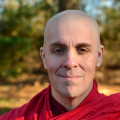


Re: Student Of The Path
“I am subject to Death, I am not exempt from Death”
The thing most feared by all beings, indeed it is said that all fears stem from fear of death. If one takes a logical step from my previous section on illness, you may infer that I have plenty of experience with death, and you’d be right. I’ve been to more funerals than many people twice my age, the first that I can remember being that of my paternal grandfather at age 9. I’ve been there at the moment of death holding the hand of two people, my maternal grandmother when I was 19 and my wife when I was 27. There is no experience in life that can compare to being with someone at the moment of their death. This is an experience that can lead someone into an acceptance and an embracing of life, or a denial and fear of it. For me it has led to a gratitude for the time I had with each person, be they family, friends, or co-workers, and a renewed desire not to waste time with petty squabbles among those who are still alive.
“There are those who do not realize that one day we all must die, but those who do realize settle their quarrels”. – Dhammapada 1.6
Ever since I can remember even back to childhood I never felt that death was a horrible thing, sad yes, but not “bad”. I think those early experiences helped shape my views on this. I never could understand why people were so distraught at funerals. There are traditional funerals in many countries where there are a group of women whose job is to just wail the whole time. As the son of an Italian immigrant I experienced this and it elicited more of a giggle from me at the high pitched shrieks than sadness.
I always thought it would be better to celebrate the person’s life rather than cry over the loss of our attachment to the person, but then again I’ve always been a bit of a “weird bird” as they say. I’ve always had world views that did not match with the culture and religion I was raised in, and indeed it was not until I found the words of the Buddha in the Theravada Pali Canon that I found the missing piece of the puzzle. With the missing piece in place, it was like “coming home” for the first time in my life.
The third “divine messenger” the Siddhartha saw was a funeral procession and a dead person. Again he was told that this befalls everyone, even kings. He struggled to understand this thing called … death.. and what it meant, and it sunk him deeper into introspection and shock.
“The Fourth Divine Messenger”
I’d like to take a quick detour from the subjects of contemplation to go over the fourth divine messenger. After seeing old age, sickness, and death, it is said that he saw a shaven headed ascetic. When he asked who this person was he was told this was a man who has renounced the worldly life in search of awakening. Siddhartha Gotama had a hunch that this weird guy with a shaved head may be on the right track, and a plan began to formulate in his mind.
So as you can see I’ve had ample experience of the first three divine messengers knocking on my door. I’d like to speak about the fourth messenger, that of a monk. I can remember the first time I had experience with a “monk”. Being raised Catholic and going to Catholic school I of course learned all about the saints.
There was only one saint that I ever really connected with, Saint Francis, a rich noble who became a poor beggar monk (sound familiar?) who preached non-violence, charity, and peace. To this day I love Franciscan monks and look forward to possible interfaith dialogue with them in the future.
The other monk I remember from an early age of course, like most westerners, is the Dalai Lama. I remember thinking to myself as an adolescent “who are these guys who are poor and wear robes yet seem to be so happy!”. That thought has stayed with me to this day, even though my idealism about monasticism has turned to realism. It was always in the back of my mind, just like the Buddha thought, that maybe these guys are on to something, and in deed I find it a funny coincidence that I became a Buddhist the same age the Buddha began his quest. Although honestly I did not have an idea to want to become a monk until a few years later.
“All that is dear to me, I will one day be separated from”
On the night of his renunciation Siddhartha was said to of looked upon his wife and newborn child and because of the divine messengers realized that one day they would all die. He was raised with the knowledge of samsara, the endless round of continued rebirth. He started to realize that through countless previous births he has experienced the loss of everything he held dear. Indeed later after his awakening he would say greater than all the water in the four great oceans are the tears you have shed over the loss of loved ones throughout your wandering in samsara.
He thought there must be a way out of this trap, a way to true permanent peace and happiness, and so he began his quest to find that way. It is a simple fact that we will all be separated one day, be it tomorrow or 50 years from now.
I find it funny when my parents to this day each say how they hope they die first so they don’t have to experience the loss of the other! Ideally I think most couples in love would rather they die at the same exact instant to avoid such suffering. I can personally say I’ve been through that, and I came out a better person for it.
The Buddha exhorts us to not try and hide from the inevitable, but to embrace it and spend the time you have skillfully. These statements of separation are not meant to illicit fear, sadness, and clinging, but to implore us to live our lives skillfully and not waste time on petty squabbles with those we hold dear.
“I am the owner of my actions, whatever I do for good or harm, to that I shall fall heir”
This is related to Kamma, but is also to be seen here in this very life. Your actions create your world and you cannot escape them, therefore it behooves us to live skillfully. Bhante G once said “the greatest impact we can have in the world is to face every circumstance with a mind of clarity, compassion, and love”. That is living skillfully, mindfully, and indeed happily. We are responsible for our actions, whether we wish to be or not.
Living skillfully is a choice, it is a practice that we all can do if we find it important enough to put for effort. You should know that you don’t need to be mired in greed, aversion, and fear. I made that decision near five years ago now, and the path has lead me to where I am today.
“In conclusion”
I became a Buddhist on Vesak in 2008, a few weeks after my 30th birthday, with the taking of the refuge and precepts. By 2011 the practice lead me to the point where I wanted to do nothing more than follow in the footsteps in the Buddha on the quest to awakening. I spent the first 36 years of my life as a lay person and I’ve experienced most all of what a person can experience in life in those short 36 years. I’ve had amazing experiences, done amazing things, met amazing people, and been to amazing places. I’ve experienced love and loss, being poor and being financially stable, good family and good friends, I don’t regret a second of it.
I’d like to spend the rest of my life now living the Dhamma, following in the footsteps of the Buddha, on the greatest quest humanity has ever known. Unlike the Buddha, who had the divine messengers come to him at age 29, I was lucky enough to of had all four divine messengers showing me the way since I was a young child.
People often think that monks hate the world or want to run from it in some way. While I have definitely developed a disenchantment with the world’s bait, I do not hate the world or want to run from it out of aversion. The practice has rooted out much of the aversion I did have and replaced it with an understanding that it is how it is, and to use one of my favorite quotes from Ajahn Brahm “suffering is asking from the world what it cannot give you”.
The people and experiences of this life and countless others have lead me to this point, and I cannot feel anything but gratitude for all of it as I move forward.
So that’s my story, based on perception and memory, two of our many faulty faculties. Whether all I have said is actually how it happened or not, I cannot know, but regardless it has all lead me to my current path, following in the footsteps of the Buddha on a quest for awakening. For a peace and happiness that lasts and is not based on external conditions. I wish you all the same peace, happiness, and freedom from suffering, in your own journeys.
Re: Student Of The Path
jayantha.tumblr.com/post/135012196607/on-ordination-bhavana-newsletter-article-on
I was asked to write an article for the Bhavana newsletter on why I wanted to ordain, It's too long put in one post so I'll post it in two for those who don't want to go to the link.
"On Ordination
Trying to explain something like the why and how of choosing monastic ordination is never an easy thing. Like most events in life it is preceded by a complex web of choices and experiences that have led me to this point. I will do my best here to put into words a coherent story of “why”, for after all that’s what our memory is, a story we tell ourselves and continuously reinforce to keep alive.
I would like to use what is normally called “the Five Subjects of Contemplation” from the Upajjhatthana Sutta of the Anguttara Nikaya as the framework for my article. The simple straight forward message the Buddha exhorts us to remember is on one end so simple as to be easily dismissed by the foolish, but on the other so profound that we try to avoid the remembrance of these at all costs. I remember being awestruck by the simple truth of these the first time I read them, and they have stayed with me as an important part of my daily practice ever since, nearly a decade later.
The Buddha said there are these five things one should always reflect on, whether you are woman or man, lay or ordained, three of these correlate directly with the “divine messengers” the Buddha saw which led him to renounce and begin his quest.
“I am subject to old age and decay, I am not exempt from old age and decay”
We are to always remember that one day this body will grow old, withered. We are constantly growing old and decaying even from birth. We do our best with modern technologies and makeup to try and hide this fact. We don’t remind ourselves that this is our nature, so we fight it instead of being at peace with it, leading us to create our own suffering.
I was lucky enough to grow up around what people call “the greatest generation”, which is the generation of people who lived through WW2. Being exposed early and often to elderly people, both in my family and in society (my town had lots of retirement communities and my father had a landscaping business, so I often spoke with elderly people), lead me to become more comfortable being around older people than adolescents my own age.
I often think back to my paternal grandmother, who at least in my experience appeared to embrace life and old age with a smile, a sense of humor, and peaceful acceptance. She did not try to hide her wrinkles and flab, but laughed about them. I find it no coincidence that she ended up living nearly two decades longer than any of my other grandparents. This way of looking at things always made more sense to me, even from a young age, and I owe her a debt of gratitude just for being her as I to move towards old age myself.
Growing up I remember saying to my mother how I can’t wait to get older, and she would say that I would regret those words when I do. So far I can honestly say I don’t regret them! Even though I had a wonderful childhood, I have no desire to go back to my youth or be a kid again, in this life or the next. I’m 37 now and in the last few years I’ve started to see grey hairs growing in and for the first time in my life I went to the eye doctor for reading glasses. My first thought with both of these experiences was “wow, awesome, the Buddha’s teaching comes alive before me!”. That is the power of this practice, of facing things head on, you experience change and uncertainty with peace and confidence instead of fear and aversion.
It is said in the story of prince Siddhartha Gotama’s(The Buddha) renunciation that his father the king tried to hide all the harsh realities of life from his son. He had all of the sensual pleasures, riches, friends, and women he could want, but something always nagged him, a sense of disenchantment that only grew the more his father tried to indulge his son. For the first time in his life, when he was 29, he saw an old and decrepit man and asked his chariot driver what that is. He was told that this is an old man and all of us, even kings, will be like this in time. This hit the Siddhartha like a ton of bricks and was the beginning of his awakening to the realities of life. Old Age was the first of four “divine messengers”.
“I am subject to Illness and disease, I am not exempt from Illness and disease”
Yet another subject to remember that is dear to my heart, and my story. I have had much experience with family and friends and illness, starting from my grandfather at age 8 to my wife and most recently my father.
I have vivid memories of traveling to Sloan Kettering cancer hospital in NYC with my father to pick up my paternal grandfather, who was in his early 60s at the time and fighting cancer. I remember walking in the building and seeing my grandfather emaciated and hunched over in a waiting room chair after just finishing another round of chemotherapy. That memory sticks with me to this day. Nearly 12 years later I would be back at Sloan Kettering when it was my mother’s turn to battle cancer, and again a couple of years after that I met the woman who would later become my wife and who would go through three years of cancer treatment with me at her side.
Most recently even as I was living at Bhavana Society as an Anagarika, I traveled back to Sloan Kettering to be with my father and my family during an operation for cancer that was detected. My maternal grandmother also had cancer, my maternal grandfather had Alzheimer’s and Parkinson’s diseases. My best friend in the first few years of grade school battled leukemia.
Can you tell cancer and I have a lot of experience together? It’s an old friend that I expect will pay me a visit at least once in this life, but If so I plan to open the door and embrace it, rather than slam the door in its face. I have been around sickness my whole life, so I have been able to see with my own experience that illness and disease are a part of life, nothing to be feared or hated, and nothing you can run away from.
I do fear, however, that some people reading this article so far may find the tone of this article to be depressing and sad, but I would not change any of my experiences even if I could. They all played a part in leading me towards the peace and happiness I continue to grow inside today. I see these experiences not as sad, depressing, horrible things, but life-affirming realities we can choose to grow from, or to run from in futility.
The second divine messenger Siddhartha saw, so the story goes, is a person on the ground wracked in pain from boils and disease. Again he was told that this is sickness and can befall anyone, even kings, which lead to further distress and disenchantment, leading closer to renunciation.