
Best Of
Re: What makes these people so different?
Humanity does present a certain level of sameness in the material sphere. In Buddhism you could present this as our preference for unskillful means. Usually these are quite attractive on the short-term and poor on the long-term (if we add reincarnation, really poor on the super-long term too!).
Neuropsychology puts now really fancy labels to the origin of some of these unskillful behaviours and has mapped out different areas in our brain that are affected or the origin of some of these: poor attention and impulsiveness can mean something is wrong in your prefrontal cortex; a strong drug habit turns into a modification of your certain areas of your brain, etc.
Perhaps in the spiritual-metaphysical realm, it could be argued that a return to this "oneness" (all beings are Buddhas), breaking away from the 10,000 differences is the path towards liberation. It does help to bring compassion and end the three poisons (in my case).
Psychology takes care of the materialist cases (antipsychotic medicine for schizophrenics, cognitive-behavioural therapy for anxiety disorders); but this does not mean that the door to spirituality needs to remain closed and rejected because of it is lack of "measurable" aspects. One thing I've learnt from my Zen practice is how some things just fall and "make sense" on its own without any further thought / discussion. This can be dangerous though! Perhaps I'm completely deluded and I'm falling into traps. Then I tend to examine it using the 5precepts and 8NP.
I think psychology should remember where it came from: philosophical and religious studies regarding the ailments of the human psyche. While the material field has provided a lot of help and insight (better treatments, longer life spans, etc) it should not fall into the trap of their material view as the possession of absolute truth and consider that this scientific-materialistic path is a straight line heading towards the end of all suffering through science. New sources of suffering will eventually emerge unless we tackle the essence. That essence which is ahistorical and has been following us, for good and for bad, since bygone times....
 Kotishka
Re: Funny Stuff
Based on a real event.
(No Orcas were harmed - Seagulls, not s much)
Orca: Tasty treat?
Seagull: Uhhh, mmmm, no
Orca: Come on. You want it
Seagull 2: Neat treat here I come!
Seagull: Thanks, but - Hay Bill! Don...
Orca: TASTY!
Moral: Beware of free treats from Orcas
 Lionduck
Re: Getting better "blog"
@FleaMarket said:
Hey @how,
The perspective makes sense to me. Putting it into practice is where I get confused.
What are some ways to identify and differentiate if what's being shared does or doesn't do that for someone's ego or attachments? Like among a group of people, or on a forum?
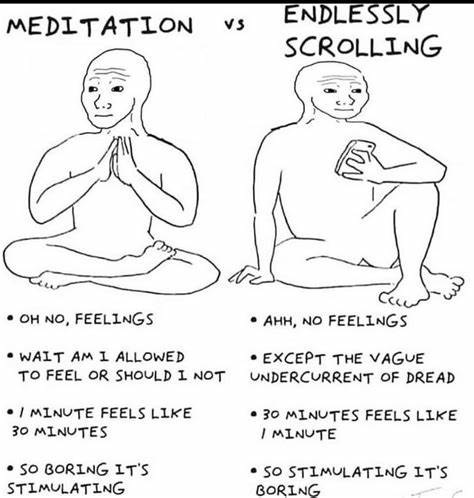
A Meditation practice is a process of training that allows us to objectively observe how we routinely create, maintain, and promote the storylines of our own egos. As we become more proficient in these observations, we see more and more opportunities within each moment to stop empowering the machinations of those storyline productions. What was once a relatively habituated set of behavioral inertias, can now become a choice in whether to continue with the storytelling or not. The degree to which we are ever able to stop the empowerment of our own storyline production is the same degree to which we can **stop triggering and empowering the storylines of all the other egos **within our spheres of influence.
 how
how
Re: How to die?
I'm not sure even Tibetan Nationals get to do sky funerals anymore. I have seen them sending nifty containers of ashes aloft hanging from party balloons that spread them which ever way the wind decides.
how
Re: Getting better "blog"
One....or is it two possible perspectives on "sharing".
If a sharing of a victory or a difficulty increases or hardens an ego or an identity, some biting of ones ass should be expected
If a sharing of a victory or a difficulty decreases or softens an ego or an identity, there will be less of an ass left for any teeth to find.
or put another way....
Sharing is wholesome when it reduces anyone's tendency towards attachments.
Sharing is unwholesome when it intensifies anyone's tendency towards attachments.
how
Re: Getting better "blog"
I don't have much of a solution but I've certainly experienced speaking something aloud and the opposite quickly taking over. It's actually pretty frequent.

Re: What makes these people so different?
What makes these people so different?
Nutshell answer.....We do...
 Shoshin1
Re: What makes these people so different?
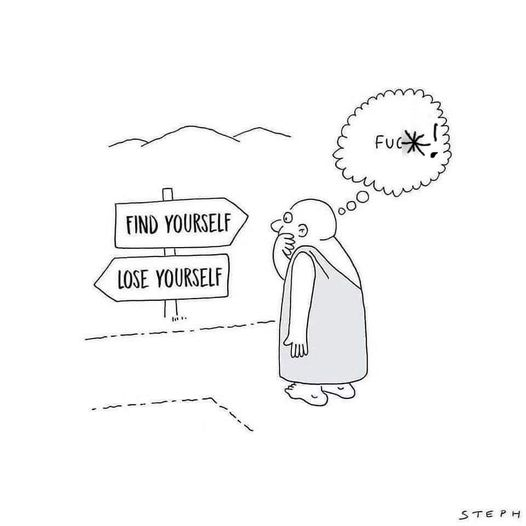
Perhaps, the question of "What makes these people so different", delusionally assumes that humanity has some level of sameness that most share when contrasted with those others we judge as being different.
Looking closer, can a fluidity take the place of those same identities when their ephemeral natures are seen to be no more substantial than any dream that we cling to?
I wonder, if psychology ponders the machinations of the various arisings of the human condition, where spirituality simply aims at a transcendence of those limitations.
I say, proudly showing off my own prejudicial dreaming's.
how