
Best Of
Re: Climate Activist Dies by Self-Immolation
Venerable Mahākāśyapa, according to the legends, lies asleep underneath the three-peaked mountain for the coming of Maitreya Buddha. When Maitreya Buddha opens the three-peaked mountain, it is said that Ven Mahākāśyapa will wake up and take his place in the right hand of Maitreya. There, he will self-immolate, burning himself on a funeral pyre in the hand of Maitreya.
Self-immolation has a long history with Buddhism. It's a difficult topic.
Venerable Ānanda too is said to have died by suicide. He entered the Samādhi of Wind while in the middle of the Gaṅgā River and divided his body into four parts, one part for Śakra Devendra (Indra), one part for the Nāgarāja Sāgara, one part for the Licchavis of Vaiśālī, and one part for Ajātaśatrurāja. It is said that a jewelled stūpa was erected in each of these places.
The myth about Ven Ānanda is an origin story for several famous stūpas, but still involves suicide. Also, the "three-peaked mountain" is called "Mount Chicken-Foot" in Chinese. Considerably less dignified-seeming.
Re: Cultivating Discipline
@FleaMarket said:
I severely lack discipline and want to improve. I will start small by creating a basic schedule. I am setting a schedule for waking up, meals, meditation, and bed. I do not expect to follow this perfectly at first and am already giving myself permission to make mistakes and be sloppy so long as I return to attempt again.
"It can take anywhere from 18 to 254 days for a person to form a new habit and an average of 66 days for a new behaviour to become automatic."
From here.
How is your discipline and what do you find helpful in its cultivation?
I am extremely regimented in my morning and evening rituals: I cold-shower, dress in the bathroom, apply my skin creams, make coffee, drink it, and then brush my teeth.
In the evening, I wash, put on my nightwear, brush my teeth and again, apply skin care.
When it comes to Meditating, reading Buddhist literature, and practising daily - I confess, I am less disciplined.
But I mean well....
 federica
Re: Climate Activist Dies by Self-Immolation
Even one, is one too many.... However heartfelt and deeply passionate they may be....
federica
Re: On the Dhammapadda
There are many Dharmapadas. They seem to have been a popular literary vehicle, in the early days of Buddhist missionary work, for spreading the teachings of the Buddha. The Pali Dhammapada is particularly old. This is from a considerably less-old Dharmapada:
When all of the dharmas of suffering
and all of the saṃskāras are submerged
as if filled to the brim with water,
there is peace. When the monk knows himself,
never again does he enter the myriad realms.
(Where there is) no entrance into empty space,
(where there is) no entrance via the many bases,
(where there is) neither entrance into non-perception nor into no non-perception,
(where there is) neither "this life" nor the "afterlife,"
(where there is) also too no notion of the sun or moon,
(where there is) no going and no remaining,
(where there is) no self that might go or come,
(where there is) no departing and no returning,
(where there is) no death and no "will be reborn,"
these are the borders of nirvāṇa.
Whether with an appearance or with no appearance (of them),
pleasure and pain accordingly are understood.
What is seen is no longer frightening.
There is no doubt regarding the unutterable and the utterable (alike).
Existence breaks when the arrow is shot.
When meeting the stupid, you do not boast.
This is the highest bliss.
This path of tranquility is unexcelled.
(Here,) the heart is resilient like the earth.
(Here,) the practice of tolerance is like a keep's gate.
(It is) pure like water. (It is) stainless and immaculate.
When birth is vanished, never again to happen,
victory in profit is seen as insufficient,
for (such) victory always returns to bitterness.
Instead, you ought to seek victory in the Dharma,
for in this victory, there is no (subsequent) birth.
It is finished, never again made new.
Burnt seeds do not give rise to life.
With the mind finished, it is like a fire has been submerged.
The womb is a defiled ocean.
Why (seek) happiness in the ways of obscenity?
Though the utmost heavens are wonderful places,
in all cases nothing is better than nirvāṇa.
Knowing all, one ceases,
never again grasping the world.
Abandoning all, there is extinguishment and crossing (of the stream).
Within all of the paths, this is victory.
The Buddha has disclosed true Dharma.
With wisdom and bravery, you can practice.
Walking in purity, faultless and chaste,
you know for yourself the world-transcending calm.
The path of practice first takes leave of lust,
so clothe yourself early in the morning with the Buddha's precepts
to destroy evil and leave the world of evil
easily, like a bird takes to the sky.
If you understand this Dharmapada,
whole-heartedly embody the path of practice.
That is the ferrying from the shore of birth and death
to where bitterness ends and there is no calamity.
On the path of the Dharma, there is no near or far.
Upright, you pay no heed to the powerful or the weak.
The crux is to be unconscious of (false) divisions,
for "bound" and "loosened" alike are calm tranquility.
With lofty wisdom, you are freed from the rotting corpse,
(and see it as) dangerous, frail, insubstantial, and unreal.
Suffering is great and happiness is meagre (here).
There are nine openings and not one is clean.
The sage shuns peril and deals in peace.
He throws away praise and ends myriad difficulties.
The face rots and melts, transforming into foam.
The sage sees it, abandons it, and is not greedy for it.
He sees that the body is a tool of bitterness.
(Because of this,) he has no birth, age, ailment, and no grief.
Throwing away corruption and walking in calm tranquility,
you can obtain the great peace.
Depending upon wisdom, rejecting the demonic,
discontinuing the defilements, attaining all,
walking in purity, striving, transcending,
of gods and men, there are none who will not laud.
(Dharmapada T210.573a23)
In case anyone is interested in text-critical study, there are a few ways that we can tell that this is a later Dharmapada than the Pali Dhammapada.
1) It references itself as "this Dharmapada."
2) It is a collage of oblique references to sūtras (such as the "arrow" that breaks existence, which is a reference to the Vālasutta, also the face becoming "foam" is a reference to mindfulness of the corpse and the Phenasutta) that presumes that the reader is actually already familiar with the body of literature that constitutes "the Buddha's sūtras." It is less useful to a beginner, because they don't know what the gāthā ("verse") is talking about.
3) It seemingly incorporates Madhyamaka-like interpretations of the Buddhadharma (e.g. "bound and loosened alike are calm tranquility").
Nonetheless, even from a second's glance, if you've read the Pali Dhammapada, you can see how different some of the other Dharmapadas that used to circulate among Buddhists are. Another very famous Dharmapada, more famous than this one, is the old Sarvāstivādin Udānavarga. It can be read here:
Re: Give
If I look at the Dharma as a gift to give, I believe those that ask for it make more use out of it. Asking can take many forms and I must practice listening to hear them.
If I hold giving other things in the way I hold sharing the Dharma, I feel safe any nature to over or under-give will find more balance. I'm hoping it works out this way.

Re: Climate Activist Dies by Self-Immolation
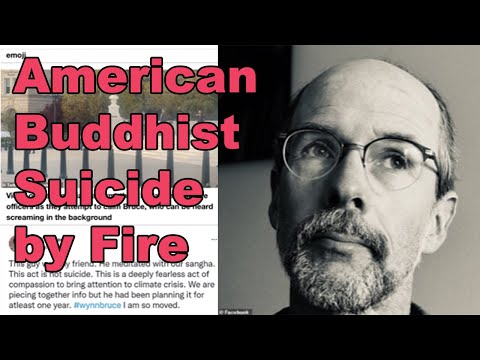
Summary: "This idea that you can do a terrible thing in order to make a good thing happen is not in line at all with the Buddhist idea of ethics."

 Kotishka
Re: Good news
Wonder what killed it. Those things can get HUGE, (1.2 metres) and weigh a ton... Some have been known to live over 30 years...
federica
Re: Climate Activist Dies by Self-Immolation
Seems like a lousy idea to light anyone on fire.
 marcitko
Re: Just for fun: the random, useless announcements thread!
I didn't know whether it was a random "a propos of nothing at all" or a muted cry for help... You never know on this forum, what you'll get day-to-day...
Thank you for keeping me on my toes!
federica
Re: On the Dhammapadda
I believe I heard it said that The Dhammapada is a summary/precis of all the Buddha's teachings, in short snappy bullet points.
I'm sure there are other longer texts which elaborate much more fully on each of the verses featured.
federica