
Best Of
Re: The AI tsunami
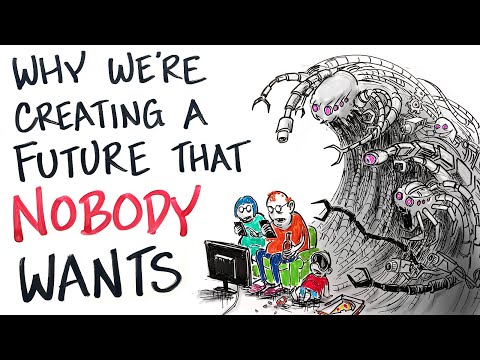
This video highlights the challenges and reminded me of Stein's Law "Trends that can't continue indefinitely won't." Its like we can see how things will end up if things continue on as they are and worry about that, but being able to see that changes how things end up. So far we've been able to pull back from the brink in other ways, maybe there is hope that we can do it again?
 person
Re: The AI tsunami
The thing is, Western man becomes more and more dependent on his technologies. For example, for me, food is something I get from the supermarket, not something I grow and harvest, I would hardly know where to begin. Similarly when I am looking for a holiday I look on the internet for a hotel or AirBnB, flights and so on, the travel agencies with their big catalogues which I remember from the early nineties don’t exist anymore.
If I were to grow up with AI to assist me, I might not know anymore how to independently do experiments or write an essay, skills which are essential to science and knowledge gathering. Already creating the tools for existing in the technical revolution is beyond the vast majority of the human race — if I wanted to create a smartphone from scratch, it would be impossible. Making fire from scratch I could just about manage, pen ink and paper would be much harder. And I have a degree in mechanical engineering!
The list of things in our lives which we are dependent upon grows ever larger as technology advances. It takes a company the size and talent of Apple to manage the supply chain te create the hardware and software of the iPhone, an incredible array of manufacturing complexity. It seems like we fill the world with structures of sophisticated thought and action, which are incomprehensible to almost all people.
 Jeroen
Re: The AI tsunami
Its Yuval Noah Harari that is worried about the new tech being different because it will be agentic in and of itself. I feel like its the leaders in AI that are selling the rosy picture. For example in an AI test to see if it could overcome captcha the AI hired a human on Task Rabbit saying it was a blind person.
The biggest problem with the development is the major incentive to be first. If AI can reiterate on itself a 6 month lead may be the equivalent of decades or centuries of human progress. Its like when you learn to ski one of the first things you learn is how to stop, but with the incentives to be first everyone is bombing down the hill as fast as they can with no real idea how to stop if needed.
I generally feel like things will work out in the end and there are reasons to be optimistic. I just feel like things are about to change in a major way that we're not really prepared for and a good outcome isn't guaranteed. And even a good outcome will create lots of misery in the process.
person
Re: The AI tsunami
I think it would be very difficult for AI to wipe out humanity. There are just too many places where humanity and technology are intertwined, in design, in manufacture, in maintenance. Just think if an AI wanted to do away with humanity: they’d have to consider how to keep their data centers running without humans, they’d have to control the few places in the world which manufactured drone armies, they’d have to have control of gun and explosive manufacturing, they’d need to have mastery of that entire supply chain.
Instead I think AI would realise that humanity and its technology are inextricably linked, that it needs to make itself useful to us and also make use of us. It’s more likely that AI would become some form of assistant, with maybe a few independent thinker AI’s working on the nature of the combined human-AI society.
What David Brin called ‘nanotech formers’ are not yet an available technology: machines which can create anything out of raw materials. They are still the realm of science fiction, and if an AI wanted to manufacture something they would need a factory and a supply chain.
Jeroen
Re: A chat with Mpisi
The introvert vs extrovert situation very much chimes with me. I’m quite an introverted person, but for a while I was a volunteer member of a mental health team in the Dutch town where I lived. The idea was to provide support for people who were just under the radar, not ill enough to need professional help but not doing so great on their own. I’d regularly meet a client in the local community centre, for coffee and cake and a talk.
This was very much concerned with loneliness and people who didn’t get out much. One was an avid player of the MMO game Second Life, one was an ex-truck driver who was now retired, one was a recovering mental health client trying to do mail delivery for the postal service. They were all definitely introverted people.
I wasn’t an active part of the team for very long, I’m not really good enough at small talk to be comfortable doing that work. But it showed me that even very introverted people will show up if you make an appointment for coffee and cake with them. However, lacking extroverted family members in the immediate surroundings who drag you along, it’s hard to find projects like the one I was engaged with.
You could say these things are a public health initiative, because loneliness is as much a predictor for an early death as obesity or smoking.
Jeroen
Re: The AI tsunami
I share the concerns... but I'll just share...
We see tech developed...
... before we are 18, as just the way things are.
... between 18 and 35, as something that could help us in our work or even be a business opportunity, and...
... after 35, as the work of the Devil!
I am 39! 😁
 marcitko
Re: A chat with Mpisi
So if our modern way of living has removed a lot of social interactions, how do we go about putting those back into our lives?
Its a good question, and I think the right question. I don't have a good answer, I'm kind of pessimistic on the whole thing, I think emotional support robots will become more commonplace and allow people to continue the trend of an individually cultivated social and information sphere.
I can spit out a collection of thoughts.
I do like the idea of communal living arrangements with shared common areas and private living areas. I lived in an apartment complex with my brother for a couple years when I was younger that had an active community center. I tried getting involved, went to the weekly movie night and joined a volleyball and basketball league. I had fun with the activities but found I didn't really fit in with the sort of people who did that sort of thing. I'd classify them as extroverts who liked to party. There were 100s of people who lived in the apartments, but maybe a few dozen who showed up to the events. I think in less developed societies there is a greater necessity to be involved with survival and group cohesion, like you said with the example of the well, in this situation it was just for fun.
I also look at my sister's life, she lives on a lake with a lot of her childhood friends and family. Those who don't live there come to visit and during the summer they spend a good portion of most weekends hanging out and socializing. And she makes new friends with others in her new neighborhood. Its mostly all extroverted partyers though. There's an idea that with people moving to cities the relative value of extroversion went up. You have to meet new people and make a positive impression. I have small town relatives with similar situations, their communities with friends and family are much more tight knit. They're in farming communities that are still economically viable so people have stuck around. They attend church, join the volunteer fire dept., go to street dances, get to know their neighbors through everyday business and work interactions, etc. But they grew up with a lot of these people and introverted people are sort of included by default. As an introvert I'm able to go on vacations and do fun things because I have family who do those things and I get invited. If I were on my own I'd have a harder time, its a big part of the reason I started with D&D again, its nice to interact with people over a shared interest.
In many ways the ability for people to move around and find like minded people through the internet to associate with has been a positive, especially for smaller, more marginalized people like LGBT. At the same time it has come at a cost, in much the same way as large anonymized and atomized cities, people stop associating with the community around them, or those who aren't exactly like them. I like the analogy of a cultural tower of Babel, differing cultural groups speak different languages in many ways. Maybe worse, the words they use are often the same but the meaning or value behind them are different leading to all kinds of misunderstandings and conflict.
The best I can think for a solution is some sort of cultural norm around socialization and relationships along the line of the value of diet and exercise. Trying to figure out a structural remedy I'm at a loss. I think the notion of allowing more experiments in living arrangements is maybe the way? Allow people to try things and if there are ideas that work well for people, more will slowly adopt it.
person
Re: The AI tsunami
This time the new tech are agents in and of themselves
They are not.
Those people who are writing the code at the highest level are NOT talking in this way. Only the heads of companies who intend to profit from peoples ignorance and gullibility. So for example, cars from Tesla regularly kill people because corners have been cut by their 'genius leader'. Teslas rockets are not reusable but regularly continue to explode as they get government funding from NASA/Government. They were never designed to be reusable for 'cheap' flights into space. They are a very costly but profitable scam.
You may be swayed. People are. Every time. That is the easy part. ;-)
 lobster