
Let Them
 person
Don't believe everything you thinkThe liminal space Veteran
person
Don't believe everything you thinkThe liminal space Veteran
I just became aware of an idea/book that has been the new trend/very popular idea by Mel Robbins. #1 bestseller everywhere, Oprah book, etc.
Its not a new idea, its kind of about being non judgmental, non controlling and personally agentic, but the simple framing in the context of our agitated world seems to have struck a chord with people.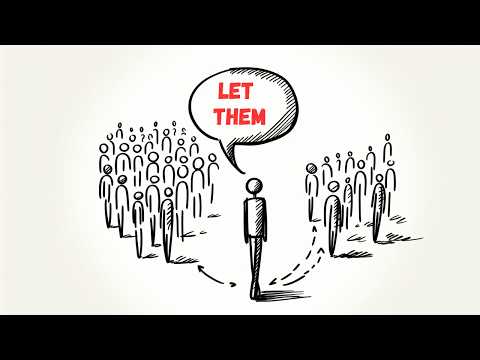
My take is "Let Them" means accept people and situations for what they are. Stop seeking to control the world. Then there is the second half of the 4 word phrase, "Let Me". Turn your focus from what the world is doing into how you can respond. So even things that are universally agreed to be wrong like sexual harassment at work. Let Them means you don't spend your energy wishing the other person would be different, Let Me puts the energy into what action you can take, confront the harasser, go to HR, leave the job, etc.

Comments
‘ The phrase “Let them” was originally written by poet Cassie Phillips, whose work has not been credited in Robbins’ promotion of the theory. While Robbins has undoubtedly brought the idea to a larger audience, failing to acknowledge its original creator raises ethical concerns about intellectual property and fair recognition.
Beyond this issue, there’s also an important conversation to be had about when “letting them” is helpful—and when it’s potentially harmful. While letting go is a powerful practice in many situations, it’s not a universal solution, especially in cases of abuse, neglect, or when boundaries need to be enforced.
Therapists often talk about locus of control, the idea that people fall somewhere on a spectrum between believing:
External control (“Everything happens to me.”)
Internal control (“I create my own outcomes.”)
Shifting toward an internal locus of control means understanding that you can’t always control others—but you can control how you respond. Instead of chasing validation, forcing relationships, or stressing over someone else’s actions, you shift your focus to what you can do.
When applied correctly, The Let Them Theory aligns with these healthy psychological shifts. But there are times when “letting them” is absolutely the wrong approach.‘
https://www.abraverspace.com/blog/the-problem-with-let-them-theory
That's good point about acknowledging her source, but Mel does also add Let Me, making a meaningful change in the idea. I think the larger point is resolved by including the second half of the phrase which is left out of the title and slips the mind. That of after Let Them, its Let Me. So in cases of abuse, etc. it isn't JUST Let Them, it also needs to be actions to take such as removing yourself, or speaking up, etc.
This has been my approach to politics and politicians for a long time, and especially now. I have one vote and my voice to speak up and state my opinions, but other than that I have no control. So let those people do what they do and I will live my life. If what they do affects my life I will find a way to live with, ignore or sidestep.
I don't control them, I only control me.