
Best Of
Re: Does karma ALWAYS happen
@vinlyn said:
Yes, exactly. The way I took his meaning is that there is nothing negative about contemplating (and discussing, as we do) karma as a concept, and trying to thus practice more positive actions; but never try to figure out is something that is happening to me a result of karma, and if it is, why?...because you will never figure that out.
This is what Pra Payutto says, @vinlyn.
We should strive to do skillful deeds simply because they lead to skillful results and help break the cycle of self-inflicted dukkha.
And never try to figure out why is this happening to me, since we will never really be able to know.
And as we well know, dukkha happens.
Re: Is hair, in fact, a sign of vanity?
Maturation is a life long process. So we are continually growing up as it were. Learning when to yield and when to hold fast. Change and change again. My father who was very strong surprised me greatly by asking me to hold his hand as he lay dying. His final words were "Can you ever forgive me for not knowing you were the one person I could trust?'
Sometimes it takes almost an entire life to see and rejoice our creators coming to a happy place of rest. As our questions are answered we are reborn once again.
 grackle
Re: Fasting
60 hours completed at 10am this morning. It was fine. A good experience. A lot of mental clarity too. I feel my digestivecsystem got a reset. I am following on now with the 5:2 lifestyle
 Hozan
Re: Is hair, in fact, a sign of vanity?
Some kind beings have told me that the silver threads overtaking the dark brown ones adds a distinguished look. Alas just another sign of being an old fart.
grackle
"Book of Eights" or Atthakavagga
I have been reading Gil Fronsdal's "The Buddha before Buddhism."
It is a translation of the Atthakavagga, one of the books that is included in the Sutta Nipata, which is believed to be among the earliest and purest Buddhist texts.
Fronsdal believes this section to "pare down the Buddha's teaching to its most uncomplicated essence."
'Keeping with The Book of Eights’ emphasis on peace and non-clinging,
the main teaching on views is the importance of not clinging to any views,
philosophies or religious teachings.
This would include views about what happens after death, the nature of the “self,”
or whether or not it is possible to fly.
The text teaches that someone should shake off every view
without embracing or rejecting anything.
In addition, a number of verses are critical of any judgment
that one’s own religious views are the truest or best while others are inferior."
Then, from the text itself:
"One who is attached gets into disputes over doctrines;
But how and with what would one dispute someone unattached?
By not embracing or rejecting anything
A person has shaken off every view, right here."
(v 787)
I also have V. Fausböll's original translation, but it is pretty old-fashioned and dry when compared to Fronsdal's.
http://www.insightmeditationcenter.org/books-articles/articles/natural-buddhism/
http://www.accesstoinsight.org/lib/authors/thanissaro/atthakavagga.html
http://www.accesstoinsight.org/tipitaka/kn/snp/
Has anyone else read the book?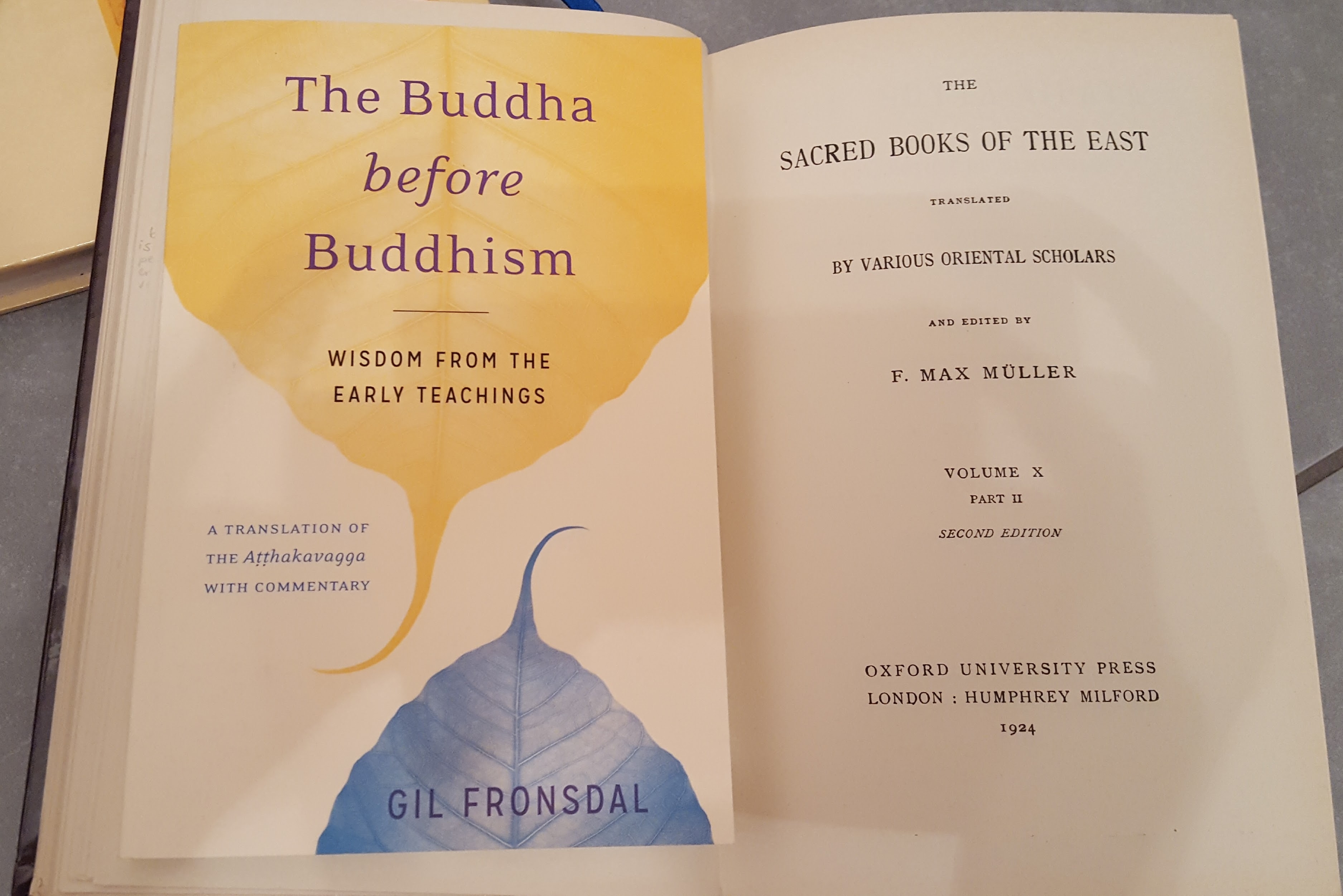


Re: Exploring different religions, particularly Hinduism
When I was 16 years-old and dallying with Vedanta, I bought a rare book (from 1905, I think) of quotes from the Upanishads.
There was a quote which appealed to me in particular, and which I used to post on birthday cards and use a lot in conversations.
Down the years, it has lost none of its magic:
"Accept only that which appeals to your heart as truth.
Let the rest pass you by, for the time being.
For to each comes his own.
And none can gain his own,
until he's prepared for it."
Re: Monk health
Human being on a treadmill. Hm, a metaphor for the human condition.

Re: Trump
Hi @vinlyn!! 
@Hozan One thing I have realized is that we are frequently told "venting" has a place and a purpose. It feels good to get that stuff off our chests, and the idea is that holding it in just makes things worse. But I do think we can process how we feel without expressing it out to the world. I have had to learn to do this. I used to call my mom to vent about various problems, but it only created more problems. Venting seemed to cause us both to hold onto the problems, and then it would continue for days as frustration set in that she kept insisting on things and then getting mad I didn't take her advice when all I wanted was to "get it out." We do need to acknowledge and process our feelings. But it doesnt' mean every thought associated with those feelings has to be verbalized. This is something I try to help my kids learn. That if you are careful with which thoughts you give a voice to, your voice becomes more important rather than just more wah-wah-wah Charlie Brown adult voices adding noise to the world. When something needs to be done, I do what I can. But I am learning to let the rest go with various meditation and breathing and even exercise or walking techniques rather than voicing all my frustrated thoughts.
Another thing is that if you give initial news a few days to play out, often you find solutions work themselves out. I went on vacation the day we withdrew from the Paris accord, but within a few days found that many states have already agreed to keep their benchmarks in place and follow the accord on their own regardless of what Trump said. including my state. So the problem resolved without me getting my panties in a twist about it. The result? I didn't get upset and frustrated because I was too busy enjoying my time and whatever the result happens to be will resolve without my voicing my input unless it's to people who can make a difference (like my politicians). We most of the time upset ourselves. We make ourselves crazy. We then blame it on Trump or whoever/whatever else. But it's only us.
 karasti