
Best Of
Modern Trauma
For a while I've had a sort of instinctive reaction against some of the ways trauma is being used and talked about today. This 5 minute segment of The Psychology Podcast gets to the heart of my objection. Its not that trauma doesn't exist, its that it gets presented in a way that traps people in a victim narrative, rather than teaching them to grow and learn.
...By going deep into that (trauma) as a victim, they're disempowering themselves and that's a problem, you know. Because then they're not accessing their inner core strength and belief in themselves...
In addition to that a quote of the day on the Insight Timer app came up that related to this. 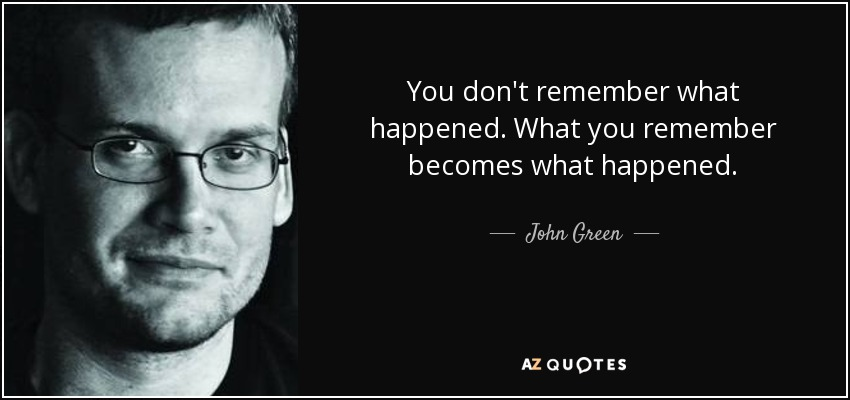
By telling yourself the story that you've been traumatized rather than you've overcome or grown creates a narrative in your mind of what the world is like. A specific example that sticks in my mind was in the Dan Harris interview with Gabor Mate, where he talks about the trauma of his youth leading him to strive and become a therapist. Its a true story, but is that story he tells himself more true than a story of gratitude about your success in life and a desire to let go of the suffering that striving causes any less true? And which story in the present lends itself to a happier more meaningful state of mind?
 person
Re: The Other Elephant In The Room
Democracy Now
U.S. Hypocrisy Laid Bare as Biden Admin Claims ICC Can’t Prosecute Israel for War Crimes
The Biden administration is claiming the International Criminal Court has no jurisdiction to charge Israeli officials for war crimes. This comes after rumors that the ICC may be close to issuing arrest warrants for Israeli Prime Minister Benjamin Netanyahu and other Israeli officials over possible crimes in Gaza. The International Court of Justice has rejected a request by Nicaragua to order Germany to halt exporting arms to Israel, but the court declined to throw out the case. For more, we speak with human rights attorney and war crimes prosecutor Reed Brody, who says ICC charges would be a “huge” development. “Since Nuremberg, no international tribunal has issued an arrest warrant for a Western official. For decades, we’ve had this double standard where international justice has only been effective for crimes committed by leaders of developing countries or by enemies of the U.S. like Vladimir Putin,” says Brody.
 Shoshin1
Re: Martial Arts and Buddhism - Is it acceptable?
She likes it still but as she has a learning disability, the other kids "get" things easier than she does and she wants to wait for a couple of years and try again.
All that will matter is which of them is still practicing in a year, in 5 years, in 10 years.
My teacher has severe dyslexia and can barely read a word. He has cerebral palsy and used crutches when he started martial arts. Today he’s one of the beat martial artists in the world and holds black belts in multiple arts.
There are 5 ways to become a great martial artist, as he says. You have to do all of them. There are no shortcuts. First is patience. Second is perseverance. Third is to practice hard. Fourth is to practice exactly what you want to perform. Fifth, meditation.
“Learn fast” is conspicuously absent.
 Linc
Linc
Re: On the unification of religion
The book is supposed to be a glimpse of what a unified religion might be like, taking on board a Christian view of God, a Buddhist enlightenment, Hindu karma and rebirth, and tying them all together with a deterministic-scientific bow. Maitreya says it was revealed to him as a view of what religion will end up being in the third millennium after Christ.
I get suspicious whenever I hear that someone had a revelation whether out in the desert, or mountaintop or cave or jungles.
The task is relinquishment and not creating a new religion. Whatever ideas he gets are a product of causes and conditions, uncertain and ever changeable.
There is no security in conditions. No unity in samsara.

Re: The Misguided Monk animation
@Santi said:
Hi Everyone
I am new here, sharing a little animation from Buddhism Now online magazine.
Thanks @Santi, the video reminded me a bit of this... 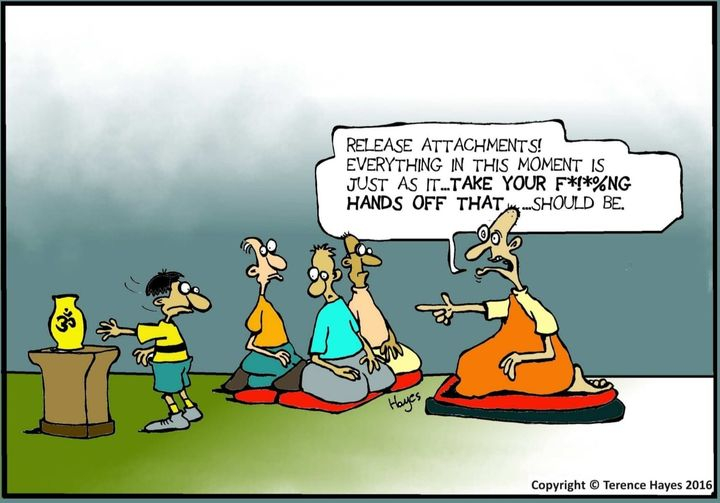
Shoshin1
Re: Martial Arts and Buddhism - Is it acceptable?
Actually, I don't know about the USA, but in the UK, bullying at school can be taken as a criminal offence and the parents of said bully can be held liable for punitive damages and punished accordingly.
As to your comment about victims having to fend for themselves, I think the crowd tends to backs the underdog or little man.
At least, certainly that has been the case in my experience.
Even though the self-defensive retaliation may not have been on a physical level, for my part, I found different ways of defeating my bullies...
There are more ways to skin a cat.... 
 federica
Re: Martial Arts and Buddhism - Is it acceptable?
It seems there was an off-duty Police Officer in there firing back. Fat lot of good that did.
federica
Re: Martial Arts and Buddhism - Is it acceptable?
@how said:
That, in case anybody wondered, is what I'd call Buddhism with little pants on.
I don't think anyone missed your use the diminutive when referring to people who see a connection between them.
Nor do I think anyone is calling martial arts a part of Buddhism. And I'd even say if you walked into the nearest studio, chances are overwhelming that what you learned there wouldn't help you.
I think the study of true martial arts complements Buddhism well.
Indeed, but that's rather what we do around here now isn't it?
Linc
Re: Martial Arts and Buddhism - Is it acceptable?
The Buddha who was well trained in the martial arts as the younger Guatama, promoted no such practices for his own followers.
Anybody wonder why???????
The most interesting thing for me about this thread, is how ardently folks are willing to support the martial arts as a companion practice for Buddhism as opposed to
how few seemed willing to query even the possibility that it might not be so.
What do we call that which we are unwilling to question?
The OP who called himself a new Theravadin leaning Buddhist with interests in the martial arts, by the very fact he was willing to question those interests, demonstrated what I think is Buddhism with big pants on.
Our thread responses though are largely a demonstration of how little (after years of Buddhist practice) we are prepared to question any interests that we identify with.
That, in case anybody wondered, is what I'd call Buddhism with little pants on.
 how
how
Re: Martial Arts and Buddhism - Is it acceptable?
@Lionduck said:
Some adopted Buddhism through their Martial Arts, most (I can't speak for everybody), do it for either conditioning or sport with no intent to use it in battle (unless, of course, attacked - but only in self-defense).
We actually have trouble sparring in our dojo, because no one trains on how to attack.  Most everything we do presupposes an attack already begun. Until we are more experienced we often have to use constructed exercises to make sure someone begins.
One oft-repeated aphorism in my school is that, when speaking of self-defense, we only really care about what could happen to you on the street, because you're never going to get into an actual fight with another martial artist!
While pure self-defense is really the lowest form of practice, speaking for myself only, I think it's a very valuable thing mentally. When you do not feel threatened, you perceive the world a little differently. It's easier to calm your mind when you have basic confidence about your physicality.
Sparring at a high level with someone who is, yes, trying to strike you - but no, not being aggressive - is extremely focusing. We speak of the idea of mushin, or "no-mind" in practice.
Some masters believe that mushin is the state where a person finally understands the uselessness of techniques and becomes truly free to move. In fact, those people will no longer even consider themselves as "fighters" but merely living beings moving through space.
The lessons you learn working with partners on the mats carry into your everyday lives. Sitting in meditation is a critical component of my practice as both a Buddhist and a martial artist, but I do not personally feel it completes the circle into the rest of my life without my experiences in the dojo.
Linc