Best Of
Re: How Many Holes Does A Drinking Straw Have?
How many holes does a garden hose have? Or, on the atomic level, how many holes? Matter is nearly all holes. The very concept of a hole breaks down, leaving the entire issue in confusion.
 Fosdick
Re: How to Teach?
Perhaps the degree to which we can manifest selflessness any time
is the same degree that the "How's" of teaching and service can equally manifest.
 how
how
Re: How to Teach?
And when we should, and shouldn't. That perception, is probably a more useful skill, than the teaching itself.
 federica
Re: Karma brought into question. I struggle to accept karma. Please help?
_f wel ook upon Karma as fixed, as in "You suffer now because 49 lives ago, you stepped upon an ant", Not so good.
However, if we view Karma as mutable, all changes. _You are suffering now? Great, you have the opportunity to change it. When we see karma as mutable, we do not face obstacles, we do not face problems, we face challenges. Snow shoes and skis arose from someone having to slog through snow - on foot. Without life's challenges, how can we advance? How can we grow?
Peace to all.
 Lionduck
Re: Understanding the do'er?
You are a doer until you become aware that " you" are actually not the doer. The doer and the doing are just part of the experience. "You" are the experience itself. Not apart from experience and nothing more than that! Whatever awareness becomes aware of is an experience that is produced from causes and conditions.
Re: Why I’m not keen on the bodhisattva vow
@Jeroen said:
The vow goes something like this: I vow not to accept enlightenment until I’ve helped all other sentient beings into nirvana.
This is a very difficult matter, because different Buddhist traditions interpret what exactly it is to be a "bodhisattva" quite differently. The "shepherd-like oath" is a specific framing of the bodhisattva path that comes from specific currents in Mahāyāna. It is not universal to Mahāyāna, and it is taught generally in a Tibetan/Vajrayāna context.
Even the matter of Bodhisattva Avalokiteśvara being the "model" for the shepherd-like oath is not universal. Outside of Tibet, in the wider generally East Asian tradition of Buddhism, the Bodhisattva Avalokiteśvara has the powers and status of a Fully-Enlightened Buddha precisely because he is a Fully-Enlightened Buddha. In the distant past, the Bodhisattva Avalokiteśvara was known as Saddharmapradīpa Tathāgata. Due to the powers of his Buddhic oaths, instead of entering into Parinirvāṇa, when his life-faculty became exhausted, he spontaneously produced the body of the Bodhisattva Avalokiteśvara as a vessel for his oath and took birth within it.
Karma follows the doer through the air.
It pursues him among the rocks.
It accompanies him into the depths of the earth.
It enters the waters of the ocean with him.It lays upon the lit pyre with him.
It ascends into the air with him.
It pursues him always and everywhere.
The shadow of karma is indestructible.The oaths of the Bodhisattva follow him through the air,
into the mountains, into the earth, the woods, and the ocean.
They accompany him always and everywhere.
The oath of Bodhi is indestructible.
As a Bodhisattva, it were better if you were a Buddha. A Buddha is in a far better position to be of service to those bound in saṃsāra. In many forms of Mahāyāna, there is no "shepherd-like oath," and this is just one reason.
The entire metaphysic that underlies the shepherd-like oath presumes that, once a Buddha attains Parinirvāṇa, his body and mind disappear, him being dead, and he cannot aid living beings. This is the reason why, in these kinds of Mahāyāna, the Bodhisattva actually attaining Bodhi, actually becoming a Buddha, is a disaster. So much work still left to be done, and the worker has abandoned the job site, an abandonment in the form of Parinirvāṇa.
Other kinds of Mahāyāna Buddhism explain that Parinirvāṇa is not extinction, and thus there is no need to avoid attaining Buddhahood in these traditions. The Buddhas can continue to aid living beings after Parinirvāṇa.
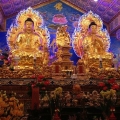
In the Lotus Sūtra, Old Prabhūtaratna lifts his throne into the heavens, and Śākyamuni lifts the Mahāsaṃgha up with it. Enthroned above, Śākyamuni expounds the Dharma:
Many aeons have passed since I attained Bodhi,
countless hundreds of thousands of millions of aeons,
endless thousands of millions of trillions of asaṃkhyeyas of aeons,
uncountable innumerable inestimable incalculable aeons.Always, I have taught the Dharma.
Countless millions of livings beings
I have caused to enter into the buddha-path
over these countless aeons.In order to liberate living beings,
I masterfully manifest Parinirvāṇa,
yet in truth I do not pass into extinction.
Always, I abide here preaching the Dharma.Although I always abide here,
through many godly psychic powers
I lead the living beings into an error:
(in that) though I am close by, I am not seen.Many see me passing into extinction.
Widely, they worship my śarīradhātus.
All of them, filled with yearning,
are yearning to gaze upon my heart.When a living being truly surrenders,
becoming genuine, straight-minded, and gentle,
and (he) wholeheartedly desires to see the Buddha,
he becomes selfless and charitible in this body and life.At that time, I and the Mahāsaṃgha,
entirely without exception, appear upon Gṛdhrakūṭa
where I, at that time, speak to them, saying:"I always abide here, but not in extinction.
Through the masterful application of my powers,
I appear to manifest extinction and non-extinction.
In distant lands, there are living beings
prostrating to me, trusting in me, rejoicing in me.
I return to abide at those places
in order to speak of the Supreme Dharma.
You, not hearing this that I say,
all call me ‘extinct’ and ‘destroyed.’
I see the many living beings
as drowning in strife.
That reason why I do not reveal my body
is to cause them to strive and yearn.
Because they have been caused to yearn for my heart,
they then go forth to hear the Dharma.
Via my godly psychic powers, it has been like this
for asaṃkhyeyas of aeons.”I always abide upon Gṛdhrakūṭa,
yet I have many other abodes.
When living beings see themselves taken
by the great conflagration that burns the aeon,my Pure Land is nevertheless peaceful,
always crowded with the gods
as they rain down mandāravā petals,
scattering them over the Buddha and the Mahāsaṃgha.My Pure Land is imperishable,
yet the masses see it completely aflame
with worry, terror, and rage.
These things they suppose it is brimming with.These many suffering living beings
because of wicked deeds and predestined fates
fare on for asaṃkhyeyas of aeons,
never hearing even the names of the three Jewels.All who cultivate virtue and merit,
who are gentle, genuine, and straight-minded,
all of them will behold my body
abiding here and preaching the Dharma.For the sake of these many living beings,
I disclose that the lifespan of the Buddha is immeasurable
and that I remain so that the Buddha can be seen.
To others, I say that the Buddha is rare to encounter.The power of my wisdom is such.
The light of my wisdom endlessly shines.
My life spans countless aeons.
I remain, continuing to practice the saving of beings.You venerable sages,
do not give rise to doubt concerning this.
Dismiss all that causes you to doubt in this.
The Buddha speaks the truth, not lies.I am like the physician schooled in many remedies
who, to treat his mad son,
truly lives but says he dies.
This cannot be called 'wicked speech.'I am the father of the world
and the physician of the many suffering invalids.
The common man is inverted.
I truly live, though I say that I cease.If I am always seen,
beings’ hearts produce arrogance, self-indulgence,
heedlessness, and attachment to the five desires.
They fall into evil paths.I always know which living beings
walk the path and which do not walk the path
and I accordingly echo their capacities,
disclosing the Dharma (to them) in manifold ways.Always, I naturally arouse this determination:
"By what means will this living being
be led to enter into Supreme Bodhi
to quickly acquire the body of a Buddha?"