
Best Of
Re: Ploggers of the world...unite!
Very nice that you are seeing the cleaner perimeter increasing, Kotishka.
I did a bit of plogging the other day - three 10 liter bags in 30 minutes. However, my lower back does not like it. So, plogging on hold until I obtain that telescopic thingy. Otherwise, as always, I see it as very good spiritual practice, and also good physical exercise.
 marcitko
Re: No Buddhist Quotes
“Fairy tales do not tell children that dragons exist. Children already know that dragons exist. Instead, fairy tales tell children that dragons can be killed.”
— G. K. Chesterton
 Jeroen
Re: Benefits of a Loving Mind
Beneficial acts when done with "intent" indicates a self-other mindset.The act, though prima facia beneficial, is often more ego, "I am doing a beneficial act because I want the reward from the act." It is a act of selfishness in the guise of a beneficial act.
A Beneficial act performed without expectation of reward, the selfless act, is the act generating true reward, the reward neither sought nor expected.
It will be interesting to see how some of the crew here reflect and or expand upon this.
Peace to all
 Lionduck
Re: Benefits of a Loving Mind
Thus have I heard...
"Wherever self is, virtue cannot exist"
So when it comes to carrying out a beneficial act .... just do it and be done with it before the self-generating ego gets wind of it and puts a spanner in the works, that is, depleting the merits/karma which may come from performing such an act.
In a nutshell : Just do it because you are in a position to do so without any expectations.
 Shoshin1
Re: Benefits of a Loving Mind
Hi August! Welcome to NB 
My opinion is that as one deepens his or her practice and the mind begins to "settle" and slow down, one can reflect on one's thoughts and patterns and, unfortunately, I have a lot of very egoistic decisions and nasty thoughts against others (including myself).
With the study of the Four Noble Truths and Right View & Right Effort, one realises how the three poisons can be countered through observation, patience and loving-kindness. It is like that quote which states the best revenge is not to become like your enemy.
Recently I saw a Zen talk that explained how metta is the most important and guides us through the rest of the other brahmaviharas (karuna, mudita, upekkha). I will try and find it and share it through here!
 Kotishka
Re: Benefits of a Loving Mind
The love we talk about is not the "Love You" nor the "Love Me" one way love.
It is the "Love All" love. It is the love that embraces self and others and all else.
It says, "I love and appreciate my life; I love and appreciate your life; I love and appreciate all life; equally.
This is the all embracing love, compassion and mercy. Such love does not always sound to the ears as live or compassion or mercy.
When a child does something he or she was told not to do and, say a vase is broken, if the parent responds with anger, "You broke my vase, now you will be punished.", though the parent may love the child, those words of anger are not coming from love.
Now, under the same scenario, the parent is upset, but chooses to not act out in anger, but, instead approaches the child and says, "You were told to be careful, yet you were recless. As a result, the vase is broken. It can not be unbroken. Of course You should be more careful. You will clean it up. But what else have we learned that we many not break more vases?"
In the first, the child learns to not upset ther parent, that is it.
In the second, while not a necessarily perfect example, the child is given the tools to evaluate the action, the causuality, and reflect to gain from the experience an understanding beyond , "You break, I punish". It is a reflection of the "Love All".
To love others without love of self is of slander self.
To love self without love of others is slander others.
Neither is good or healthy.
To live self with a love that enables love of others, the "Love All" is the Middle Way.
It is not the way of the selfish or the coward. It is the way of the truely brave.
Peace to all
Lionduck
Re: Benefits of a Loving Mind
@Kotishka
Some thoughts written humbly, since it's easy to give advice and perspective, and difficult to implement. Feel free to ignore all of the following 🫡
1) If there were not some challenges, it would not be called practice, and there would not be much benefit.
2) Re the hotel workers, maybe this famous quote is relevant: 'First they ignore you, then they laugh at you, then they fight you, then you win'. Easier said than done, but to my mind, a most excellent little experiment would be to see whether you can win them over via virtous means, which might include some slightly difficult conversations.
3) Do not expect everyone to praise your most excellent plogging efforts. Some will berate you for doing it. I know, since that was also my experience. It is best to a) find a firm resolve in ourselves and - yes - praise and rejoice in our good action ourselves and b) discuss it mostly with those who are on a similar path, with good spiritual friends. And you have those at a minimum on these boards. We must learn to stick to our right action and right effort even in the face of criticism by those a bit less fortunate in terms of understanding what is wholesome and what is not. Not always easy, but sooner or later, we must learn that too.
4) Do not expect the plogging to be a 'walk in the park'. Yes, mostly it is very nice and pleasurable. But sometimes, just like in meditation, obstacles arise. Then, we work with them. Plogging is, to my mind, meditation in action, meditation while giving the body something to do.
5) Your job is not to rid the world of trash, nor is it to initiatiate some kind of revolution in approaching trash in your community. If a bit of that happens, great. But do not expect it. Your job, to my mind, is to a) train yourself in virtue b) spend time in a wholesome activity c) brighten the mind and emotions and d) gain merit/good karma/kamma, if that's something you believe in.
In any case, I applaud your most excellent efforts! I also read your updates with great interest. You motivate me to come back to the plogging, since I let it slide for a while. So, maybe you won't get a bunch of hotel workers to change their ways, but you just might inspire another fellow plogger ie. me. 🤗🫡❤️
marcitko
What questions Buddhist monks have for Sadhguru
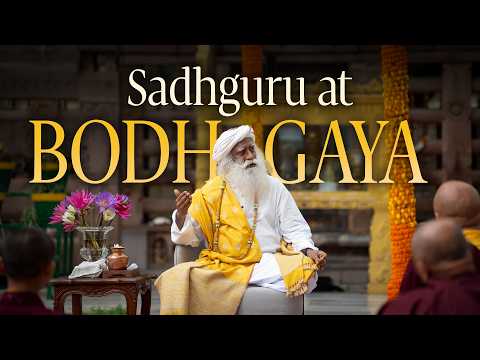
I came across this video of Sadhguru visiting Bodh Gaya, and taking questions from a number of Buddhist monks. It is interesting to see what their concerns are — not how to interpret the Buddha, but how to honour him; how to bring an end to war and conflict; what Sadhguru’s doubts are.
One of the things Sadhguru said was, if we create enough meditators, people who realise they are love, they will elect politicians of similar minds. Fascinating video.
I feel there is much we can learn from videos like this, about the Bodhisattva path, about what to do beyond just our own attainment of peace or our own practice.
Jeroen