Welcome home! Please contact lincoln@icrontic.com if you have any difficulty logging in or using the site. New registrations must be manually approved which may take several days. Can't log in? Try clearing your browser's cookies.
I thought this was pretty good, certainly in the Western world today there is a great culture of individuality, and it is usually considered healthy for even young children to develop boundaries and a sense of what they do and do not want. In the East the collective is emphasised far more, although there too there are signs of the rise of individualism.
It leads to problems with being accepted, with feeling part of a greater whole.
I think there is an important note about balance here. In the west we've been on the path of individualism for a while and its leading to some unhealthy extremes. Before we jump fully back on the collective train, remember some of the things about collectivism we fought to leave behind. The notion that a child has to follow in the footsteps of the parents or live a life that brings respect to the family or village rather than follow their own interests is collectivism. That there are cultural norms or values, such as heteronormativity that one needs to adhere to because its best for society, or simply because that is what everyone else is doing is collectivism. Tall Poppy syndrome, don't stand out, don't be exceptional, collectivism.
What I generally strive for in my own mind is to be an individual that understands and appreciates my place in society and what others do for me and what I do for others, often invisibly.
1
JeroenNot all those who wander are lostNetherlandsVeteran
“Man suffers only because he takes seriously what the gods made for fun.”
― Alan Watts
I like that this implies that the meaning of the universe is for amusement. It seems a better reason than many… when you are young and go skipping through the park and looking at the clouds while you are full of dreams about what you might do later in your life you don’t appreciate that you are perhaps closer to the real meaning of the universe than many an aged philosopher.
I think as you get older the mind and the brain get clogged up with “facts” and “methods” and “seriousness”… and you lose “magic” and “dreams” and “spontaneity”. The mind becomes a burden, casting the same world that seems wondrous in childhood with somber, dreary and grey overtones. It is what happens to many in old age.
Which is why I love Alan Watts, he has a great and playful understanding.
2
personDon't believe everything you thinkThe liminal spaceVeteran
“Man suffers only because he takes seriously what the gods made for fun.”
― Alan Watts
I like that this implies that the meaning of the universe is for amusement. It seems a better reason than many… when you are young and go skipping through the park and looking at the clouds while you are full of dreams about what you might do later in your life you don’t appreciate that you are perhaps closer to the real meaning of the universe than many an aged philosopher.
I think as you get older the mind and the brain get clogged up with “facts” and “methods” and “seriousness”… and you lose “magic” and “dreams” and “spontaneity”. The mind becomes a burden, casting the same world that seems wondrous in childhood with somber, dreary and grey overtones. It is what happens to many in old age.
Which is why I love Alan Watts, he has a great and playful understanding.
There's a Dogen quote that I think gets to the heart of what you're saying
“Before one studies Zen, mountains are mountains and waters are waters; after a first glimpse into the truth of Zen, mountains are no longer mountains and waters are no longer waters; after enlightenment, mountains are once again mountains and waters once again waters.”
― Dōgen
I read this as a path forward and through, not a regression though. Its pointing to a mature wisdom rather than a childish innocence.
1
JeroenNot all those who wander are lostNetherlandsVeteran
Well, the Dogen quote is about how one finds enlightenment through Zen. It’s not quite the same thing as my original statement which was about playfulness. And from the statements of the Buddha, I don’t know if enlightenment actually leads to playfulness, or playfulness to enlightenment.
I have posted some pieces of Osho talking about Hotei in the Buddhist Quotes thread, which aren’t actually the one known story about Hotei in the official Buddhist texts but they are more Osho expanding upon laughter as the flowering of spirituality. I thought they were interesting, although Osho also gave a treatment of the one official story.
0
personDon't believe everything you thinkThe liminal spaceVeteran
@Jeroen said:
Well, the Dogen quote is about how one finds enlightenment through Zen. It’s not quite the same thing as my original statement which was about playfulness. And from the statements of the Buddha, I don’t know if enlightenment actually leads to playfulness, or playfulness to enlightenment.
I have posted some pieces of Osho talking about Hotei in the Buddhist Quotes thread, which aren’t actually the one known story about Hotei in the official Buddhist texts but they are more Osho expanding upon laughter as the flowering of spirituality. I thought they were interesting, although Osho also gave a treatment of the one official story.
What comes to my mind when talking about playfulness, amusement, spontaneity in a spiritual context are the many realized teachers who are joyful and funny, not at all sticks in the mud. Or from another map, that of Maslow and the self realized individual. An AI overview:
According to Maslow, self-actualization is the highest level of human need, characterized by traits like autonomy, authenticity, creativity, self-acceptance, a sense of purpose, and the ability to have meaningful relationships. Self-actualized individuals also experience peak experiences and a continued freshness of appreciation for life.
Key characteristics of self-actualization, according to Maslow:
Acceptance of self, others, and nature:
Self-actualized individuals embrace their own flaws and imperfections, as well as the strengths and weaknesses of others and the natural world.
Spontaneity and naturalness:
They are authentic and genuine in their thoughts, feelings, and actions, rather than trying to conform to social expectations.
Problem-centered:
They are focused on solving problems and making a positive impact on the world, rather than being self-centered.
Autonomy and independence:
They rely on their own experiences and judgments, rather than being overly influenced by external opinions or authority.
Continued freshness of appreciation:
They experience a sense of wonder and awe in everyday life, seeing beauty and value in simple things.
Deep interpersonal relationships:
They form meaningful and lasting connections with others, characterized by trust, respect, and empathy.
Sense of humor:
They appreciate the absurdity and irony of life, and have a good sense of humor.
Creativity:
They are original, inventive, and expressive in their thoughts and actions.
Moral and ethical standards:
They have a strong sense of right and wrong, and are guided by their own values and principles.
Peak experiences:
They experience moments of intense joy, ecstasy, and awe, often associated with a sense of oneness with the world.
Resistance to enculturation:
They are not easily swayed by societal norms and expectations, and are willing to challenge the status quo.
Unconventionality:
They are not afraid to be different and to express their individuality.
Gratefulness:
They appreciate the blessings in their lives and are not easily discouraged by setbacks.
Purpose:
They have a sense of meaning and purpose in their lives, and are driven by a desire to contribute to the world.
Self-actualization is an ongoing process:
It is not a destination but a journey of personal growth and development.
Maybe you're talking about something slightly different? You referred to Osho, I'm not that familiar with his teachings, I think I remember something about laughing practice or something along those lines. I don't understand it, so its hard to give an opinion about their validity according to my understanding.
1
personDon't believe everything you thinkThe liminal spaceVeteran
“I can smile, and murder while I smile.”
— Shakespeare
I don't quite get the point of this one on a Buddhist thread? I googled the meaning and it seems to be about King Richard's Machiavellian nature.
0
JeroenNot all those who wander are lostNetherlandsVeteran
I don't quite get the point of this one on a Buddhist thread? I googled the meaning and it seems to be about King Richard's Machiavellian nature.
I did post this in the Non Buddhist Quotes, and this thread is now an all Quotes - Discussion since Fede changed the title. It was from my Elements of Eloquence book as an example of a type of rhetoric, Diacopia; it is a line by a revolting peasant from Henry VI: Part 2, one of Shakespeare’s early plays where he was still learning the craft of creating memorable lines.
It is all about the unlikely association between murder and smiling, created by the repetition of the smiling in the sentence, it is an excellent line from the play which does not have many memorable lines.
0
personDon't believe everything you thinkThe liminal spaceVeteran
I don't quite get the point of this one on a Buddhist thread? I googled the meaning and it seems to be about King Richard's Machiavellian nature.
I did post this in the Non Buddhist Quotes, and this thread is now an all Quotes - Discussion since Fede changed the title. It was from my Elements of Eloquence book as an example of a type of rhetoric, Diacopia; it is a line by a revolting peasant from Henry VI: Part 2, one of Shakespeare’s early plays where he was still learning the craft of creating memorable lines.
It is all about the unlikely association between murder and smiling, created by the repetition of the smiling in the sentence, it is an excellent line from the play which does not have many memorable lines.
Sorry, I misspoke. I didn't mean Buddhist thread, I meant Buddhist forum. By that I don't mean that its forbidden or anything remotely like that on a Buddhist forum. Its more that its meaning was completely lost on me.
It sounds like it was an interesting line that was in your head? I suppose I still don't really get it though, you've mentioned an interest and pursuit of writing lately, is it the structure that strikes you? And its not so much about the meaning of the words?
0
JeroenNot all those who wander are lostNetherlandsVeteran
Oh ok, no, it’s true that it’s a little more out there for a Buddhist forum, but then we have hosted other things which diverge from Buddhism, like political discussion, activism, talks on psychedelics, psychology, addiction, people’s morning walks, reading habits, family health travails and so on.
But I thought this quote had an interesting double layer to it, that one may smile and yet be a villain capable of murder… you can see it in the conjunction of Putin’s politics and his warfare. Or in Israel’s presence in and mastery of the American news machine and their genocide at home. It seems that it is a highly effective tactic on the world stage.
1
personDon't believe everything you thinkThe liminal spaceVeteran
@Jeroen said:
Oh ok, no, it’s true that it’s a little more out there for a Buddhist forum, but then we have hosted other things which diverge from Buddhism, like political discussion, activism, talks on psychedelics, psychology, addiction, people’s morning walks, reading habits, family health travails and so on.
But I thought this quote had an interesting double layer to it, that one may smile and yet be a villain capable of murder… you can see it in the conjunction of Putin’s politics and his warfare. Or in Israel’s presence in and mastery of the American news machine and their genocide at home. It seems that it is a highly effective tactic on the world stage.
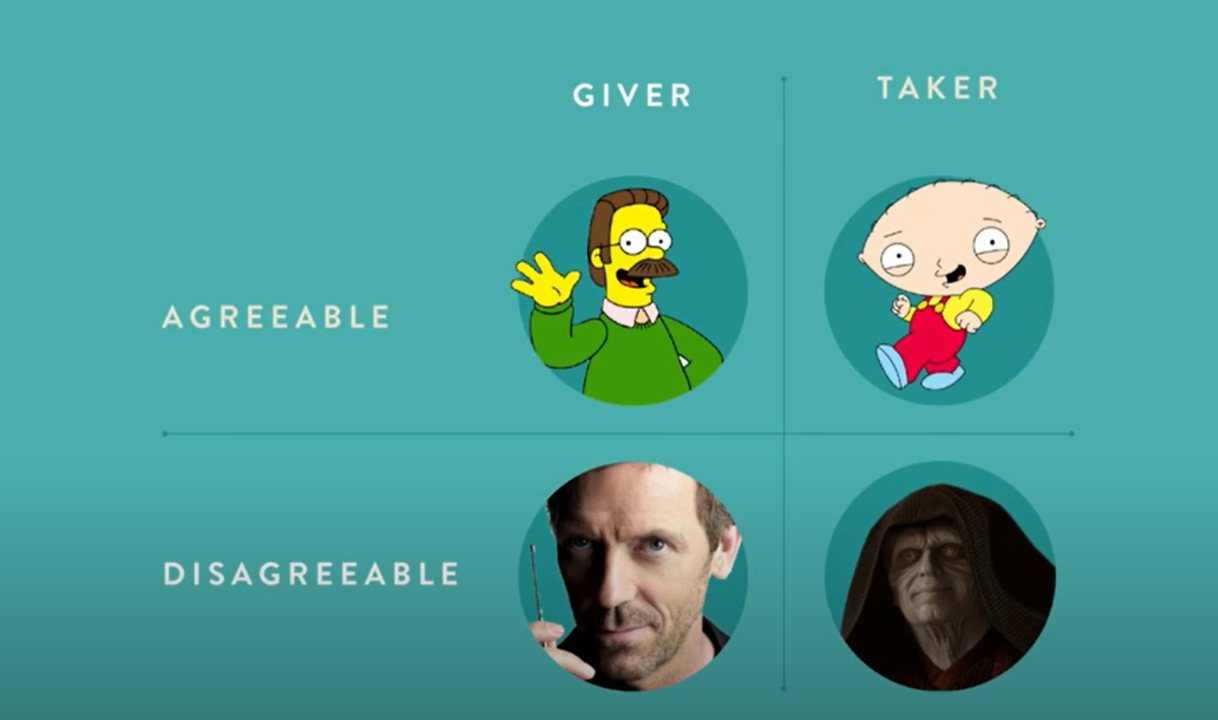
The popular author Adam Grant had a book out a few years ago where he had a 4 quadrant model with agreeable/disagreeable on one axis and giver/taker on the other.
His basic point is that we often think about agreeableness as good and disagreeable as bad, but that's not quite how it works in practice. Each picture is a good example from popular culture of each quadrant. House is a jerk, but he's always trying to help. Stewie is friendly but is trying to take over the world.
0
JeroenNot all those who wander are lostNetherlandsVeteran
edited April 2025
“This constant lying is not aimed at making the people believe a lie, but at ensuring that no one believes anything anymore.
A people that can no longer distinguish between truth and lies cannot distinguish between right and wrong. And such a people, deprived of the power to think and judge, is, without knowing and willing it, completely subjected to the rule of lies.
With such a people, you can do whatever you want.”
~Hannah Arendt, German historian and philosopher (1906–1975)~
This put me in mind of trends on the internet: Trump’s fake news, the scams, the click baiting. To my mind it is not leading to a people who do not believe anything, but rather to a people where the first response is skepticism and fact checking. Even people like my mother, who is of average intelligence, has taken note that texts coming into her phone from strangers are almost certainly trying to scam her.
Similarly here in the Netherlands there is a different view of politicians, that they are halfway to being scammers even if they hold to certain principles. This view of skepticism and fact checking is extending to different areas of society. So Hannah Arendt may have been right in a less media-savvy world such as the 1930’s, but I’m not sure that her view still holds with regards to the public in 2025.
0
personDon't believe everything you thinkThe liminal spaceVeteran
“This constant lying is not aimed at making the people believe a lie, but at ensuring that no one believes anything anymore.
A people that can no longer distinguish between truth and lies cannot distinguish between right and wrong. And such a people, deprived of the power to think and judge, is, without knowing and willing it, completely subjected to the rule of lies.
With such a people, you can do whatever you want.”
~Hannah Arendt, German historian and philosopher (1906–1975)~
This put me in mind of trends on the internet: Trump’s fake news, the scams, the click baiting. To my mind it is not leading to a people who do not believe anything, but rather to a people where the first response is skepticism and fact checking. Even people like my mother, who is of average intelligence, has taken note that texts coming into her phone from strangers are almost certainly trying to scam her.
Similarly here in the Netherlands there is a different view of politicians, that they are halfway to being scammers even if they hold to certain principles. This view of skepticism and fact checking is extending to different areas of society. So Hannah Arendt may have been right in a less media-savvy world such as the 1930’s, but I’m not sure that her view still holds with regards to the public in 2025.
I think you make a good point about people's response to our information environment today. My mom too is more in touch with making sure her sources are good. People have to do what they can to cope. Our immune system reacts to illness and gets stronger.
At the same time its a known strategy to confuse people, viruses can kill us too. Steve Bannon has openly said he wants to "flood the zone with shit" so people will lose trust in expertise and institutions which then makes it easier to get his ideas in. If people don't know who to trust all information is equivalent and most people don't have the time or bandwidth to attempt to sort through it all.
To be fair, experts and institutions have a share in the problem too. Using their trusted status to say and do things that turn out to not be true or serve an agenda. A lot of the things done and said during Covid are good examples.
0
JeroenNot all those who wander are lostNetherlandsVeteran
Steve Bannon is a bad influence for everyone, and most of all his readers! The rest of us can just ignore him, but if you’re a republican and you’ve drunk the conspiracy theorist cool-aid, you give this man free rein to poison your mind. It’s not healthy.
1
personDon't believe everything you thinkThe liminal spaceVeteran
I think its important for people to do what they can to filter through all the noise. But this goes much farther than Steve Bannon, there are deeper problems with our sense making systems. They aren't functioning well, these are the things to fix, blaming and shaming people not only doesn't work, its counterproductive, it makes it harder to reach them.
1
JeroenNot all those who wander are lostNetherlandsVeteran
“An illusionist creates various things
Like horses, elephants, and so on.
His creations do not really exist;
You should understand everything the same way.”
— The Buddha
In a way this is very reminiscent of the famous passage in the Diamond Sutra, but I find it interesting because this too is from a sutra, though I don’t know the English name. Perhaps it is a Mahayana sutra, and not from the Pali Cannon.
In any case, it is a clear pointer to the illusory nature of the world.
0
personDon't believe everything you thinkThe liminal spaceVeteran
edited April 2025
"Where is the wisdom we have lost in knowledge? Where is the knowledge we have lost in information?"
TS Eliot
Here's an AI synopsis of the meaning:
Information vs. Knowledge:
.
The quote suggests a difference between simply possessing information and having a deep understanding or knowledge. Information is often seen as raw data or facts, while knowledge involves the interpretation, application, and understanding of that information.
Knowledge vs. Wisdom:
.
Even with knowledge, one might still lack wisdom, which is the ability to apply knowledge practically and make sound judgments based on experience and insight. Wisdom, according to Eliot, is something that can be lost or diminished even as knowledge increases.
The DIKW Model:
.
The quote is often associated with the DIKW model (Data, Information, Knowledge, Wisdom), a framework used to understand how information is transformed into higher-level understanding. The quote raises the question of where we lose the higher levels (knowledge and wisdom) as we focus on gathering and processing data.
The Waste Land Connection:
.
Eliot's famous poem, "The Waste Land," reflects a sense of fragmentation and lack of meaning in modern life, potentially connecting to the idea that a flood of information can leave us feeling lost and disconnected from true understanding.
Beyond Data:
.
The quote encourages a critical reflection on how we acquire and utilize information, emphasizing the importance of not only collecting data but also seeking deeper meaning and wisdom.
To me it speaks of the way humanity's knowledge and power has outpaced our wisdom to apply it well. Its probably always been the case to some extent, it just seems worse now. And the second half about information highlights the pitfalls of the flood of information delivered by information technology.
0
JeroenNot all those who wander are lostNetherlandsVeteran
"Where is the wisdom we have lost in knowledge? Where is the knowledge we have lost in information?"
~TS Eliot
The distinction between wisdom, knowledge and information is interesting, but the quote doesn’t say very much about it. In my view, wisdom is about deep insight that arises from experience. It’s quite a tricky topic.
0
personDon't believe everything you thinkThe liminal spaceVeteran
"Where is the wisdom we have lost in knowledge? Where is the knowledge we have lost in information?"
~TS Eliot
The distinction between wisdom, knowledge and information is interesting, but the quote doesn’t say very much about it. In my view, wisdom is about deep insight that arises from experience. It’s quite a tricky topic.
Here's a couple books I've read that I can recommend that say quite a bit more about it.
JeroenNot all those who wander are lostNetherlandsVeteran
“What the seeker has sought, has been found. But the seeker has disappeared.”
— Kabir
I think this is inevitably what happens. You come to the conclusion that you are already what you have been seeking, that you always were, you come home. And there are no more questions, there is just this.
0
personDon't believe everything you thinkThe liminal spaceVeteran
edited May 2025
I initially gave this quote an insightful as it seemed to speak to an honesty and integrity. But as I reflected I don't think I like it. I imagined myself living by its ethos and I didn't like the way it made me feel.
Its like the same sort of sentiment that someone who intentionally misgenders people might feel. Or just anyone with a firm religious conviction, they're fine with gay people doing their thing over there, just don't do it around me sort of attitude. Power is always shifting, any principle that applies only to one group will inevitably be taken up by others.
Its from To Kill A Mockingbird so there are more noble intentions behind it that were ultimately proven correct. But, I feel it lacks an intellectual humility, I've lost track of how many times in my life I've thought I was right about something only to have been proven wrong, either wholly or partially.
Somewhat cheekily, I suppose I respect someone's right to have that opinion, but I have to live with myself and my own sense of personal integrity around balance, openness, humility.
...but I have to live with myself and my own sense of personal integrity around balance, openness, humility.
As you know, being wrong, weak minded and prone to believe all kinds of nonsense is part of the madness of my favourite hobby-horse...
In other words if someone thinks or feels or interprets according to their present criteria... Rather than face it as an illusion, I will incorporate and present it as a reality.
It might be an illusion or delusion or temporary state but who cares to admit that?
Oh wait, you know what I read in a fortune cookie or sutra somewhere? [answers to the usual threads and The moment the vision of no-self is there, manas, the elusive notion of “I am,” disintegrates, and we find ourselves enjoying, in this very moment, freedom and happiness.] https://www.lionsroar.com/the-four-layers-of-consciousness/
0
personDon't believe everything you thinkThe liminal spaceVeteran
I initially gave this quote an insightful as it seemed to speak to an honesty and integrity. But as I reflected I don't think I like it. I imagined myself living by its ethos and I didn't like the way it made me feel.
Its like the same sort of sentiment that someone who intentionally misgenders people might feel. Or just anyone with a firm religious conviction, they're fine with gay people doing their thing over there, just don't do it around me sort of attitude. Power is always shifting, any principle that applies only to one group will inevitably be taken up by others.
Its from To Kill A Mockingbird so there are more noble intentions behind it that were ultimately proven correct. But, I feel it lacks an intellectual humility, I've lost track of how many times in my life I've thought I was right about something only to have been proven wrong, either wholly or partially.
Somewhat cheekily, I suppose I respect someone's right to have that opinion, but I have to live with myself and my own sense of personal integrity around balance, openness, humility.
Reflecting more I think it is about nuance and degree and the middle way. I don't want to live with David Duke or the Westboro Baptists, but I also don't want to reject and condemn anyone who isn't in complete agreement with my views and values. Solidarity and diversity are in tension.
0
JeroenNot all those who wander are lostNetherlandsVeteran
“I’d like to keep growing as I get old.”
— Dr Gabor Maté
For me this quote was a timely call to action. I’ve noticed that as I get older I am no longer as quick or as versatile in my comprehension, and I think in part this has to do with my habits. I read a lot, it is true, but mostly spiritual books which don’t really keep me grounded in the real world or stretch my understanding.
I’m now 52, if I want to continue growing I’m going to have to add some new habits to my routines, I think. It’s difficult to honestly look at these things about yourself, but this feels true to me.
1
personDon't believe everything you thinkThe liminal spaceVeteran
“I’d like to keep growing as I get old.”
— Dr Gabor Maté
For me this quote was a timely call to action. I’ve noticed that as I get older I am no longer as quick or as versatile in my comprehension, and I think in part this has to do with my habits. I read a lot, it is true, but mostly spiritual books which don’t really keep me grounded in the real world or stretch my understanding.
I’m now 52, if I want to continue growing I’m going to have to add some new habits to my routines, I think. It’s difficult to honestly look at these things about yourself, but this feels true to me.
Doing new things is usually pretty awkward at first, but it can be fun too. I find there is a learning curve where its tough and boring for a while, but if you can stick with it there comes a point when you gain enough skill/knowledge where it starts to flow more naturally. Don't be afraid to look stupid or fail, that's where learning happens.
I'm also an advocate of starting small. So rather than running away to join the circus, spend 30 minutes a day learning to juggle.
0
JeroenNot all those who wander are lostNetherlandsVeteran
Carl Jung tells in one of his books of a conversation he had with a Native American chief who pointed out to him that in his perception most white people have tense faces, staring eyes, and a cruel demeanour. He said: "They are always seeking something. What are they seeking? The whites always want something. They are always uneasy and restless. We don't know what they want. We think they are mad."
— told by Eckhart Tolle
I think there is truth in this. A lot of white people, a lot of Western civilisation is full of people pushing themselves, wanting things, desiring material gains. That attitude pushes the mind into ruthlessness, and you can see in the history of Western civilisation the desire for empire. In a way this goes back to the merchants mentality of wanting profit.
In a way the story of early history is about mind dominated by belief in the invisible world. Shamans and elders used to be the senior figures in the time man wandered the Earth in tribes, the wisdom keepers of the ancient world. People didn’t have much, didn’t want much, but they had an understanding of the mythical dimension of the world they lived in.
Nowadays people’s thinking is dominated by entertainment, politics, society’s systems, science, learning, mobile phones, computers, television, the internet… all kinds of stuff to do with the modern society. It is a cloud of concepts, thoughts and urges which drags people along, and only by returning our mind to the earlier forms can we shed this.
0
personDon't believe everything you thinkThe liminal spaceVeteran
Carl Jung tells in one of his books of a conversation he had with a Native American chief who pointed out to him that in his perception most white people have tense faces, staring eyes, and a cruel demeanour. He said: "They are always seeking something. What are they seeking? The whites always want something. They are always uneasy and restless. We don't know what they want. We think they are mad."
— told by Eckhart Tolle
I think there is truth in this. A lot of white people, a lot of Western civilisation is full of people pushing themselves, wanting things, desiring material gains. That attitude pushes the mind into ruthlessness, and you can see in the history of Western civilisation the desire for empire. In a way this goes back to the merchants mentality of wanting profit.
In a way the story of early history is about mind dominated by belief in the invisible world. Shamans and elders used to be the senior figures in the time man wandered the Earth in tribes, the wisdom keepers of the ancient world. People didn’t have much, didn’t want much, but they had an understanding of the mythical dimension of the world they lived in.
Nowadays people’s thinking is dominated by entertainment, politics, society’s systems, science, learning, mobile phones, computers, television, the internet… all kinds of stuff to do with the modern society. It is a cloud of concepts, thoughts and urges which drags people along, and only by returning our mind to the earlier forms can we shed this.
There is truth in it, but I think you're looking at the past through narrow, rose colored glasses. I think its more that Western civilization found itself on top when the music stopped than it is its uniquely bad. I think to the Mongols, the Aztecs, Chinese history, Imperial Japan, on and on.
Small scale societies are able to live more harmoniously because of the way human psychology works with people you know and interact with regularly. Its the way most people interact with the people they know in their lives today. In my opinion, the problem has more to do with the size and inevitable anonymity of today's world and the culture that creates, rather than the other way around. Small tribal societies were often very exclusionary and violent towards those outside their group.
I think we've learned a lot and made progress in many ethical areas, individual rights being a big one, as well as technical advances such as sanitation and medicine.
I'd say learn what we can from what is good in the past, leave behind the bad things, take what we've learned and strive to do better going forward. Seeking to return to an idealized past that never really existed isn't the way.
1
JeroenNot all those who wander are lostNetherlandsVeteran
Very interesting @person, it seems that man has for a long time been a rather violent animal.
I notice I carry a number of idealised pictures of different societies in my head. Which may or may not be true, they are just impressions from popular culture.
I suppose the only cultures which can truly be said to be nonviolent are those which practice ahimsa: the Jain, the Tibetans, perhaps a few others.
it seems that man has for a long time been a rather violent animal.
Yes and that violence appears rooted in three things: a protective nature, a survival instinct, and greed, putting profit over people. What we’re seeing in today’s world is mostly the last one. It's often disguised as legitimate: carried out by governments, corporations, or justified under the banners of "development" and "security"
As we grow, so too does the movement towards an Ideal... This morning I got wet trying to put out a pot of gold for the leprechauns to guard...
0
JeroenNot all those who wander are lostNetherlandsVeteran
“When you learn to be the witness of your thoughts and emotions, which is an essential part of being present, you may be surprised when you first become aware of the background "static" of ordinary unconsciousness and realise how rarely, if ever, you are truly at ease within yourself. On the level of your thinking, you will find a great deal of resistance in the form of judgment, discontent, and mental projection away from the Now. On the emotional level, there will be an undercurrent of unease, tension, boredom, or nervousness. Both are aspects of the mind in its habitual resistance mode.”
— Eckhart Tolle
I found this to be true. Often when I am not examining myself and am just in ‘the flow of things’ then judgment appears near instantly. I like the smell of my mothers coffee, I appreciate the view onto the garden, i like the birdsong… judgment is there, and I am dragged off into a future where I have opened the garden doors and am sitting outside with my own coffee. Discontent is subtle but am I not moving from a dissatisfactory present to a more satisfying future?
The mind often is bored or uneasy. It is rare to find it truly at ease.
0
JeroenNot all those who wander are lostNetherlandsVeteran
“The Buddhist path is letting go, more letting go, and even more letting go.”
— Ajahn Chah
This for me was a key statement. At its heart, equanimity is a continual letting go of many small things. It is also a letting go of larger things, when they come along.
0
JeroenNot all those who wander are lostNetherlandsVeteran
“When I speak of healing, I mean nothing more or less than a natural movement towards wholeness.”
— Gabor Maté
What an excellent definition of healing, which of course references the root of the word healing, which comes from ‘to make whole’. But I think in that it also includes a tendency towards balanced, normal modes of being, which has relevance for mental health. So one could say wholeness for mind, body and spirit.
1
personDon't believe everything you thinkThe liminal spaceVeteran
“They are doing immense harm without knowing it, because they are helping people to become knowers without knowing. This is the greatest harm that can be done to man, to give him a sense that he knows -- and he knows nothing. You have destroyed his whole life. You have destroyed the opportunity in which he may have known, experienced, lived. You have taken all his opportunities, all his possibilities of growth.”
— Osho
I'm wondering what this means, what is the context? One reading I can hear something like Zen empty your cup. Another reading I hear a cult leader removing his followers ability to question what they're being told.
0
JeroenNot all those who wander are lostNetherlandsVeteran
It was a piece on how leaders of religions tend to indoctrinate their flock, with learning rather than direct experience. By telling someone, this is what you will see when you meditate, you remove their incentive to go and experience for themselves.
0
JeroenNot all those who wander are lostNetherlandsVeteran
Everything evolves would come to mean that nothing is true
~Nietzschean style quote~
It seems to me this is mostly correct. The few things that are true, like the statement “that what is is true” and on an individual basis “I am”, are really constructs of consciousness. Real life is messy and incomplete and partial, always caught amid step.
Life, it seems to me, is meant to be experienced, watched meditatively until its meaning surfaces. It’s like contemplating a koan, you watch the mind at work trying to unpick the tricky concept. Just like that, mind is trying to solve life. Instead, just watch.
0
JeroenNot all those who wander are lostNetherlandsVeteran
'The Gift of Presence' by Spirit of a Hippie
✍️ Mary Anne Byrne
Beautiful poem. But I just had a dream, which was a kind of answer to this. It included a moment of shocking violence and horror, which should have lifted me out of the dream to awareness of the present, but it was a fraction too late, and I witnessed a scene which if it had been real would have inflicted some battle trauma.
0
personDon't believe everything you thinkThe liminal spaceVeteran
“You have your way. I have my way. As for the right way, the correct way, and the only way, it does not exist.”
— Nietzsche
I feel like this is only a partial truth and more of a corrective to an absolutist, parochial morality than something very current and pertinent to today's more multicultural world.
It is true that there isn't one way, but that isn't the same as every way produces the same results as every other way. As humans we value some results more than others, truth, justice, beauty, fairness, loyalty, etc. Not everyone has the same disposition for values that matter. A scientist will value and pursue truth, an artist beauty, an activist justice. None of those ways are the only way, but each have value and they all have more value to humanity than selfishness, deceit, dominance, betrayal.
1
JeroenNot all those who wander are lostNetherlandsVeteran
@person said:
None of those ways are the only way, but each have value and they all have more value to humanity than selfishness, deceit, dominance, betrayal.
You would hope this is true, but I don’t think it can be stated with certainty. Look at the two sides of the War on Drugs. The cartels are based on greed, selfishness, dominance, etcetera, yet they provide products that are wanted by many. The DEA and their ilk are based on duty, workmanship, loyalty, justice, etc, but they are often seen as boot-licking imperialists. The net effect is a stunning negativity for everyone concerned.
0
personDon't believe everything you thinkThe liminal spaceVeteran
@person said:
None of those ways are the only way, but each have value and they all have more value to humanity than selfishness, deceit, dominance, betrayal.
You would hope this is true, but I don’t think it can be stated with certainty. Look at the two sides of the War on Drugs. The cartels are based on greed, selfishness, dominance, etcetera, yet they provide products that are wanted by many. The DEA and their ilk are based on duty, workmanship, loyalty, justice, etc, but they are often seen as boot-licking imperialists. The net effect is a stunning negativity for everyone concerned.
I guess I'm not really down with that. I don't think the DEA and Cartels are moral equivalents. Its not the case that its black and white, people and motives are complex, but its also not all the same.
I view the moral landscape more like this with lots of peaks and valleys.
0
JeroenNot all those who wander are lostNetherlandsVeteran
No, it’s not all the same, but it’s a lot more ambiguous than “as long as truth and justice are the goals you’re on the right path”. The things that contribute to a happy and just world are often side effects, and good intentions can lead to bad consequences. I see this landscape more as a lowland with just a few peaks.
0
personDon't believe everything you thinkThe liminal spaceVeteran
edited November 2025
AI Overview of Max Weber's framing of the two opposing and complementary poles.
AI Overview
The ethics of moral conviction (Gesinnungsethik) prioritizes pure intentions and adherence to absolute principles, disregarding negative consequences, while the ethics of responsibility (Verantwortungsethik) focuses on the foreseeable outcomes of actions, accepting accountability for them, even if it requires morally ambiguous means. Max Weber, who coined the terms, argued that a politician needs both, as an extreme focus on either conviction or responsibility alone leads to moral failure. Ethics of Moral Conviction (Gesinnungsethik) Focus: The purity of intent and adherence to a set of absolute moral rules or beliefs. Action: Does what is inherently right according to one's principles, regardless of the consequences. Responsibility: The actor does not take responsibility for negative outcomes, believing the fault lies with the world, others, or God. Example: A political leader who refuses to compromise on a core value, even if doing so could prevent significant societal harm. Critique: Can lead to impractical idealism and a lack of accountability for real-world impacts. Ethics of Responsibility (Verantwortungsethik) Focus: The foreseeable consequences of actions and the actor's accountability for them. Action: Weighs potential outcomes and may use means that are not ideal to achieve a greater good. Responsibility: The actor accepts full responsibility for the results of their decisions. Example: A politician who makes a difficult decision that involves morally uncomfortable tactics to avoid a larger catastrophe. Critique: Can lead to moral compromise and an underestimation of the importance of foundational principles. Weber's Synthesis
Weber believed these two ethics were in "profound opposition" but were ultimately complementary.
He asserted that the true calling for politics demands both, as an excessive focus on one is insufficient.
A truly responsible actor must be guided by deep convictions but also be ready to account for the consequences of their choices.
An actual article on the topic
...“[A]n ethics of conviction is [not] identical with irresponsibility or an ethics of responsibility with a lack of conviction. Needless to say, there can be no question of that. But there is a profound abyss between acting in accordance with the maxim governing an ethics of conviction and acting in tune with an ethics of responsibility. In the former case this means, to put it in religious terms: ‘A Christian does what is right and leaves the outcome to God,’ while in the latter you must answer for the (foreseeable) consequences of your actions...” https://www.essca-knowledge.fr/en/all-posts/posts-articles/max-weber-ethics-responsibility-martin-luther-here-i-stand-can-do-no-other/
An example is Obama publicly opposing gay marriage even though his personal convictions supported it. Should he have stated his true feelings or did he do the right thing with his public position helping him win the power to help make the actual changes that helped people?
0
personDon't believe everything you thinkThe liminal spaceVeteran
@Jeroen said:
No, it’s not all the same, but it’s a lot more ambiguous than “as long as truth and justice are the goals you’re on the right path”. The things that contribute to a happy and just world are often side effects, and good intentions can lead to bad consequences. I see this landscape more as a lowland with just a few peaks.
I read this again and what struck me is that we seem to be in high agreement on the first two sentences, but disagree on what it means regarding the moral landscape.
0
JeroenNot all those who wander are lostNetherlandsVeteran
In a way, ethics of responsibility include already the ethics of conviction. The ethics of conviction function as a motivating force, setting oneself in motion when you see the opportunity to help your convictions, be that truth or justice. The ethics of responsibility are more involved with execution, the how exactly of making a step towards your goal.
0
personDon't believe everything you thinkThe liminal spaceVeteran
@Jeroen said:
In a way, ethics of responsibility include already the ethics of conviction. The ethics of conviction function as a motivating force, setting oneself in motion when you see the opportunity to help your convictions, be that truth or justice. The ethics of responsibility are more involved with execution, the how exactly of making a step towards your goal.
Maybe you're already living in balance?
0
JeroenNot all those who wander are lostNetherlandsVeteran
edited November 2025
Or perhaps I’m just confused? 😵💫 🤣
1
personDon't believe everything you thinkThe liminal spaceVeteran
Looking at the idea in an integrated, holistic way its all a spectrum and there aren't these pure ideas out there. It doesn't make sense and is confusing to juxtapose poles.
Looking at it philosophically there are two poles that we all fluctuate between. But then the notion is that while opposed they are also complementary. Its the whole framework of yin/yang, poles opposing and complementing while also containing the seed of the other within themselves.
0
JeroenNot all those who wander are lostNetherlandsVeteran

Comments
I think there is an important note about balance here. In the west we've been on the path of individualism for a while and its leading to some unhealthy extremes. Before we jump fully back on the collective train, remember some of the things about collectivism we fought to leave behind. The notion that a child has to follow in the footsteps of the parents or live a life that brings respect to the family or village rather than follow their own interests is collectivism. That there are cultural norms or values, such as heteronormativity that one needs to adhere to because its best for society, or simply because that is what everyone else is doing is collectivism. Tall Poppy syndrome, don't stand out, don't be exceptional, collectivism.
What I generally strive for in my own mind is to be an individual that understands and appreciates my place in society and what others do for me and what I do for others, often invisibly.
I like that this implies that the meaning of the universe is for amusement. It seems a better reason than many… when you are young and go skipping through the park and looking at the clouds while you are full of dreams about what you might do later in your life you don’t appreciate that you are perhaps closer to the real meaning of the universe than many an aged philosopher.
I think as you get older the mind and the brain get clogged up with “facts” and “methods” and “seriousness”… and you lose “magic” and “dreams” and “spontaneity”. The mind becomes a burden, casting the same world that seems wondrous in childhood with somber, dreary and grey overtones. It is what happens to many in old age.
Which is why I love Alan Watts, he has a great and playful understanding.
There's a Dogen quote that I think gets to the heart of what you're saying
I read this as a path forward and through, not a regression though. Its pointing to a mature wisdom rather than a childish innocence.
Well, the Dogen quote is about how one finds enlightenment through Zen. It’s not quite the same thing as my original statement which was about playfulness. And from the statements of the Buddha, I don’t know if enlightenment actually leads to playfulness, or playfulness to enlightenment.
I have posted some pieces of Osho talking about Hotei in the Buddhist Quotes thread, which aren’t actually the one known story about Hotei in the official Buddhist texts but they are more Osho expanding upon laughter as the flowering of spirituality. I thought they were interesting, although Osho also gave a treatment of the one official story.
What comes to my mind when talking about playfulness, amusement, spontaneity in a spiritual context are the many realized teachers who are joyful and funny, not at all sticks in the mud. Or from another map, that of Maslow and the self realized individual. An AI overview:
Maybe you're talking about something slightly different? You referred to Osho, I'm not that familiar with his teachings, I think I remember something about laughing practice or something along those lines. I don't understand it, so its hard to give an opinion about their validity according to my understanding.
I don't quite get the point of this one on a Buddhist thread? I googled the meaning and it seems to be about King Richard's Machiavellian nature.
I did post this in the Non Buddhist Quotes, and this thread is now an all Quotes - Discussion since Fede changed the title. It was from my Elements of Eloquence book as an example of a type of rhetoric, Diacopia; it is a line by a revolting peasant from Henry VI: Part 2, one of Shakespeare’s early plays where he was still learning the craft of creating memorable lines.
It is all about the unlikely association between murder and smiling, created by the repetition of the smiling in the sentence, it is an excellent line from the play which does not have many memorable lines.
Sorry, I misspoke. I didn't mean Buddhist thread, I meant Buddhist forum. By that I don't mean that its forbidden or anything remotely like that on a Buddhist forum. Its more that its meaning was completely lost on me.
It sounds like it was an interesting line that was in your head? I suppose I still don't really get it though, you've mentioned an interest and pursuit of writing lately, is it the structure that strikes you? And its not so much about the meaning of the words?
Oh ok, no, it’s true that it’s a little more out there for a Buddhist forum, but then we have hosted other things which diverge from Buddhism, like political discussion, activism, talks on psychedelics, psychology, addiction, people’s morning walks, reading habits, family health travails and so on.
But I thought this quote had an interesting double layer to it, that one may smile and yet be a villain capable of murder… you can see it in the conjunction of Putin’s politics and his warfare. Or in Israel’s presence in and mastery of the American news machine and their genocide at home. It seems that it is a highly effective tactic on the world stage.
The popular author Adam Grant had a book out a few years ago where he had a 4 quadrant model with agreeable/disagreeable on one axis and giver/taker on the other.
His basic point is that we often think about agreeableness as good and disagreeable as bad, but that's not quite how it works in practice. Each picture is a good example from popular culture of each quadrant. House is a jerk, but he's always trying to help. Stewie is friendly but is trying to take over the world.
This put me in mind of trends on the internet: Trump’s fake news, the scams, the click baiting. To my mind it is not leading to a people who do not believe anything, but rather to a people where the first response is skepticism and fact checking. Even people like my mother, who is of average intelligence, has taken note that texts coming into her phone from strangers are almost certainly trying to scam her.
Similarly here in the Netherlands there is a different view of politicians, that they are halfway to being scammers even if they hold to certain principles. This view of skepticism and fact checking is extending to different areas of society. So Hannah Arendt may have been right in a less media-savvy world such as the 1930’s, but I’m not sure that her view still holds with regards to the public in 2025.
I think you make a good point about people's response to our information environment today. My mom too is more in touch with making sure her sources are good. People have to do what they can to cope. Our immune system reacts to illness and gets stronger.
At the same time its a known strategy to confuse people, viruses can kill us too. Steve Bannon has openly said he wants to "flood the zone with shit" so people will lose trust in expertise and institutions which then makes it easier to get his ideas in. If people don't know who to trust all information is equivalent and most people don't have the time or bandwidth to attempt to sort through it all.
To be fair, experts and institutions have a share in the problem too. Using their trusted status to say and do things that turn out to not be true or serve an agenda. A lot of the things done and said during Covid are good examples.
Steve Bannon is a bad influence for everyone, and most of all his readers! The rest of us can just ignore him, but if you’re a republican and you’ve drunk the conspiracy theorist cool-aid, you give this man free rein to poison your mind. It’s not healthy.
I think its important for people to do what they can to filter through all the noise. But this goes much farther than Steve Bannon, there are deeper problems with our sense making systems. They aren't functioning well, these are the things to fix, blaming and shaming people not only doesn't work, its counterproductive, it makes it harder to reach them.
In a way this is very reminiscent of the famous passage in the Diamond Sutra, but I find it interesting because this too is from a sutra, though I don’t know the English name. Perhaps it is a Mahayana sutra, and not from the Pali Cannon.
In any case, it is a clear pointer to the illusory nature of the world.
Here's an AI synopsis of the meaning:
Information vs. Knowledge:
.
The quote suggests a difference between simply possessing information and having a deep understanding or knowledge. Information is often seen as raw data or facts, while knowledge involves the interpretation, application, and understanding of that information.
Knowledge vs. Wisdom:
.
Even with knowledge, one might still lack wisdom, which is the ability to apply knowledge practically and make sound judgments based on experience and insight. Wisdom, according to Eliot, is something that can be lost or diminished even as knowledge increases.
The DIKW Model:
.
The quote is often associated with the DIKW model (Data, Information, Knowledge, Wisdom), a framework used to understand how information is transformed into higher-level understanding. The quote raises the question of where we lose the higher levels (knowledge and wisdom) as we focus on gathering and processing data.
The Waste Land Connection:
.
Eliot's famous poem, "The Waste Land," reflects a sense of fragmentation and lack of meaning in modern life, potentially connecting to the idea that a flood of information can leave us feeling lost and disconnected from true understanding.
Beyond Data:
.
The quote encourages a critical reflection on how we acquire and utilize information, emphasizing the importance of not only collecting data but also seeking deeper meaning and wisdom.
To me it speaks of the way humanity's knowledge and power has outpaced our wisdom to apply it well. Its probably always been the case to some extent, it just seems worse now. And the second half about information highlights the pitfalls of the flood of information delivered by information technology.
The distinction between wisdom, knowledge and information is interesting, but the quote doesn’t say very much about it. In my view, wisdom is about deep insight that arises from experience. It’s quite a tricky topic.
Here's a couple books I've read that I can recommend that say quite a bit more about it.
https://www.amazon.com/Constitution-Knowledge-Jonathan-Rauch/dp/0815738862
https://www.amazon.com/Nexus-Brief-History-Information-Networks/dp/059373422X
I think this is inevitably what happens. You come to the conclusion that you are already what you have been seeking, that you always were, you come home. And there are no more questions, there is just this.
I initially gave this quote an insightful as it seemed to speak to an honesty and integrity. But as I reflected I don't think I like it. I imagined myself living by its ethos and I didn't like the way it made me feel.
Its like the same sort of sentiment that someone who intentionally misgenders people might feel. Or just anyone with a firm religious conviction, they're fine with gay people doing their thing over there, just don't do it around me sort of attitude. Power is always shifting, any principle that applies only to one group will inevitably be taken up by others.
Its from To Kill A Mockingbird so there are more noble intentions behind it that were ultimately proven correct. But, I feel it lacks an intellectual humility, I've lost track of how many times in my life I've thought I was right about something only to have been proven wrong, either wholly or partially.
Somewhat cheekily, I suppose I respect someone's right to have that opinion, but I have to live with myself and my own sense of personal integrity around balance, openness, humility.
As you know, being wrong, weak minded and prone to believe all kinds of nonsense is part of the madness of my favourite hobby-horse...
In other words if someone thinks or feels or interprets according to their present criteria... Rather than face it as an illusion, I will incorporate and present it as a reality.

It might be an illusion or delusion or temporary state but who cares to admit that?
Oh wait, you know what I read in a fortune cookie or sutra somewhere? [answers to the usual threads and The moment the vision of no-self is there, manas, the elusive notion of “I am,” disintegrates, and we find ourselves enjoying, in this very moment, freedom and happiness.]
https://www.lionsroar.com/the-four-layers-of-consciousness/
Reflecting more I think it is about nuance and degree and the middle way. I don't want to live with David Duke or the Westboro Baptists, but I also don't want to reject and condemn anyone who isn't in complete agreement with my views and values. Solidarity and diversity are in tension.
For me this quote was a timely call to action. I’ve noticed that as I get older I am no longer as quick or as versatile in my comprehension, and I think in part this has to do with my habits. I read a lot, it is true, but mostly spiritual books which don’t really keep me grounded in the real world or stretch my understanding.
I’m now 52, if I want to continue growing I’m going to have to add some new habits to my routines, I think. It’s difficult to honestly look at these things about yourself, but this feels true to me.
Doing new things is usually pretty awkward at first, but it can be fun too. I find there is a learning curve where its tough and boring for a while, but if you can stick with it there comes a point when you gain enough skill/knowledge where it starts to flow more naturally. Don't be afraid to look stupid or fail, that's where learning happens.
I'm also an advocate of starting small. So rather than running away to join the circus, spend 30 minutes a day learning to juggle.
I think there is truth in this. A lot of white people, a lot of Western civilisation is full of people pushing themselves, wanting things, desiring material gains. That attitude pushes the mind into ruthlessness, and you can see in the history of Western civilisation the desire for empire. In a way this goes back to the merchants mentality of wanting profit.
In a way the story of early history is about mind dominated by belief in the invisible world. Shamans and elders used to be the senior figures in the time man wandered the Earth in tribes, the wisdom keepers of the ancient world. People didn’t have much, didn’t want much, but they had an understanding of the mythical dimension of the world they lived in.
Nowadays people’s thinking is dominated by entertainment, politics, society’s systems, science, learning, mobile phones, computers, television, the internet… all kinds of stuff to do with the modern society. It is a cloud of concepts, thoughts and urges which drags people along, and only by returning our mind to the earlier forms can we shed this.
There is truth in it, but I think you're looking at the past through narrow, rose colored glasses. I think its more that Western civilization found itself on top when the music stopped than it is its uniquely bad. I think to the Mongols, the Aztecs, Chinese history, Imperial Japan, on and on.
Small scale societies are able to live more harmoniously because of the way human psychology works with people you know and interact with regularly. Its the way most people interact with the people they know in their lives today. In my opinion, the problem has more to do with the size and inevitable anonymity of today's world and the culture that creates, rather than the other way around. Small tribal societies were often very exclusionary and violent towards those outside their group.
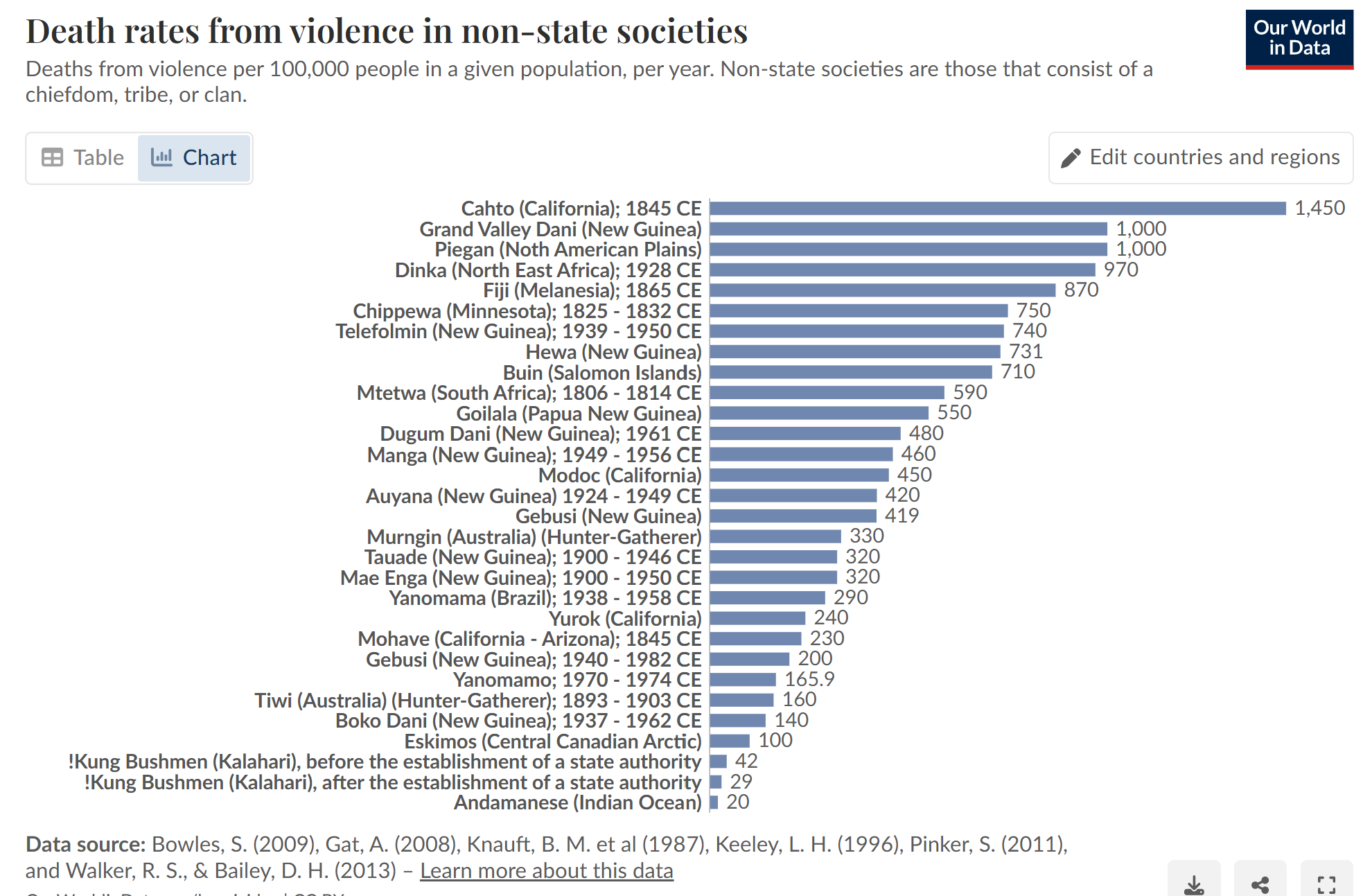
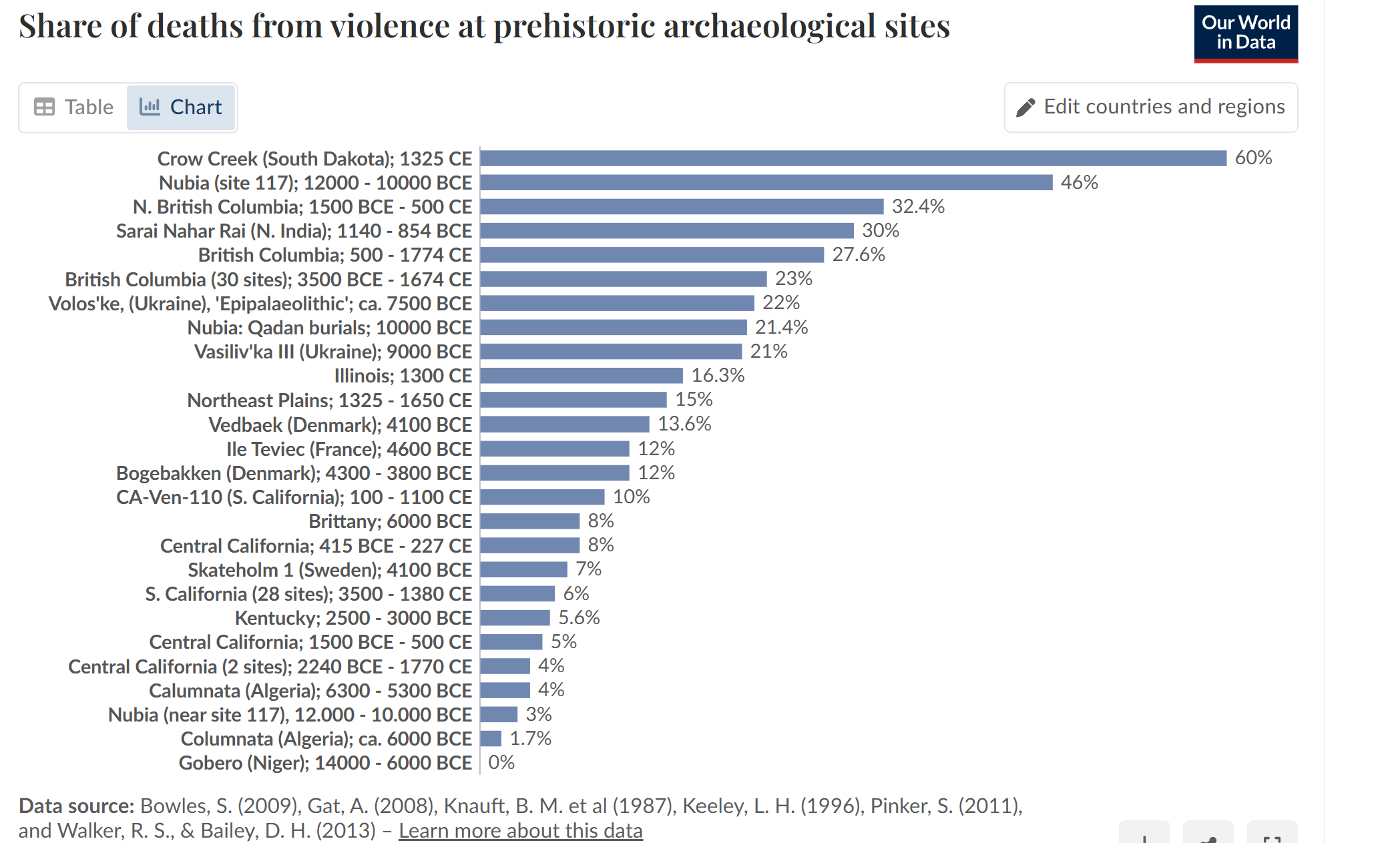
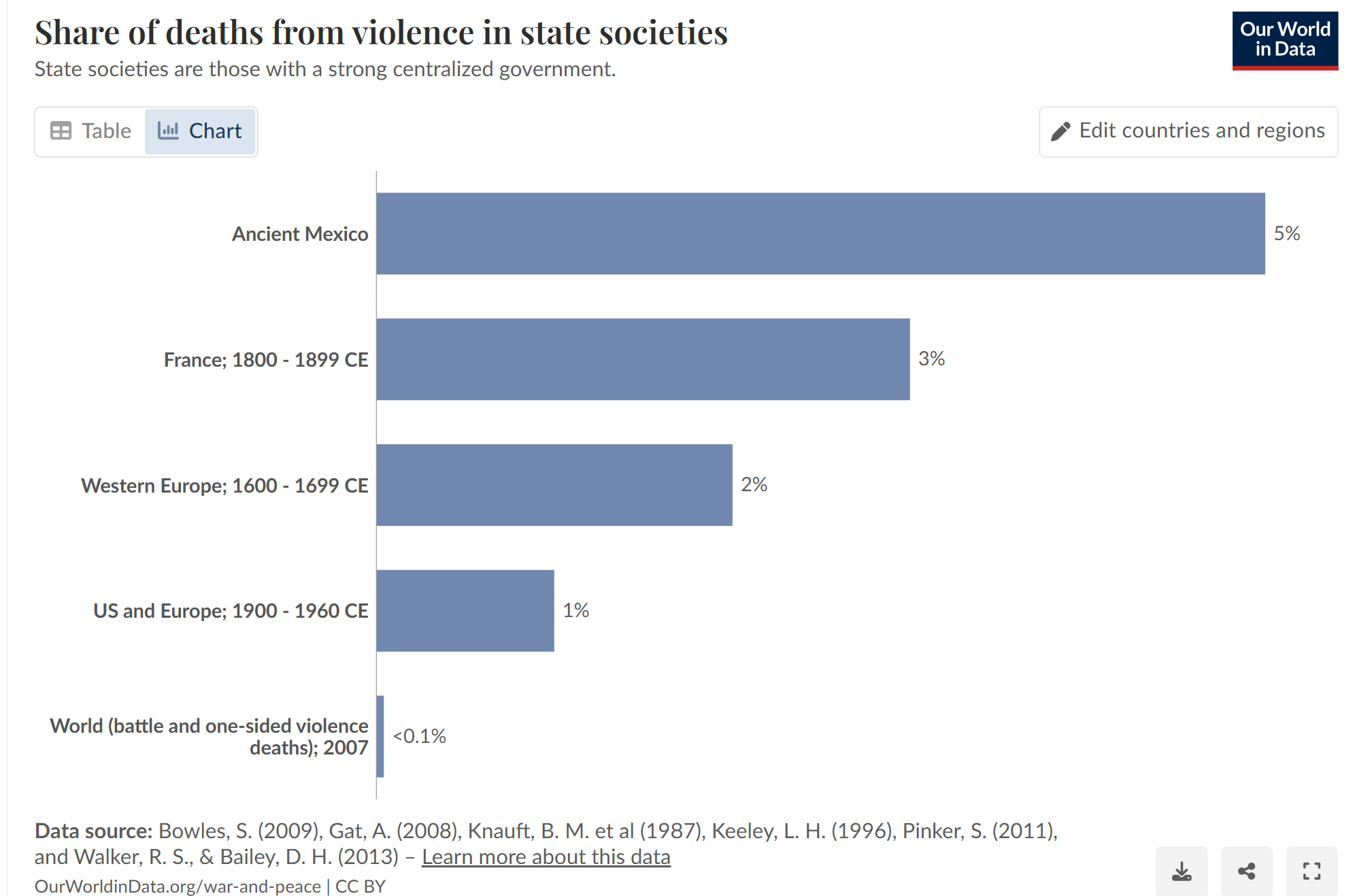
Also the past was a very violent time, deaths by violence today are like 1 in 100,000 whereas in the past it could be much, much higher.
https://ourworldindata.org/ethnographic-and-archaeological-evidence-on-violent-deaths
I think we've learned a lot and made progress in many ethical areas, individual rights being a big one, as well as technical advances such as sanitation and medicine.
I'd say learn what we can from what is good in the past, leave behind the bad things, take what we've learned and strive to do better going forward. Seeking to return to an idealized past that never really existed isn't the way.
Very interesting @person, it seems that man has for a long time been a rather violent animal.
I notice I carry a number of idealised pictures of different societies in my head. Which may or may not be true, they are just impressions from popular culture.
I suppose the only cultures which can truly be said to be nonviolent are those which practice ahimsa: the Jain, the Tibetans, perhaps a few others.
Yes and that violence appears rooted in three things: a protective nature, a survival instinct, and greed, putting profit over people. What we’re seeing in today’s world is mostly the last one. It's often disguised as legitimate: carried out by governments, corporations, or justified under the banners of "development" and "security"
On the outer rim of the mandala of death are sometimes depicted the Nidanas
https://en.wikipedia.org/wiki/Pratītyasamutpāda#The_twelve_nidanas
As we grow, so too does the movement towards an Ideal...
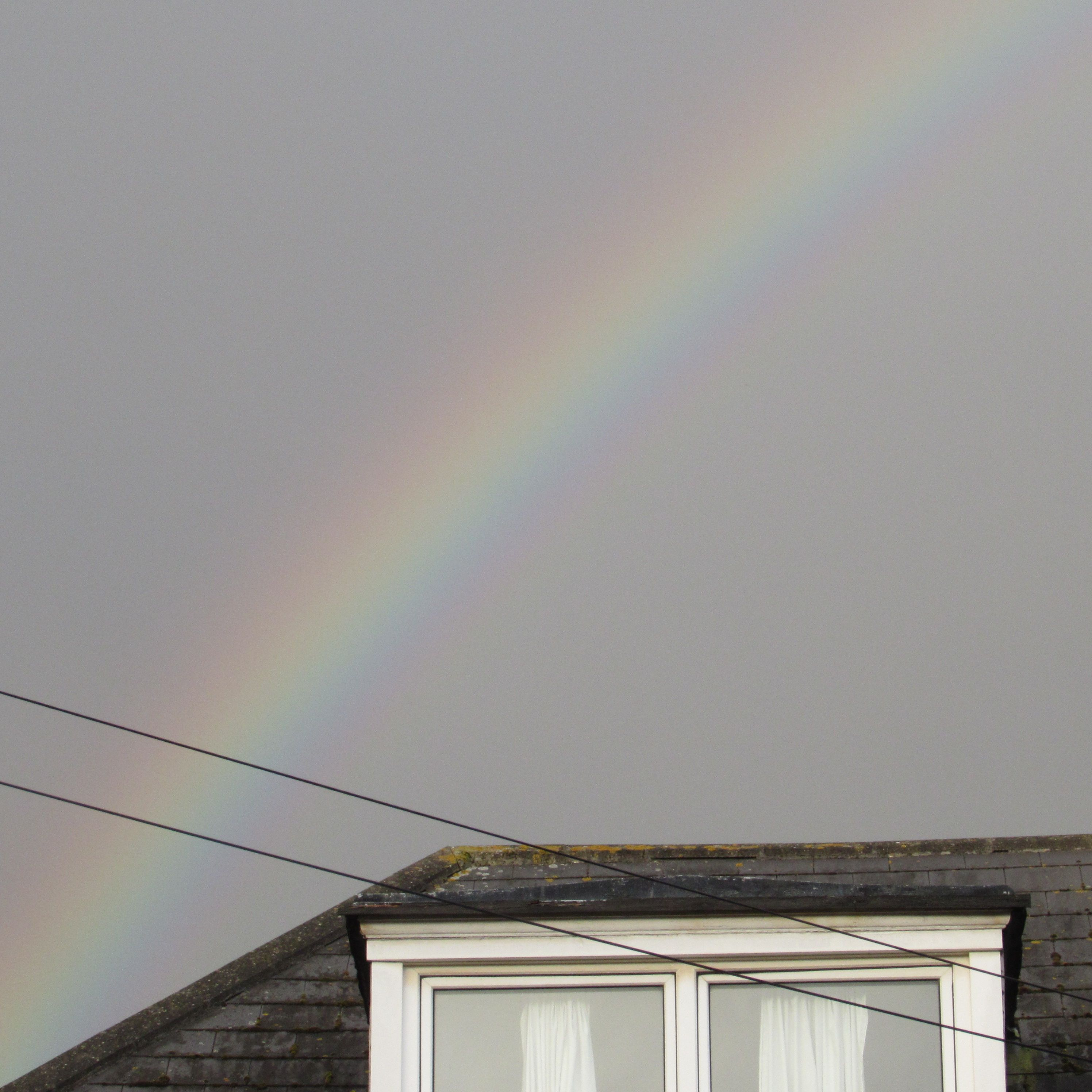
This morning I got wet trying to put out a pot of gold for the leprechauns to guard...
I found this to be true. Often when I am not examining myself and am just in ‘the flow of things’ then judgment appears near instantly. I like the smell of my mothers coffee, I appreciate the view onto the garden, i like the birdsong… judgment is there, and I am dragged off into a future where I have opened the garden doors and am sitting outside with my own coffee. Discontent is subtle but am I not moving from a dissatisfactory present to a more satisfying future?
The mind often is bored or uneasy. It is rare to find it truly at ease.
This for me was a key statement. At its heart, equanimity is a continual letting go of many small things. It is also a letting go of larger things, when they come along.
What an excellent definition of healing, which of course references the root of the word healing, which comes from ‘to make whole’. But I think in that it also includes a tendency towards balanced, normal modes of being, which has relevance for mental health. So one could say wholeness for mind, body and spirit.
I'm wondering what this means, what is the context? One reading I can hear something like Zen empty your cup. Another reading I hear a cult leader removing his followers ability to question what they're being told.
It was a piece on how leaders of religions tend to indoctrinate their flock, with learning rather than direct experience. By telling someone, this is what you will see when you meditate, you remove their incentive to go and experience for themselves.
It seems to me this is mostly correct. The few things that are true, like the statement “that what is is true” and on an individual basis “I am”, are really constructs of consciousness. Real life is messy and incomplete and partial, always caught amid step.
Life, it seems to me, is meant to be experienced, watched meditatively until its meaning surfaces. It’s like contemplating a koan, you watch the mind at work trying to unpick the tricky concept. Just like that, mind is trying to solve life. Instead, just watch.
Beautiful poem. But I just had a dream, which was a kind of answer to this. It included a moment of shocking violence and horror, which should have lifted me out of the dream to awareness of the present, but it was a fraction too late, and I witnessed a scene which if it had been real would have inflicted some battle trauma.
I feel like this is only a partial truth and more of a corrective to an absolutist, parochial morality than something very current and pertinent to today's more multicultural world.
It is true that there isn't one way, but that isn't the same as every way produces the same results as every other way. As humans we value some results more than others, truth, justice, beauty, fairness, loyalty, etc. Not everyone has the same disposition for values that matter. A scientist will value and pursue truth, an artist beauty, an activist justice. None of those ways are the only way, but each have value and they all have more value to humanity than selfishness, deceit, dominance, betrayal.
You would hope this is true, but I don’t think it can be stated with certainty. Look at the two sides of the War on Drugs. The cartels are based on greed, selfishness, dominance, etcetera, yet they provide products that are wanted by many. The DEA and their ilk are based on duty, workmanship, loyalty, justice, etc, but they are often seen as boot-licking imperialists. The net effect is a stunning negativity for everyone concerned.
I guess I'm not really down with that. I don't think the DEA and Cartels are moral equivalents. Its not the case that its black and white, people and motives are complex, but its also not all the same.
I view the moral landscape more like this with lots of peaks and valleys.
No, it’s not all the same, but it’s a lot more ambiguous than “as long as truth and justice are the goals you’re on the right path”. The things that contribute to a happy and just world are often side effects, and good intentions can lead to bad consequences. I see this landscape more as a lowland with just a few peaks.
AI Overview of Max Weber's framing of the two opposing and complementary poles.
An actual article on the topic
An example is Obama publicly opposing gay marriage even though his personal convictions supported it. Should he have stated his true feelings or did he do the right thing with his public position helping him win the power to help make the actual changes that helped people?
I read this again and what struck me is that we seem to be in high agreement on the first two sentences, but disagree on what it means regarding the moral landscape.
In a way, ethics of responsibility include already the ethics of conviction. The ethics of conviction function as a motivating force, setting oneself in motion when you see the opportunity to help your convictions, be that truth or justice. The ethics of responsibility are more involved with execution, the how exactly of making a step towards your goal.
Maybe you're already living in balance?
Or perhaps I’m just confused? 😵💫 🤣
I'm not quite sure how to take that.
Looking at the idea in an integrated, holistic way its all a spectrum and there aren't these pure ideas out there. It doesn't make sense and is confusing to juxtapose poles.
Looking at it philosophically there are two poles that we all fluctuate between. But then the notion is that while opposed they are also complementary. Its the whole framework of yin/yang, poles opposing and complementing while also containing the seed of the other within themselves.
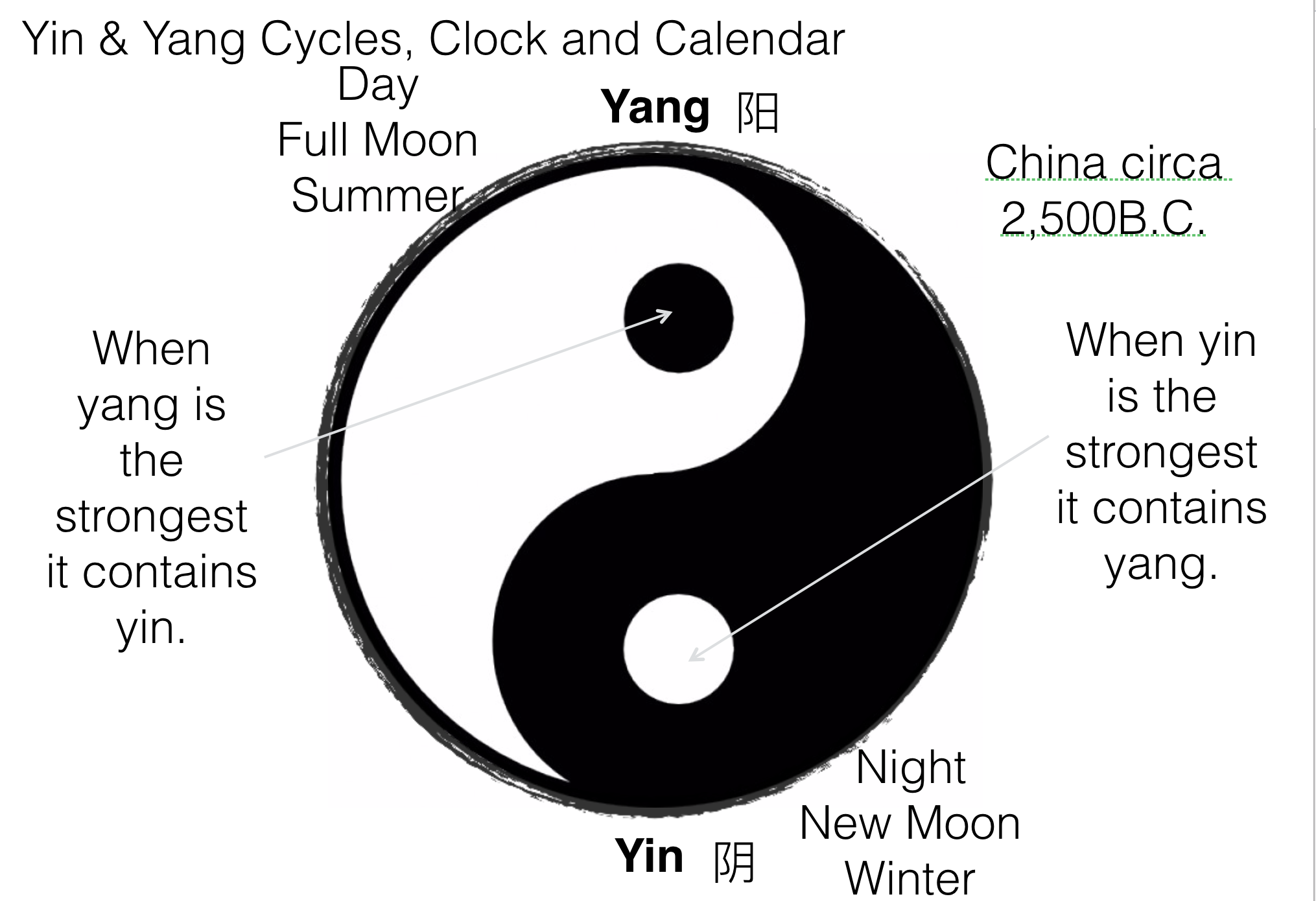
I was just channelling @lobster