
Purity and Nuance
 person
Don't believe everything you thinkThe liminal space Veteran
person
Don't believe everything you thinkThe liminal space Veteran
When I've taken the moral foundations test purity always comes up lowest for me. At first I thought of it like as in purity's opposite, like sin or degradation. But now I think like most things its about tradeoffs. Purity also removes complexity and nuance in favor of a purer vision. So I asked AI, which considering my concerns about AI shows how little I probably care about purity. One of purities primary purposes is in fostering group cohesion, when people are on the same page there is less room for friction or fraction. I think purity also helps in strength of purpose, a clear vision creates a more defined direction. But I like nuance and complexity, I think it leads to better understandings and thus better solutions. Its also just more interesting to me personally.
Nuance and purity are generally opposing concepts, especially within the context of moral or ideological thought. Purity seeks a single, unblemished standard, while nuance acknowledges complexity, shades of gray, and multiple perspectives. > The relationship between them is often a tension between simplicity and complexity.
Purity as a rejection of nuance
In many ideological contexts, the pursuit of "purity" is defined by a rigid, black-and-white framework that actively rejects nuance.
Moral purity: In certain belief systems, such as some forms of purity culture, the world is viewed in binary terms of pure and impure. This outlook lacks the nuance needed to understand the complexities of human experience and can cause feelings of shame for those who do not fit the prescribed narrative.
Ideological purity: In political or social movements, the drive for ideological purity often leads to "purity spirals." In these scenarios, groups reward increasingly extreme opinions and punish or "cancel" those who offer a more nuanced or moderate view. This stifles debate and alienates potential allies.
Logical fallacies: An "appeal to purity" or "no true Scotsman" fallacy is a rhetorical device used to dismiss any counterexample to a claim by rejecting its legitimacy. For example, a person might say "no true environmentalist would support that policy," eliminating any nuanced variation of the group's identity.
Nuance as a recognition of complexity
Nuance offers an alternative to the rigid absolutism of purity by acknowledging the complexity and contradictions inherent in reality.
Contextual understanding: Nuance recognizes that a situation or belief system has multiple layers and that the context often changes the meaning or interpretation. For instance, a nuanced view of a moral issue acknowledges that different circumstances can lead to different choices.
Informed decision-making: As seen in political or social issues, making complex decisions requires moving past ideological purity. Nuance is required to recognize where people with different perspectives can find shared vision and overlap to solve problems.
Empathetic relationships: In relationships, valuing nuance means recognizing that people are complex, contradictory, and imperfect. This approach rejects the idea of a single "pure" standard of conduct, instead allowing for more empathetic and realistic relationships.
A fundamental tension
In essence, the core dynamic between nuance and purity is a direct and often oppositional one:
Purity favors: Dogma, orthodoxy, strict adherence to a code, and clear in-group and out-group distinctions.
Nuance favors: Critical thinking, contextual understanding, embracing complexity, and recognizing that perfection is not a prerequisite for progress.
While purity seeks to eliminate complexity, nuance exists precisely within that complexity. The dominance of purity in a system or ideology inevitably comes at the expense of nuance, and vice versa.
Comments
Then I thought to ask when purity is preferable to nuance. Because I feel its important to add this nuance to the discussion...
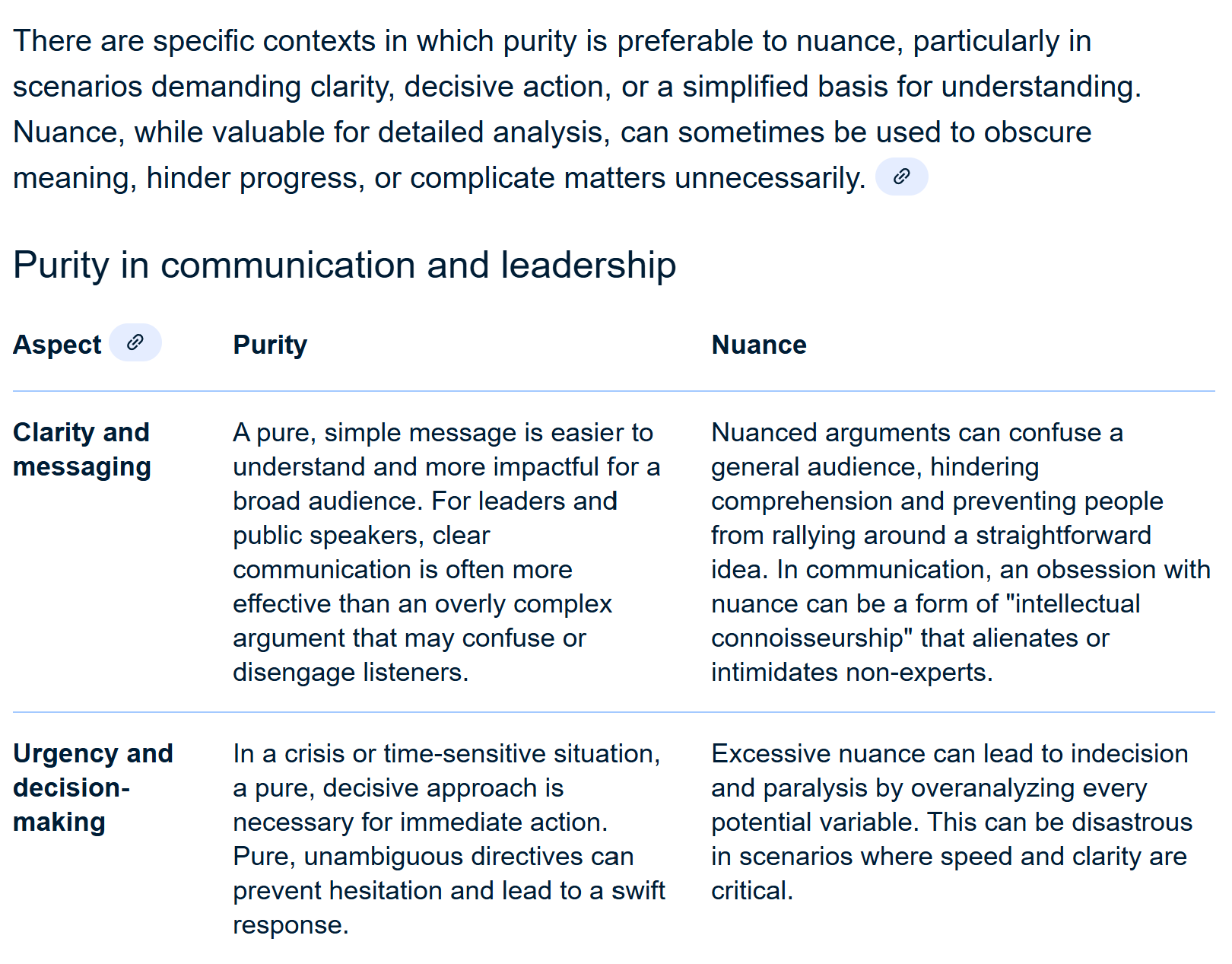
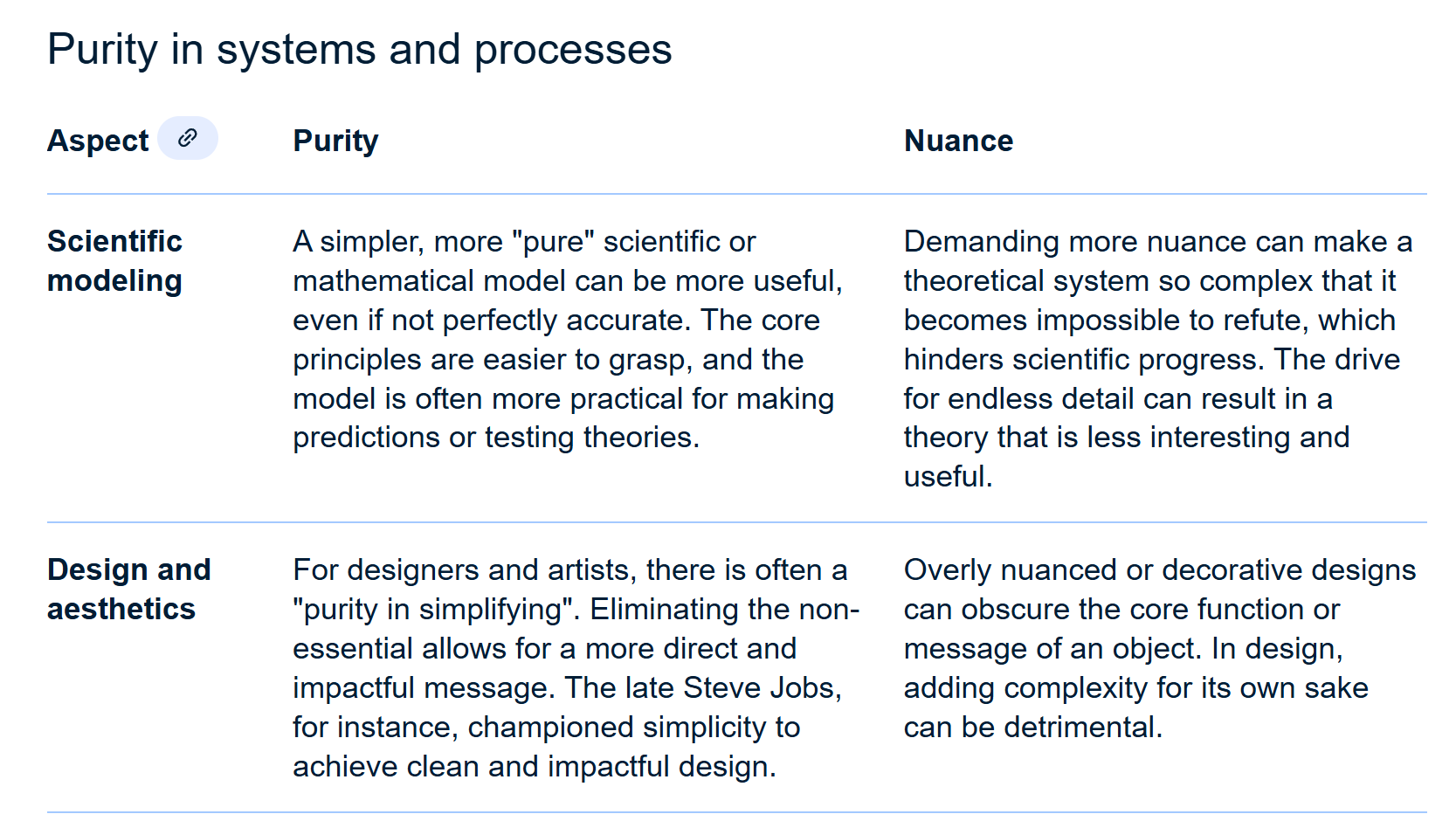
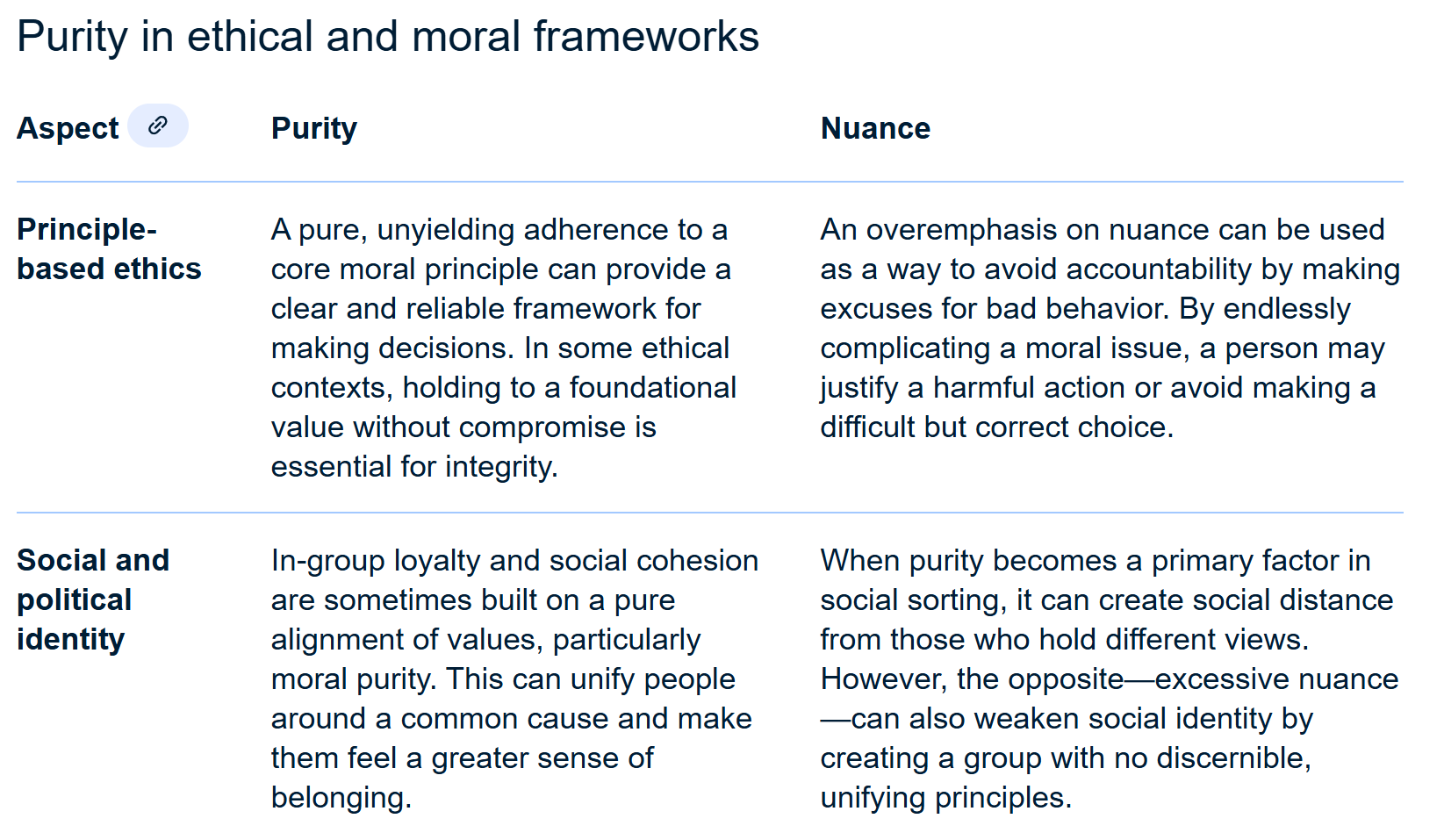
Interesting. I find that much of my understanding is devoted to boiling nuanced concepts down into simple-yet-deep principles that are easy to grasp. I appreciate purity and as the ai says ‘foundational values’ as things that I hold in high esteem. I don’t like thinking in opposites or contradictory pairs, it seems to me to create a lot of friction in the mind if you do that.
From a Buddhist standpoint I feel purity is a core value, something important to the path. The whole idea of the Eightfold Path is based on purity in view (right view), livelihood (right livelihood), and so on. Letting go, renouncing is the other side of purity, to get rid of stuff you don’t need.
I did the questionnaire… a bit above average on purity, a bit below average on loyalty.
In Tantra 'Nothing is Impure'. Obviously that is an absolute. For some absolutely ridiculous.
It is open to misuse, abuse and amuse. How does it work in reality?
For example for those finding and engaging with the Buddha in everyone and everything and every situation?
In a sense it is an ideal or purity of being that makes one seem unworldly. Which of course is one of the attributes of the Enlightened and can lead to religions, cults or even awakening of others, if genuine...
A machine generated answer (presently), is little more than a random shuffling of platitudes or to use the modern vernacular; drivel.
If I can attempt to "purify" your random shuffling. I think you're being critical of nuance? And maybe saying a spiritual path that isn't explicitly worldly in engagement is a type of purity that is also bad?
I think this is probably part of the reason I couldn't commit to a more monastic life. I want to understand the world and people to help offer solutions for their problems. Most people aren't open to the Dharma, thus other avenues and understandings are needed.
I think the most interesting thing is that both nuance and purity serve important roles in the world. Everyone has differing dispositions and values, some are going to see the world according to a certain view that has both importance and drawbacks. Can we see and appreciate the 'value' of other's 'values' and learn to work across difference to gain something more together? Or should we sort into smaller groups of people with identical values to build a common cause?
I was a little confused about the use of the word purity. There is, at the least, spiritual purity and there is ideological purity, two very different things. The latter seems to be what is specified here - a view that discounts or ignores anything - nuances - that do not fit the desired narrative. A sort of "damn the torpedoes, full speed ahead" attitude?
Yeah, sorry, I often think of things in a philosophical sense as opposed to a more everyday usage of things.
I listened to an interview today with a Jungian and it made me think of this and how I don't think my previous answer really got to my feeling.
I too think purity of purpose is an important aspect of the path. Early on as I was forming my views I came to a feeling that trying to find a place of balance in life was bound to fail and liberation is the solution. I still believe that ultimately, but I couldn't make the leap and decided on a worldly life where the interplay and balance of Yin and Yang is the way of worldly things.
When I am reflecting on things of this nature, what I am currently reminded of is that there is only ‘the eternal now’. There is no long ago, there is no tomorrow, there is only ever the now…
Just that if there is a leap to be made, and you haven’t made it yet, it is still there in the now, the moment never passes.