
Buddhist Epistemology
 person
Don't believe everything you thinkThe liminal space Veteran
person
Don't believe everything you thinkThe liminal space Veteran
When I was early in my practice I more readily accepted many of the metaphysical claims made in Buddhism. Then I encountered some teachings on the hells that described how far below the surface of the Earth each level was. At some point they got deep enough that it would put them all the way through the other side of the planet out into space. That sort of unlocked a sense that personal experience wasn't always valid.
I've been doing some reading on Buddhist epistemology, the study of knowledge, how we know what we know and what counts as valid or not. Its a deep and complex subject but I think I can at least get to something practical. Scientific epistemology relies on empiricism and third party verification. Buddhism also looks to reason but it also allows for personal perception and experience, something like "come and see". We can't really verify through someone else if practicing the path leads to greater happiness and freedom, it has to come from within. But personal observation isn't perfect, so there has to be some limit.
So, where does that leave me? Both the Kalama and Canki suttas tell us things about how the Buddha thought about distinguishing between how a belief is held and whether it is true. I can have conviction about something false and uncertainty about something true. We are instructed not to hold something as true out of reason, tradition, scripture, or teacher authority alone. We need to test it out for ourselves like a goldsmith would test gold. But obviously experiencing something personally isn't sufficient in itself. So how to think about what come and see really means, what can it show us and what are its limits?
Comments
It’s a topic worth thinking about, how you discern what is true. I’ve heard it said, what is true is “that which is”. Which means, all of the physical world plus that which you can observe. Where you run into trouble is all the constructs of the mind.
What I have found is that the heart perceives more truly than the consciousness when it comes to perceiving what is true. Trust what you feel, rather than trying to work out what you should think.
>
Right, there is the problem of interpretation. Two people can perceive the same thing but interpret it differently. Is the cylinder a circle or a square?
Surely there's more to it than that though. People feel all sorts of thing to be true that aren't. Nobody felt their way into space and God didn't burn the image of Jesus into your toast. So when are feelings a valid measure of truth and when aren't they?
Pretty much everyone when they look at this image feel A and B are different colors
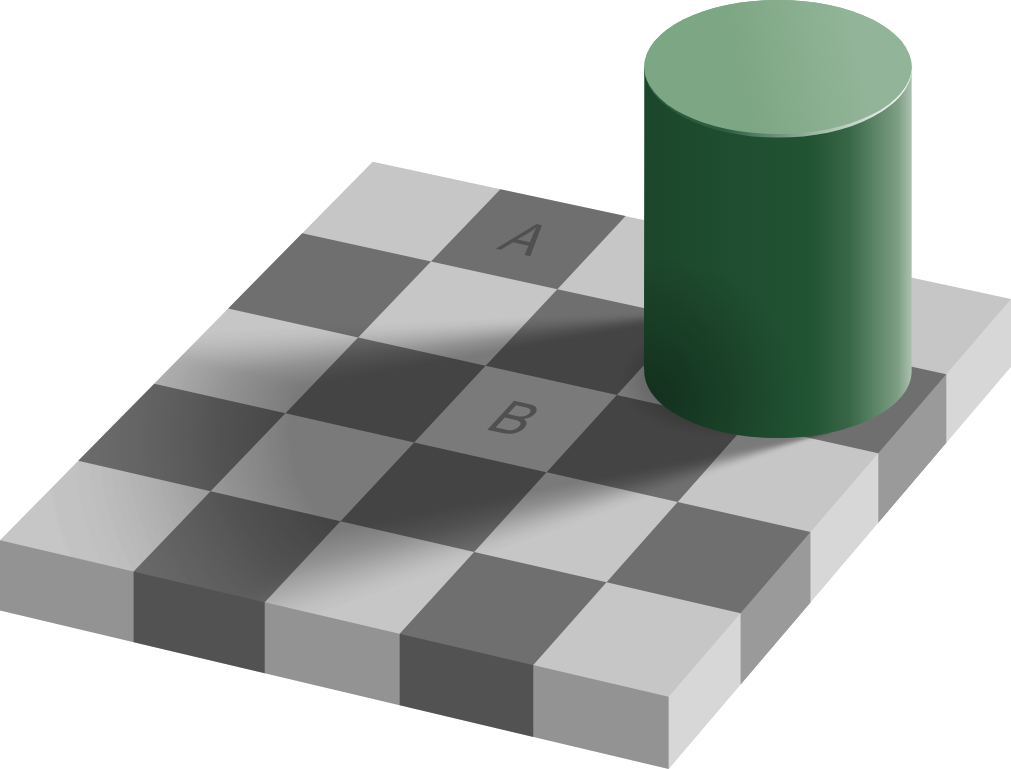
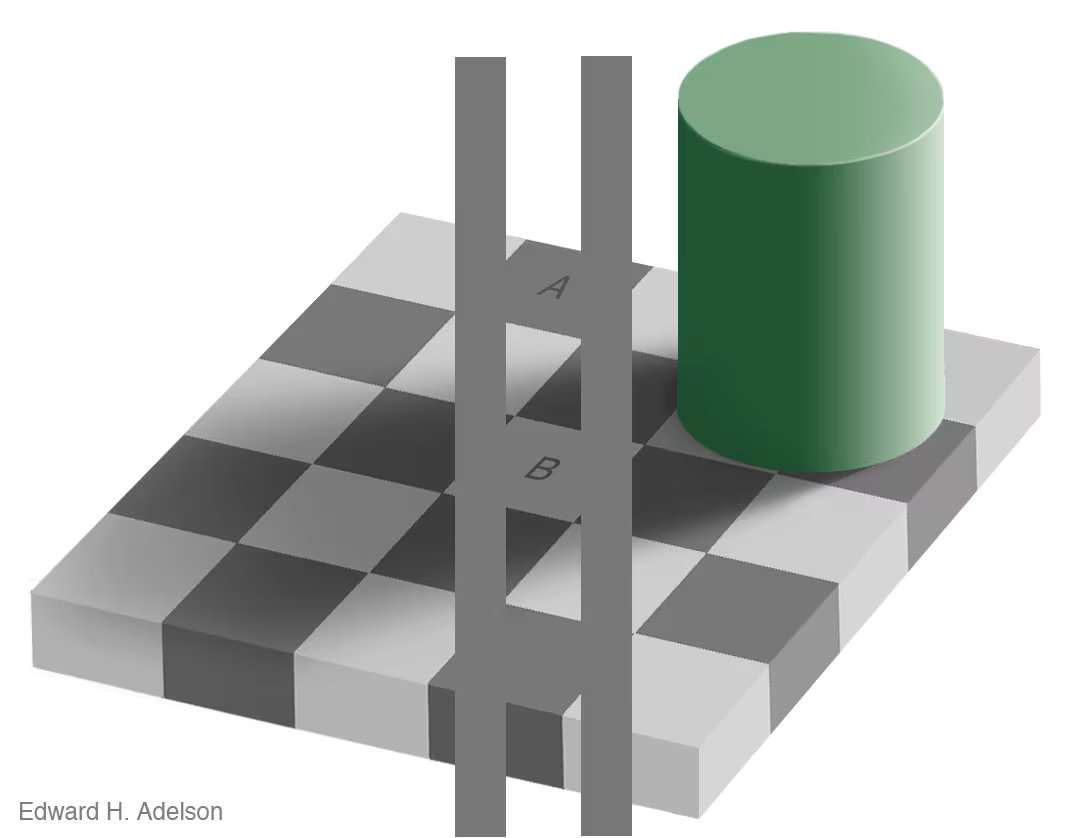
But they're the same, what we perceive and feel isn't automatically true. So what qualifiers are needed to say trust what you feel?
Hmmm yes, good points. All I can say is, this quest for truth through thought, what has it brought mankind? We are overpopulating the planet and destroying the natural world, mental health is becoming an increasing problem, the climate is shifting out of balance.
Perhaps it is better to accept that our ability to discern truth has limits, and instead of aiming yourself at truth, which is always going to end up in a dry, mechanical, perfect-but-dead world, instead of that cultivating kindness and peace?
The pre rational world wasn't exactly a great place to live, superstition, tribal violence, disease, famine went largely unchecked. The pursuit of truth has given us medicine, sanitation, reduced poverty, expanded moral circles. I might argue that many of the problems you worry about are due to a lack of understanding, from motivated reasoning and tribalism.
Also, how exactly did you come to understand that these problems are problems if not through a reasoned analysis of the world?
I think this is a good point. The Buddha only gave us the leaves in his hand, the knowledge that would help lead us to liberation. Admittedly, my interest has a worldly element in it, how do we organize and structure our world to make it better for people, and ultimately all sentient beings.
And its true that I value truth rather highly and beauty less so, but it ought to be possible to include beauty without throwing out truth.
What is interesting me is that Buddhist epistemology is open to first hand experience. But it also isn't whatever you feel or experience is true, its fairly explicit in the ways that greed, hatred and ignorance influence our judgement and perceptions. There are seemingly some criteria for examining and establishing valid vs invalid first person perceptions.
I've done some reading, but frankly its very dense and esoteric with a large amount of base knowledge needed just to get to the part that interests me. Its the kind of thing that it would be nice to have a teacher informed in the area to be able to answer.
My own intuition, or feeling if you will, is that some level of meditative training and development or letting go of the kleshas to get to a clearer, less biased perception feels important. Then I'd make a distinction between first person accounts like the nature of suffering in our minds, the flavor and texture of craving, or whether the practices produce equanimity, compassion, insight on the one hand. And on the other third person phenomenon like the size of the sun and moon, whether ghosts exist or if nuclear power is safe, and other third person claims about how the world works.
That is kind of what I’m getting at. I’m trying to say that the world and mankind would be better off if we focused on the leaves in Buddha’s hand, and that the modern world has disadvantages too, and that perhaps the disadvantages of the ancient world would be compensated by it’s advantages over the modern world.
If I have to choose, a world filled with kindness versus a world filled with scientific truth, it would be a world filled with kindness every time. I think mankind can live without truth, but he cannot live without love except when he starts shrivelling up and dying before he dies. Even dictators and mafia bosses have dogs and cats, love women, have children.
I think that one thing has to have the focus, and that for most people in the modern world that is “the desire for more”. First you want food and shelter, then you want a car, then you want a wife, then you want to own a house, then you want kids, then you want to own a yacht, then you want a mansion… it never stops. Mostly these are people who spend too much time doing, and not enough time looking into their own minds.
I've said before that perhaps humans would have been better off not having settled down from hunter-gatherers, our psychology is better fit for small groups and rugged life.
>
That's a false dichotomy. Truth and kindness aren't mutually exclusive. The pre rational world wasn't especially kind. And trying to be kind and offer something like medicine requires truth to actually help and not harm.
Don't understand what this is in relation to?
I think with your responses you're saying something like peace, kindness, love are more important than truth. Perhaps you're overstating that point by negating the value of truth or saying that its actually harmful even though that might not be your belief?
I'm saying that I think Buddhism quite clearly thinks truth is important, understanding is at the core of its view on liberation. And I'm personally saying here and elsewhere that in order to be skillful at kindness and actually avoid doing harm out of good intentions truth is vital.
To bring the Canki sutta in here that I mentioned in the Sitting With Uncertainty thread.
Saying something is your conviction, or your belief about what you find valuable rather than "only this is true; anything else is worthless" is how to safeguard truth.
Very much so. I think any statement of “the absolute, the one and only truth” is rather hyperbolic. It is better to say “I believe”, I think even “my conviction is” is a rather too strong statement of my kind of truth. In a world full of illusions and falsehoods, where the deceptions of those in power are constantly revealed and ones worldviews can be shaken every other month, it be hooves one to be cautious.
And I think everyday truth and honesty is a high virtue. I’m just rather doubtful about final truths? It seems to me that to go chasing after, say, an understanding of the relationship of consciousness and matter is a bit extreme, if you’re going to dedicate years to it.
Alright, well the point of this thread is to discuss how we evaluate what is true, not whether other things are more important to you. Or whether anyone should or shouldn't spend their life in pursuit of truth, which includes the liberative aspect of the Buddhist path.
I think its apparent that Buddhism does put a fairly high value and emphasis on truth, so I think its perfectly reasonable to talk and think about it.
I'd add that I'm realizing I also have a relationship to values similar to the truth model in the Canki sutta. I think something like these are my values, this is what is important to me, rather than "only this is valuable, anything else is worthless".
Then there is the whole issue of my truth, your truth, our shared truth. As you were already indicating with your mention of the cylinder seen as a circle or a square, but this in fact extends to many other areas. Dare I mention Trump and American politics - now there is a man who has mastered the art of appearing to some as a perfect circle while to others he is definitely a square.
I'm glad you brought this up. This is kind of what my question was about regarding Buddhist epistemology and the way it includes some first person experiences as valid markers of truth.
But yes, to be clear there are different things that we call truth. There's the personal account of what its like to be you, what the world feels like from your unique perspective. There's the sort of collectively shared truths, things like nations or money or language, that aren't objectively real, but are stories about the world that we all share. These aren't arbitrary, they're interdependent structures built on other stories and certain objective truths. Objective truths are things like the speed of light or the number of electrons in an atom of gold, or which team won the World Cup this year.
From a Buddhist point of view, how one forms a vision of truth is one of the things that determines the shape of one’s mind, something which is an important factor in meditation and the search for Dhyana. This is necessarily a personal truth, something which may be shaped by others but cannot fully be explained.
You could say that the part of the Eightfold Path to do with Right View is the key factor here. But I’ve only ever heard of Right View described as “in accordance with Dhamma”, which is painting with a very broad brush indeed. If one had to learn all of the Dhamma in order to attain to Right View and thus a sense of personal truth, you could be busy for a long time.
Anyway, that is an avenue one could explore, in search of the Buddhist sense of truth: the various teachings around Right View. Preferably in collaboration with a teacher.
Yeah, right view does seem very intertwined here. But it is incremental and developmental rather than binary like the rest of the sutra path. Some Buddhist schools, like Dzogchen, do work with direct transmission of a teacher showing you the direct vision of the realization, then you working to expand and stabilize that.
And it is the work of a lifetime, even multiple lifetimes.
Personally Right View - if it is a view according to the sutras - seems a long way off. I’ve never been good at intentionally changing my view through any method other than realising truth.
@Jeroen said:
My experience of it is like when you read or listen or watch something and there's something in it that shifts your perspective and you see things in a different light. The practice is to repeatedly encounter and reflect on the teachings, but then when those occasional shifts happen to sit with that feeling and let it soak in to our felt being rather than move on to the next thing.
So for something like the Buddha's 5 daily remembrances, you'll maybe spend the first part of your meditation repeating and reflecting on them and should some feeling of conviction arise, sit with that feeling.
...
This seems very relevant to the thread and the notion of first person knowledge. How is it for you? What are you realizing when you say truth?
I think the solution is context.
The scientific method is very much about empiricism and third party verification on the physical level and in terms of things that can be tested through physical processes via physical instruments. Buddhism, on the other hand, is very much about empiricism and third party verification on the mental level and in terms of things that can be tested through mental processes via subjective experience.
The two can certain be compatible on many levels and agree, but there are also areas where they're delving into different fields of study and experience. And the Buddha presents his teachings as such—put them into practice and see what you observe and experience. Do you experience less suffering? Do you contribute les harm? If yes, then continue along the path. If no, then find one that does offer these results.
I'll say that from personal experience, Buddhism has greatly led me a place where I experience less suffering and contribute less harm to the world. And for that, I'm eternally gratful.
How do you mean about third party verification in regards to subjective experience? What comes to my mind is interviews with a qualified teacher who says right, or you haven't got it, work on it some more.
I think more what I'm asking is in science someone can propose that the expansion of the universe is speeding up and someone else can also look to see if that is genuinely the case or if the claimer's observations are off. In subjective experience someone can say they're calmer and kinder and an outside observer can agree or not.
But someone could also say they have a subjective experience that they're psychically communicating with an alien intelligence, a place my mind has slightly gone to in the past, but that claim couldn't be verified from an outside source. Or maybe more to the point in Buddhism, say they've seen their past lives.
Or how about the group level delusion of cults. They could all say they experience past lives or that they've talked to the aliens arriving with the comet to take them all away and can verify what the others have experienced.
When are subjective experiences valid and when not? My understanding of Buddhist epistemology is that it is largely a later development. Though the Buddha talked a bit in that direction in the Kalama and Canki suttas. Perhaps you're aware of other Pali suttas that shed some light?
Ah, yes, it should have been: “Buddhism, on the other hand, is very much about empiricism, [first-person], and third party verification on the mental [and psychosocial] level and in terms of things that can be tested through mental processes via subjective experience.”
So you’re verifying things subjectively and often with an experienced teacher who can help to verify your progress from their own experience (and even possibly through supranormal ways (psychic powers). But even there, the Buddha gives guidelines on what to look for and how to judge a good teacher from bad, which again is very empirical. The only issue is, the primary focus of the path is something immaterial, our conscious experience of the world, and there’s no real way to test consciousness. One can only see corollary physical phenomena associated with consciousness and its effects on the body and vice versa, never the subject itself. That said, the Buddha did advocate a healthy skepticism in places like the aforementioned Kalama Sutta and Canki Sutta. But again, the heart of those is testing things out for yourself to see the results.
Whereas the knowledge of science is the physics of the material world, Buddhist knowledge is physics of the inner world of our mind—one that has a very specific purpose, liberation from suffering. Even if one doesn’t believe in or have any experience with some of the more metaphysical aspects like rebirth, one can still put the teachings into practice and see what the results are if they so choose. I don’t know how to tell someone when their subjective experience is ‘valid,’ as I think they’re all valid. But if you mean conform to some objective truth or reality, that’s not something I think anyone can do, which is why the Buddha gives so many guidelines—the most basic being observing the results of our actions and the intentions underlying them.
Maybe we're using the word differently, or maybe there is a disagreement? I'm not using it in the current cultural usage. I have been a bit sloppy, its a word I've heard used in Buddhist circles, but wasn't really aware of its specific usage until I looked into it after your post.
Its what is known in Buddhist epistemics as pramāṇa, or valid cognition. Like a simple example, if someone says "Hey, how's it going" to you and you hear "hey, how's it going", that is a valid cognition. If instead you hear, "hey, you big idiot" that is an invalid cognition. And it goes much deeper.
This short article I read, https://elizabeth-reninger.com/when-is-knowledge-reliable/ describes 4 types of valid cognitions. I think for the purposes of my question in this thread talks about a yogic direct perception that includes more mystical types of knowing. Though my skeptical mind still wants to know how to distinguish between someone who makes a valid yogic claim and the deluded cult leader making an invalid yogic claim.
And another good, short overview of pramana and its importance in Buddhism
https://www.lionsroar.com/what-is-pramana/
The problem with ‘Buddhist epistemology’ is that there’s not just one POV. Depending on the tradition, especially in relation to the Abidhammic corpus of those traditions, you’re going to get slightly different answers. And the individual points and distinctions between them are no longer my focus, to be honest. I’ve long since taken Ajahn Thanissaro’s advice about keeping the goal of the path at the forefront—the cessation of suffering. And the most important question in that regard is, what when I do it will be for my long-term welfare and happiness?
There are many answers to what constitutes a valid cognition, as well as what makes for a valid cognition starting from the verification of healthy functioning sense organs onwards. And I’m not sure what answer would satisfy everyone considering the inherent difficulty of trying to categorize and verify someone’s subjective experience. The term used in the Pali Canon, panna, essentially means wisdom or knowledge that’s gained from our sense awareness (which includes congnition) and contemplation. This type of knowledge is broken down in many ways in the Pali Canon, often in terms of the three characteristics of inconstancy (annica), stessfulness/unsatisfactoriness (dukkha) and not-self (anatta). But there are other frameworks and perceptions, such as the knowledge of meditative absorptions through direct experience (e.g., DN 34. So throughout the Pali Canon, what’s often translated as insight, knowledge, understanding, wisdom, etc. is always associated with some aspect the four noble truths—dukkha, the cause of dukkha, the cessation of dukkha, and the path leading to the cessation of dukkha. Then, of course, later Abhidhammists and sects and traditions started creating epistemological structures and having debates with one another about who had it right.
Yes, I think my worldly concern about our modern epistemic crisis we're in where we're losing the ability to agree on basic facts about the world and how to even come to know what is true or not, has bled into my Buddhism.
The Buddha was only concerned about the leaves in the hand that would lead to liberation. But even in that context still, I think there is room and importance for higher level epistemics. Its hard to distinguish between deep absorptions that are merely blissful and deep absorptions that are truly liberative. What feels good now vs what produces reduced suffering in the long run.
I think in most Buddhist traditions there is a similar concept of "Don't Know Mind". As much as it feels right to hold onto some concepts as immutable truths, there is always room for more information and if we think we know for sure, we close ourselves off to new perspectives. Attachment to our views is to be avoided.
The Heart Sutra of the Mahayana teachings hints at this when the Bodhisattva Avalokiteshvara is updating Shariputra's understanding, basically replacing the Abhidharma with the teachings of Prajnaparamita. The only time the Buddha taught the Abhidharma was when he is said to have gone to the realm of the 33 Devas to teach and free Mahamaya (who was reborn there as a deva) for three months. He returned every day to collect alms and summarize to Shariputra.
"Don't Know Mind" also hints at a sort of primordial awareness before thought but that's another thread.