
Best Of
Re: Blessings
I thought this an important blessing to share. I hope it doesn't violate any community standards about monkfarts. _/_ 
 Dhammika
Re: Just for fun: the random, useless announcements thread!
Well I've had a busy week, last weekend my son came over, we had a nice catch up and he enjoyed his first swim in a long while...He reminded me of how fortunate we are here in Aotearoa to have such freedoms...
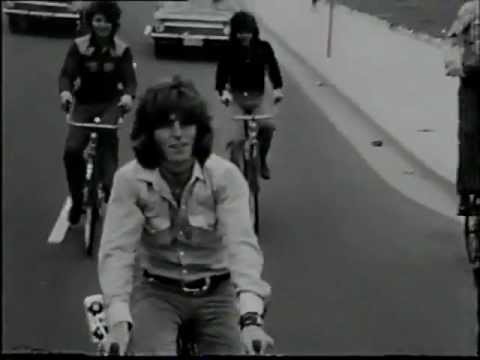
On Sunday I bought the ebike Onya F19 sky blue ..
The island is quite hilly, so the motor helps when tackling the hills, not that I have used it much...I rode it to my job in the village on Monday and had a couple of rides during the week to get use to the gears, throttle and the thrust control....
 Shoshin1
Re: The art of crying
Yagr. Could I recommend a book to you?
It’s called The Feeling Buddha by David Brazier who is both a Shin Buddhist teacher and a psychologist. His view is that the idea that Buddhism urges us to suppress our feelings is a grave a serious error resulting from the loss in translation that happens both literally and as a metaphor for the kind of misperceptions that can creep in in discussion involving peoples with a very different world view.
Braziers view is that we are not called to suppress emotion or deny our feelings, but to refine them and see them in their true context in our lives. He would see nothing odd in Buddhists shedding tears, both of joy and grief. We are not to try to become robots.🙂
 Choephal
Meditation Related Injuries
Hello,
So... I almost tore my inner meniscus while meditating crossed legged (1/4 lotus). A burning feeling overcame my knees and instead of acknowledging it and doing something about it, I kept forcing my knees until I was overcome by pain and an almost constant burning / achey feeling.
It has been a good experience for my practice because I recall how resistant I was regarding using a chair or simply having a break until my knees recovered. It could have been a small break, instead of months of slow recovery. But, the ego was strong: "how can you not use your beautiful zabuton and a cushion like those monks you've read so much about? It doesn't look very "Buddhistic to use a chair."
After spending the last 2 months listening to my knees - using the chair and following the doctor's instructions- they are finally on their way towards a complete recovery. The veredict was that inner meniscus was swollen and I had slightly displaced it. Why didn't I listen to my body? I was so focused on practising and improving my mindfulness that I had actually gone in the opposite direction. I've learnt my lesson: don't entrap yourself by clinging to unrealistic phantoms created by the mind.
Any advice or suggested excercises are welcome. I'm currently just trying to lose weight and walking at least once around the lake everyday to strengthen my leg muscles. I would also like to know how common these injuries are. Has this happened to you? How long did it take you to recover? I remember Ajahn Punnadhammo warning people over YouTube of how many meditators that he had met in the 70s-80s ended up requiring surgery because they had ruined their knees (full lotus position). He recommended the cobbler's pose to stretch our poorly -assuming the reader is Western / Chair-educated- educated hips and thighs.
 Kotishka
Walking away from mindfulness
Good day, everyone. I had a moment yesterday that I would like to share. Let me begin with a bit of context for clarity… These days, my practice consists of five components.
Morning meditation: I sit each morning at 7 a.m., except on Sundays when I sit at 9 a.m. I found a (semi)local Zen center that is meeting online at this time, due to the coronavirus, and I join them each morning. This is the first time that I have participated in a real-world sangha despite the fact that we are meeting virtually at this time.
Walking meditation: I practice walking mindfully each day. I often stop, interspersing my walking with visit with the birds, ducks, frogs and cats. On my latest walk, due to the previous evening’s rain, I also visited with the worms.
Gratitude list: I have an ongoing gratitude list in a Word document on my computer. I keep it open constantly, and whenever I feel gratitude throughout the day, I return to the list to add to it.
Cookie jar: I have a small plate filled with colorful pieces of paper and a pen that I keep in front of a cookie jar. As I quit sugar about eight months ago now, I decided to repurpose my cookie jar on January first. During the day, each time I catch myself doing something kind, thoughtful or compassionate – including (re: especially) when it is a kindness of thoughtful act of compassion toward myself, I stop to consider it. Aware of my action, I embrace the feelings that it generates until it transforms into gratitude. That gratitude, in turn, manifests itself into a thought. I take the thought, write it on one of the colorful pieces of paper, and drop it in the cookie jar. The plan is, that on New Year’s Eve, I’m dumping them all out on the living room floor and reading back all the messages of encourage, love and compassion that I’ve written to myself.
Mindful meal: I have eaten most of the meals that I’ve had in my life mindlessly and while willfully distracted. So many meals have been grabbed at a drive-thru and eaten in the car while driving to a destination twenty minutes away that I need to be at in nineteen minutes. Many others have happened while having a conversation - taking bites while they’re talking, and getting the fork at the ready to shove in my mouth after I stop interrupting them. Or while watching television or reading or surfing the net or... So, I tried to eat mindfully. The draw to distract myself while I eat was too great and I failed again and again. Then I realized that I had enough compassion for myself that I could eat one meal a day mindfully – and so that’s what I do today. I eat one meal per day as a mindful, meditative practice. It’s a long process to eat this way, but the deeper I go, the more joy I experience. The more joy I experience, the m ore likely that my compassion for myself will increase sufficiently for me to be able to eat two meals per day like this – or even all of them.
Anyway, as I said above, I wrote that to provide a bit of context to my story about yesterday’s walk that resulted in laughter. As I rounded the last corner on my return home, aware that this collection of flotsam and jetsam from the universe had arranged itself in this incredibly fortunate way to allow walking, joy and gratitude were leaking out of me. And then the thought, “I want more!” followed immediately with “How can I get more?” The next instant, dozens of thoughts rushed my joy, muting it. Awareness arose that I was no longer present for my walk. I physically stopped and stood, enjoying the irony of becoming less mindful to think about how I can become more mindful…until I chose the joy of walking again over the joy of appreciating the irony.
And now, I’m heading over to my gratitude list because right now I’m feeling grateful to this community that has encouraged and supported me (once, literally 😊) for so many years. Thank you!
yagr
Re: Is it desirable to free the mind?
Freeing the mind from habits and being able to recognise how sometimes I've been dragged by an endless cycle of self-deceit?
I like that.
I think it has been one of the most remarkable effects of my meditation practice. 
Kotishka
Re: Jobs for Buddhists in life?
or manifests compassion, love and wisdom over greed, hate & delusion.
 how
Relatively New Buddhist Books & Articles | thread begun March 2021
Greetings. I am starting up this suggested thread with 2 books:
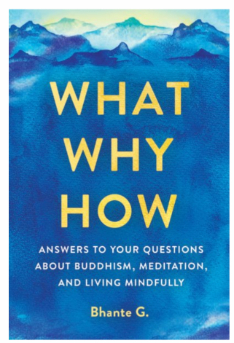
BOOK 1: "WHAT WHY HOW: Answers to Your Questions in Buddhism, Meditation, and Living Mindfully," be Bhante G
I had a curator's hand in helping this 2020 Wisdom Publications book into being. Many on this site will know Bhante G — full name, Bhante Gunaratana, 93-year-old abbot of the Theravadan Buddhist monastery and retreat center in my home state of West Virginia. He is author of many books, including the classic meditation primer "Mindfulness in Plain English" (translated into more than two dozen languages.)
Bhante G has been a key meditation teacher and spiritual friend to me since I first did a newspaper story on Bhavana back in 1990. Impressed by the succinct, insightful off-the-cuff answers he gave in retreats and Dhamma talks, I pitched to him the idea of a book collecting his best Q-and-A responses from his more than a half-century of teaching. I began gathering them 15 years go. My life went off the rails from addiction, I got sober 7 years ago. I got older. I worried my promise of editing such a book would be another phantasm in my life. About 4 years ago, I buckled down and took a deep dive into all the recorded Bhante G Dhamma talks and transcripts online. Interviewed him twice at Bhavana. And, by gum, Wisdom accepted the manuscript. It is not 'my' book, as I was just a helpful editor. It is all Bhante G.
HERE IS ONE OF THOSE RESPONSES:
BHANTE G: "... when we start to pay mindful attention to our moment-to-moment experience, we learn to see the mind’s restlessness and distraction, its illusions and desires, more keenly. That is where letting go comes in. Very often you hear about 'letting go of things.' Sometimes meditators become confused by this phrase. We must remember what is meant. We learn to let go of those things that are harmful to our practice, but we keep those things that are beneficial.
"What is harmful to us? Greedy thoughts are harmful. Hateful thoughts. Jealousy, fear, worry, confusion—we must train ourselves to abandon these states by cultivating their opposites. When we have mindful reflection, what do we see? What do we gain? We gain clear comprehension.
"Clear comprehension or clear understanding of the purpose, according to the Buddha, means we understand our aim. It means that we meditate not just to gain a little relaxation or to temporarily feel good. Those are certainly nice byproducts of meditation practice. But the ultimate aim of practicing meditation is the purification of our being. We aim at no less than overcoming suffering, treading the path that leads to liberation, and finally attaining that liberation. Our mind and body are our laboratory for this effort."
YOU CAN EXPERIENCE THE BOOK'S CONTENT as a free series at: https://wisdomexperience.org/wisdom-article/ask-bhante-g/)
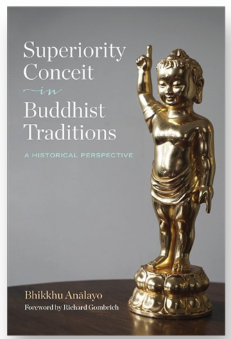
BOOK 2: "Superiority Conceit in Buddhist Traditions: An Historical Perspective" by Bhikkhu Analayo.
I wish I could discuss this book's content, but it is just out by Wisdom and I just ordered it. Those who have read Analayo's prior works or heard his Dhamma talks know he is a scholar monk of the highest rigor, integrity, and insight. I am very much looking forward to reading this, since Buddhist practice in America is, in my limited experience, riven with what Bhante Analayo writes of — 'my tradition is better than yours, mine is superior, yours inferior, your practice is blinkered, mine expansive, etc. etc. etc.'
MORE HERE: https://wisdomexperience.org/product/superiority-conceit/
“Scholars within the academic discipline of Buddhist studies have long benefited from Bhikkhu Anālayo’s many careful and excellent studies of early Buddhist thought, based on a comparative reading of the available sources. Now, he makes the results of his many years of research available in an accessible and highly personal form: an impassioned plea to his fellow Buddhists to recognize their conceit—that is, their feelings of superiority over their fellow Buddhists—and its utter inconsistency with the core teachings of the Buddhist tradition. This slim volume will provide much food for thought for scholars and Buddhist practitioners alike. Highly recommended.”—Reiko Ohnuma, professor and chair, Department of Religion, Dartmouth College
Dhammika
Re: Just for fun: the random, useless announcements thread!
The Shaky Isles lives to shake another day 👍... (but I'll keep the emergency pack packed and at the ready...just incase...)
Well I managed to get all my washing done...I will have a stroll this afternoon...sticking to high ground...
Shoshin1