
Best Of
Re: Mental Health and Emotions.
Hi @Wheel I suffer from Schizophrenia and depression, I haven't taken anti-depressants in a few years though I still take the anti-psychotics for Paranoid Schizophrenia. I haven't really felt depressed since a couple of years after meditating, I still have a lot of paranoid and anxious thoughts but due to practice I let them slide by like clouds on the wind or on the occasions when I do get caught up in them I let them drop and bring my attention back to the moment.
My community mental health team are very supportive of my meditation practice and attribute it with a minimal dose of medication to me showing no signs of psychosis or depression. Before I discovered meditation I used to deal with difficult emotions by consuming a lot of alcohol.
This morning when I sat down to practice i had a lot of anxiety but I just breathed and labelled it anxious, anxious in Mahasi Sayadaw's Burmese Sattipathana style of Vipassana. It lasted for about the first fifteen minutes of meditation and then just naturally dissipated leaving me feeling calm, happy and balanced. The key is to just let the emotions be without embracing them or pushing them away. One tip from Vietnamese Zen master Thich Nhat Hanh is to smile at your difficult emotions and hold them gently in your sense of awareness.
Awareness is the key, your ego and emotions are untrustworthy phantoms. The part of you that is aware of your anxiety isn't anxious and it becomes a question of training yourself to naturally open and relax into that awareness. Or at least that's what works for me.
 Zenshin
Re: New Perspective
Be sure to be gentle with others. You have to realise that their intentions are benign, and that in many different ways, they are manifesting their care for you.
I could be entirely wrong - and if I am, I unreservedly apologise - but I get the undercurrent impression that you hold a certain amount of low-level, almost imperceptive hostility towards those around you who are firmly attached - or in the grip of - doing things that would also make them feel better about you...
See, people iz funny folk.
They have been raised and conditioned to believe that the more you accumulate, the more successful you are, and the better at living life you are.
Your 'shedding of the old ways' is an alien concept to them, and detachment an uncommon gift....
"Having it all" is a sign you've made it.
Having nothing is the sign of a homeless desperate person whose wretchedness merits our pity and charity.
Be gentle with them.
Explain in "idiot" terms how serene this has made you, but make allowances for their mis-understanding you.
You're not suicidal. You're shifting baggage.
This story is true, because I remember vividly watching it as part of a documentary on so-called "Silver Nomads".. elderly and/or retired people who abandon their static and un-moving homes, buy a Winnebago of one kind or another, and set off to drive the whole periphery of Australia, first in one direction, then another....
One individual was a middle-aged man on a motorbike, with a simple rucksack and one large saddle bag.
he had once been an eminent, respected and highly successful Psychiatrist who specialised in dealing with criminal minds. The stress and accumulative knowledge of his job led him to eventually suffer a huge breakdown, and he himself had to be sectioned for both his own safety and that of his family. His wife divorced him, his children shunned him and he lost absolutely everything save for a few personal possessions.
Left desolate by his solitude and exclusion, he acquired a motorbike, and gathering what he could of the little he owned, he decided to travel round Australia.
Everywhere he stopped, he left something behind. Something he didn't need any more, something that had become excess baggage.
By the time the documentary had caught up with him, he had travelled round Australia four times, and was by now well-known on the circuit; at the majority of his stops, he worked for a meal, and did whatever necessary to get by. He had with him a tent, a knife, fork and spoon, two billy-cans, two cutting knives, a pocket-watch that had belonged to his father, and a picture of him and his family.
He had one set of clothes and whenever he stopped, he borrowed, was lent or found a blanket, and slept on the ground. (a couple of places actually kept a package of useful stuff for his use when he next stopped by....)
He would rinse his clothes when necessary, and dry them (if they were still wet) as he rode on his motorbike....
He was finally in touch with his eldest son, who kept the rest of the family abreast of his father's well-being, but he himself never contacted anyone, and they never knew where he was or what he was doing.
He professed himself happier than he had ever been in his whole life. He was at peace, both with himself, and the world.
He came across as a calm and unassuming soul, and as I think of him now, I hope he is still well and living as he wishes.
He had a rich life. It taught me a lot about having as opposed to owning....
 federica
You want wisdom? Try Will Rogers
"Never Squat With Your Spurs On!"
(Will Rogers, who died in a 1935 plane crash in Alaska with bush pilot, Wiley Post, was one of the greatest political/country/cowboy sages ever known.)
Some of his sayings:
1. Never slap a man who's chewing tobacco.
2. Never kick a cow chip on a hot day.
3. There are two theories to arguing with a woman. Neither works.
4. Never miss a good chance to shut up.
5. Always drink upstream from the herd.
6. If you find yourself in a hole, stop digging.
7. The quickest way to double your money is to fold it and put it back into your pocket.
8. There are three kinds of men:
The ones that learn by reading.
The few who learn by observation.
The rest of them have to pee on the electric fence and find out for themselves.
9. Good judgment comes from experience, and a lot of that comes from bad judgment.
10. If you're riding' ahead of the herd, take a look back every now and then to make sure it’s still there.
11. Lettin' the cat outta the bag is a whole lot easier'n than puttin' it back in.
12. After eating an entire bull, a mountain lion felt so good he started roaring. He kept it up until a hunter came along and shot him.
The moral: When you're full of bull, keep your mouth shut.
ABOUT GROWING OLDER …
First ~ Eventually you will reach a point when you stop lying about your age and start bragging about it.
Second ~ The older we get, the fewer things seem worth waiting in line for.
Third ~ Some people try to turn back their odometers. Not me. I want people to know 'why' I look this way.
I've traveled a long way, and some of the roads weren't paved.
Fourth ~ When you are dissatisfied and would like to go back to your youth, think of algebra …
Fifth ~ You know you are getting old when everything either dries up or leaks.
Sixth ~ I don't know how I got over the hill without getting to the top.
Seventh ~ One of the many things no one tells you about aging is that it’s such a nice change from being young.
Eight ~ One must wait until evening to see how splendid the day has been.
Ninth ~ Being young is beautiful, but being old is comfortable and relaxed.
Tenth ~ Long ago, when men cursed and beat the ground with sticks, it was called witchcraft. Today it's called golf.
And, finally ~ If you don't learn to laugh at trouble, you won't have anything to laugh at when you're old.
 genkaku
Re: Just for fun: the random, useless announcements thread!
The Alps viewed from the airplane that took me -grudgingly and unwillingly- back to Switzerland

Re: Seeking Validation
I'm going to let someone more insightful than I am feeling at the moment answer your question but I did want to comment on the fact that you realizing this and owning it is quite an accomplishment on its own.
 yagr
Re: A Painting....
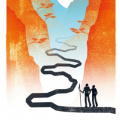
If you do a google search on "Buddhist abstract art" you can find some pretty interesting things on the internet. It would be nice if there was an actual gallery... but I think in the Far East the preferred art styles are much more concrete, and there is not much market even though there are many Buddhists.
I liked this one...

 Jeroen