
Best Of
Re: Being free from fears
@Kerome said:
I once heard Osho say, all fears are a reflection of the fear of death. If we accept that death is the great threshold to a new form of incarnation, a rebirth either on a spiritual plane or on a physical one. Then in effect fears disappear... what remains? Maiming? That is a subtle form of being beholden to the ego, the body is impermanent, if it gets maimed in an arm one can still dance... Pain? Again impermanence, in is unpleasant but not so common in our world.
I'm not sure. Fear of death is certainly there, but my fears are usually more about quality of life. The teaching of the 8 worldly winds comes to mind here: http://blog.sivanaspirit.com/buddha-8-worldly-winds/
When fears arise I tend to acknowledge them and carry on.
I do think it's the case that fear of death underlies a lot of religious belief, though I suspect that is more about seeking comfort than truth. Clutching at metaphysical straws.

Re: Buddha's Love
@eggsavior said:
As much as Buddhism has helped me there is something I've noticed that bugs me. The contexts surrounding his love and compassion are always universal. While this is great sentiment I sometimes wish for something more personal. I am attracted to how Jesus is depicted in a personal fashion. I feel like people can communicate to him and feel his love one-on-one so to speak. But the Buddha feels more distant. Maybe this is because I am a Westerner. And I have barely scraped the surface with my own learning and practice.Are there any sutras or texts pertaining to connecting with Buddha as an individual? I guess I am having issues taking refuge in him particularly. I understand the dharma and sangha
@eggsavior
On a personal level I see taking refuge in the three Jewels as follows....
Refuge in the Buddha (an awakened mind)
Refuge in the Dharma (the true nature of things)
Refuge in the Sangha ( like-minded people)
In a sense one is not taking refuge in a person called the Buddha, (someone separate from themselves) one is taking refuge in one's own awakened mind...
The Buddha will feel more distant, the further one is away from the truth ie, the "Dharma", once one familiarises themselves with the Dharma one will find The Buddha is always close by 
 Shoshin


Meditation to Foster Forgiveness
Two monks are walking down the road. They arrive at a muddy stream crossing, and a well dressed woman declares without introduction, “Don’t just stand there. Someone carry me across this mess.“
Without pause, the older monk lifts her across. She says nothing, not even a thank you.
The two monks walk all day. The whole time, the younger one stews in his mind—How could he pick her up? We’re not supposed to touch women, or even talk to them. And she was so rude, someone should say something to her, she didn’t deserve our help.
Finally, arriving at the inn for dinner, he can’t hold himself back. “What were you thinking? She was nasty, and you broke the rules, and she didn’t even say thank you.”
The older monk smiles gently and replies. “Wow, I put that woman down hours ago, but you’ve been carrying her all this time!”
So what does that mean in real life? We make mistakes. Other people make mistakes. We do things to others. Others do things to us. There’s an actual experience that can be trivial or even traumatic. We add to the suffering with judgment, anger, and blame. It’s sometimes referred to as adding a second arrow after being struck by a first. Something unpleasant happens, but then we add more to the experience.
Forgiveness isn’t the same as condoning ourselves or anyone else for misbehavior. But we so easily hold ourselves infinitely responsible, often for experiences utterly out of our control or from decades past. With forgiveness, we make amends when needed but let go of the extra baggage. We give ourselves the same benefit of the doubt we’d offer a close friend.
On the other hand, we sometimes allow someone else to influence our lives long after they’ve gone in a similar fashion. Another driver cuts us off in traffic, putting us in danger, and then speeds off. The driver arrives at brunch and relaxes, but we make our own coffee break bitter dwelling in our own anger. It’s a concept that holds across larger situations too. Anger and resentment simmer and grow, while compassionate resolve allows us to address what needs addressing without slinging additional arrows.
from: http://www.mindful.org/10-minute-guided-mindfulness-meditation-foster-forgiveness/
link has a 10 min guided meditation.
 Vastmind
Re: Funny Stuff
I got this advice yesterday....
When you're quietly sitting alone, minding your own business, say, on a park bench (Meditating...?  ) or in a cafe, reading, and a stranger comes along and tries to strike up a conversation, just stare at them wide-eyed for a second or two, then whisper to them, in mock-astonishment...
"You can see me....?!"
(Can't wait to try it!)
 federica
The Beauty of Spring
Hello Everyone,
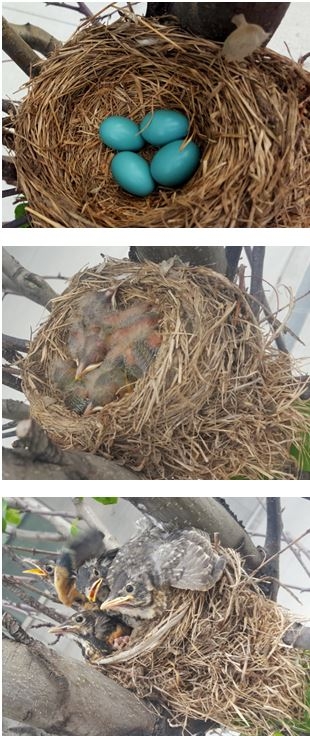
Spring is finally here on this side of the world and I wanted to share some pictures I have. FYI - these pictures were actually taken last spring (May and June).
One day walking to work I noticed a birds nest, very close to the ground. It made me nervous because It was at arms reach and I was afraid someone would try and destroy it or accidentally damage it due to curiosity. It was at the foot of my condo so I watched it very closely for 2 months making sure nobody touched it (as did others I noticed). I want everyone to know that I did everything I could to take these pictures without scaring the birds or mother. I usually waited until the mother was gone to snap the pictures. I'm sure I scared them a little but I never had the opportunity to see something so beautiful up close like this. enjoy!
It was only about 30-40 days from the 1st picture to the last which is pretty amazing.
 Tigger