
Best Of


Weaknesses and restraint
I think I have been lucky. When I was young there was never much money, and so I got into the habit of only buying what I needed. This meant that I never really paid attention to what I desired, and so even in wealthier times I was modest in what I would buy. Pretty much the only things I spent money on were books, DVDs and technology. My mother used to call me a cyber monk.
Living a humble life in this way shields you from your desires and aversions, it keeps them small without repressing them. It was that in combination with the old saying, “take everything in moderation”. This gets you into the habit of applying a counter-pressure to desire, and taking the things that you enjoy in small quantities, without foregoing them entirely. You allow yourself to enjoy, but only once in a while.
I find myself doing the same thing with beer: once every month or two I will buy a bottle of Belgian Trappist beer, and just sit back and enjoy it with a few nuts on a quiet afternoon. I find this allows me to savour the enjoyment. But I don’t look forward to these things, that would be fuelling craving, I just buy them on impulse once it’s been a month or so since the last time. I don’t really keep track rigorously.
Some things I don’t keep in the house, like “borrelnootjes” or paprika crisps, because I know I won’t be able to restrain myself and will just end up eating an entire bag of the things. I’ve found it best to just not buy certain things which I know i have a weakness for.
Restraint is a theme you often come across in the sutras (Aparihani Sutra or Bhikkhuvagga) with respect to the senses or about the monks’ heedfulness, but I think it is important to lay people as well. I find it something that I sometimes struggle with to keep it in mind, especially with food items that I am fond of, like a salmon mousse or certain potatoe dishes. But often I remind myself of it, and then I give up a few more places where maybe I had been eating over-generous portions.
 Jeroen
Re: A Buddhist teacher admits ... BUDDHISM HAS FAILED!
I've seen some blunt comments to be sure, but I haven't seen anyone criticize Jundo as a person. I don't know him personally. I have no idea about his family, his friends, what he's like at the office, etc. All I know is what I see here:
1. He's using a clickbait banner for his funnel
2. The funnel is to book sales
3. He denies he's selling books (despite providing us the links)
4. Beneath all that, he's advocating (I think; I didn't buy the books) recognition of the potential for technology to increase the dissemination of a message; the message being Buddhism in this case.
Having observed him here and in the videos to be observant and articulate, i recognize that there is certainly the potential for him to contribute meaningfully to the forum should he choose.
I doubt he'll choose. Among us, Shoshin did engage him on the concepts, at least initially. But critical mass in this thread seems to be that the sales/denial/innocense approach is off-putting (as it is to me), possibly fatally, and should he see this and decide to engage and salvage the effort here, it will be at notable cost in time and focus, for a very small audience/prospect pool. (And his approach will have to be "OK, OK, my cloak is off now; let's talk.") If he doesn't resurface, or if he does but continues on the marketing trajectory, then it was just a sales channel. If he comes back and engages in substantive discussion about technology and the expanded medium it confers, it could definitely be quite an interesting conversation.
My prediction and my hope are opposites. Jundo, come through!
 Steve_B
Re: Artificial General Intelligence in 7 months?
Back when Al Gore and Newt Gingrich invented the internet, although people knew it could be revolutionary/useful/dangerous, no one could have predicted the vast complexity and second-tier effects that resulted. But humans are still humans, in all our fabulous diversity, we just have a powerful tool to enable and magnify -- but not invent -- the native talent. Artists, scientists, and horse rustlers moved to the internet, but the internet didn't invent art, science, or crime. AI seems similar to me: It will change everything and it will change nothing. I expect it won't reduce my ability to discover things that match my (peculiar) taste, and I don't think it likely that human talent will become more rare; quite the contrary I'd imagine. I certainly expect things to get pretty interesting, but I also expect to still be able to go for a hike, play the piano, have interesting dreams, cold beer, and hot showers. I'm expecting something akin to turning up the gain in a circuit: signal-to-noise will get worse, the signal itself will get amazing, art and science will both boom, sleazeballs will get sleazier, scams will get scammier, Jundo will beam a 5-dimensional treeleaf directly into all our synapses, and Bill Gates won't need to use vaccines to implant his microchips any more. But even with all those and many unimagined-yet miracles to come, I think/hope we'll still need soap and windshield wipers and loud electric guitars played raucously.
We invented the wheel, then we invented propulsion, then we flew the Flyer at Kitty Hawk, then we flew to the MOON. Welcome AI -- let the future begin!
Steve_B
Re: The Other Elephant In The Room
I'll just say that the US is very large and diverse. Each state is the size of an average country, we have a federal system of government where each state has a lot of control over how it is governed. Since it is one country though people can move easily from one region to another without needing to change citizenship or currency, etc., so there is a lot of self sorting. Its easy to move and live with more like minded people.
I've lived in the same area for 50 years and have rarely witnessed the attitudes you talk about. I've seen the Christian identitarianism prominently displayed when I've traveled to certain other areas and I've experienced some of the competitiveness occasionally when dealing with people from outside my region. For example I just did a lot of work for someone who grew up here but moved out east for her professional life and just recently moved back to retire. People in her neighborhood would stop and make small talk and she'd talk to me about how this seemed really weird to her, like they were up to something. She also was much more perfectionistic and passive aggressive than I'm used to dealing with.
The competitiveness seems from my perspective like more of an elite professional thing. I listen to podcasters who live in that world and they talk about trying to let that sort of thing go and a desire to develop attitudes that just seem like part of my everyday working class life.
Mainly I'm saying don't judge us all by the headline grabbing extremists.
 person
Re: A Buddhist teacher admits ... BUDDHISM HAS FAILED!
Lets try to keep any criticism we have to the ideas or approach and avoid critiquing Jundo as a person. We really don't know all that much about him.
person
Re: Have I ever truly meditated?
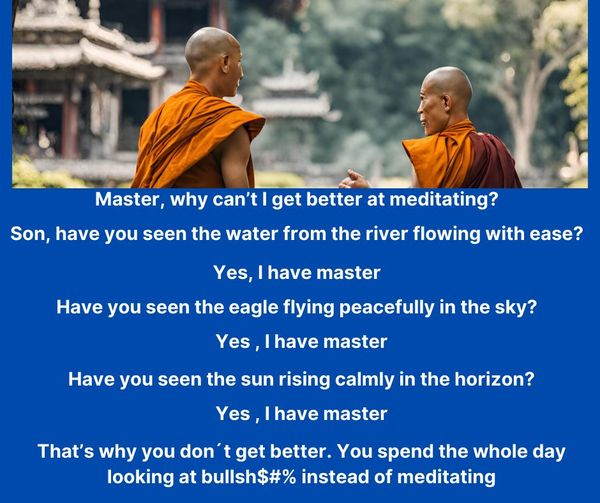
Have I ever truly meditated?
There are probably as many definitions of meditation as there are practitioners.
Some questioning of whether you are truly meditating or not, tends to be a less deluded space to practice within than just assuming that your meditation is true.
The real difficulty however in attaining a satisfactory answer to this question is more tied up in our attachments to a sense of self than it is about whether our meditation technique is true or not.
If the human condition is seen as a dream state of our ego or identity's storyline,
meditation is simply our attempted disassembly of the constructs of that dream.
To the degree that one approaches meditation as something to be acquired & possessed, is the same degree to which one's slumbering continues over any real awakenings.
To the degree that one approaches meditation as a renunciation of one's attachments, is the same degree to which the question answers itself.
All meditation practitioners who honestly persevere will eventually have awakenings of differing strengths and longevity. The most common prelude to such things though seem to arise when the practitioner no longer seeks out such experiences.
Take some comfort in a meditative truth that is seldom told.
When comparing awakenings.....
Small awakenings arise from small delusions
Big awakenings arise from big delusions.
.
 how
Re: A Buddhist teacher admits ... BUDDHISM HAS FAILED!
@Jundo said:
100% of the proceeds will go to Buddhist and other charities, nothing to me. I would never sell Dharma.
I don't care about the money from the book. You're still trying to sell it. You're selling Dharma. You just aren't keeping the money. My guru earns his living from his books. What he doesn't keep are the annual offerings made by his centers and the national organization. He sends the checks back. I don't care if you keep the money or not, Jundo. I care about seeing things for what they are, and you sir, are, for whatever reason, trying to sell a book.
Good luck :-)