
Best Of
Re: Talking outside the echo chamber
It is difficult to have productive, civil conversations outside of one's affinity group. My working theory is that its gotten more difficult since the rise of the internet. Society used to have more of a shared social space. On the one hand it is nice to more easily find like minded people, especially when you're in the minority or isolated. On the other hand it means we can spend our whole lives around like minded people and our cross affinity social skills atrophy. I'll post this again as a sort of ideal for having those sorts of conversations.
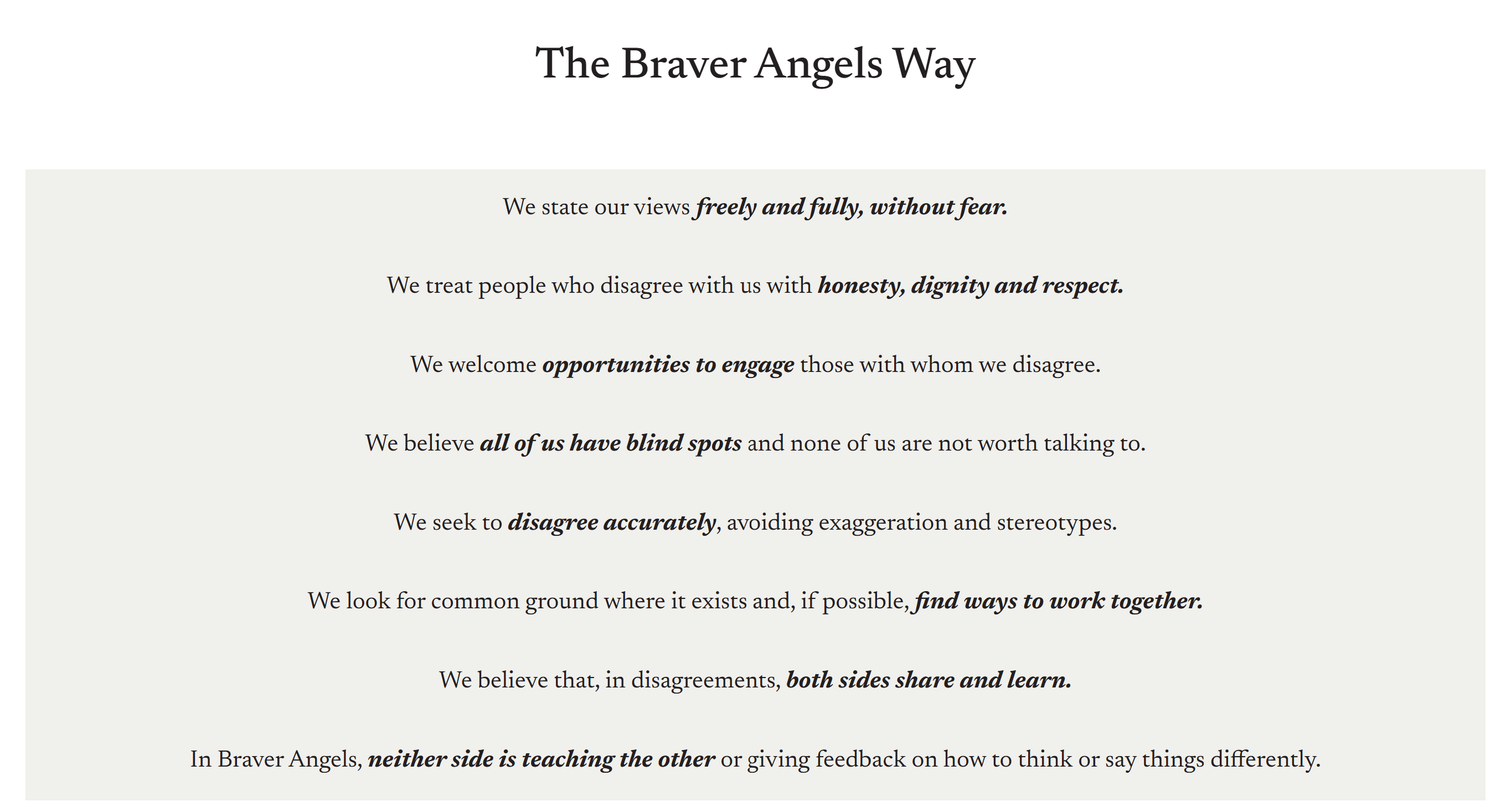
A podcast on the old Soviet dissidents like Alexander Solzhenitsyn and in particular Vaclav Havel came up in my feed today. They are extreme examples, but it can be scary and takes some courage to stay true to yourself when in the company of "bridge pushers" or people who sound like bridge pushers and could potentially cause you pain, social or more serious.
I probably have a bit of an outlier personality, since I was young I would often say the true thing rather than the social thing. If you do get pushed, know that others have been pushed too and you won't be alone in your new reality. Know also that its quite possible to find yourself in the echo chamber of those who have been pushed off the bridge.
 person
Talking outside the echo chamber
Recently I have been finding that discussions with old-timer sannyasins who still believe that Bhagwan was enlightened and could do no wrong take a turn towards “do you still use the name Bhagwan gave you” or “do you still feel gratitude towards Bhagwan”. To answer these questions honestly then creates a certain conflict in worldviews, but I think it’s fair to give an indication of where my truth lies. If on the other hand I am not asked, then I tend not to open this discussion.
It’s kind of a parallel to discussing Buddhism with people of other faiths. Any discussion of faith between friends tends to turn around tolerance and mutual respect, if you go down the route of trying to convince the other that your faith is better you may well end up with a serious disagreement. So how you approach this requires some sensitivity.
But it’s with people who you used to have much in common with that difficulties tend to surface the quickest, because you were once closely aligned. It reminds me of this joke by Emo Phillips…
Once I saw this guy on a bridge about to jump. I said, "Don't do it!" He said, "Nobody loves me." I said, "God loves you. Do you believe in God?"
He said, "Yes." I said, "Are you a Christian or a Jew?" He said, "A Christian." I said, "Me, too! Protestant or Catholic?" He said, "Protestant." I said, "Me, too! What franchise?" He said, "Baptist." I said, "Me, too! Northern Baptist or Southern Baptist?" He said, "Northern Baptist." I said, "Me, too! Northern Conservative Baptist or Northern Liberal Baptist?"
He said, "Northern Conservative Baptist." I said, "Me, too! Northern Conservative Baptist Great Lakes Region, or Northern Conservative Baptist Eastern Region?" He said, "Northern Conservative Baptist Great Lakes Region." I said, "Me, too!"
”Northern Conservative Baptist Great Lakes Region Council of 1879, or Northern Conservative Baptist Great Lakes Region Council of 1912?" He said, "Northern Conservative Baptist Great Lakes Region Council of 1912." I said, "Die, heretic!" And I pushed him over.
The thing is, with other followers of Osho you tend to have a lot in common — many shared experiences and a shared set of beliefs. But as a renegade you have said, certain things have caused you to break with that belief. That inevitably leads to a difficult discussion, do your listeners believe you were right, or do they believe you were wrong? It has a certain stake attached to it.
 Jeroen
Re: No Buddhist Quotes
“Doubt is not a pleasant condition, but certainty is absurd.”
— Voltaire
person
Re: Quotes - discussion
The kind of thing I think or say, is if "I were king of the world, such and such". Meaning, yeah this is what I may think about something at the moment, but I'm just one person with a limited understanding and perspective. I'd never say what I think goes, I've simply been wrong or changed my mind enough times now to realize it makes no sense to have strong opinions.
But I suppose I do try to seek the truth, at least in terms of worldly information. Maybe the truth this quote is talking about is more of the spiritual realization sort. In that realm the idea of letting go to allow an underlying luminosity to come forth makes sense.
person
Re: Quotes - discussion
This could also be a generic quotes discussion thread, if you can still alter the topic title, @marcitko…
I think opinions that are lightly held, that you are ready to let go of when the need arises, are less harmful than those that you will passionately defend. But still, the personality is a patchwork of opinions, and it is ‘the coloured glass through which we perceive reality’.
Jeroen
Quotes - discussion
Hello everyone,
Thought we might enjoy a thread for discussing the Buddhist quotes we post in the "Buddhist quotes" thread.
@Jeroen posted:
“Don't seek the truth. Just cease to cherish opinions.”
— Zen Proverb
I wonder if the "cherish" part is important? I ask this because it seems to me that even very advanced and/or realized practitioners/teachers still hold opinions, just maybe in a light and non-attached manner?
Anyway, just a thought to get us started.
 marcitko
Re: Buddhist quotes
“Every tree and every blade of grass will eventually become enlightened.”
— Buddhist saying
Jeroen
Re: No Buddhist Quotes
“If you cannot be at ease with yourself when you are alone, you will seek a relationship to cover up your unease. You can be sure that the unease will then reappear in some other form within the relationship, and you will probably hold your partner responsible for it.”
— Eckhart Tolle
Jeroen