
Best Of
Re: Dementia and Buddism
@33_3 said:
@pegembara said:The dhamma practice is that of letting go. That means the letting go of your thoughts, memories, stories, fantasies etc. They are not a reliable refuge since their very nature is impermanence. They are not what you are, truly.
In the case of dementia, it is more the taking away of those things rather than a letting go.
So perhaps one way to practice is to let go of them before they are taken away.
Be well.@pegembara could you explain how? thanks
Have you noticed that dementia patients have no worries or anxieties about their future?
They don't have any regrets about the past as well.
Isn't it one of the "blessings" of dementia?
If we want to also have a similar freedom from stress, we can't just lose our memories and worries at will without resorting to drugs and alcohol, which are only temporary and come to bite us in the end. The only way to do that is by way of mental cultivation, aka practice.
You don't lose your mind, but what you lose is believing that what your mind tells you is true.
To put in simply, you are not the mind, you are not your memories. Your memories live in you! They are impermanent and can be taken away. They are not you nor do they belong to you! They don't define you. If nothing truly belongs to you, then nothing can ever be taken from you! All the rest are just "dream-stuff".
Re: Modern Trauma
I listened to the podcast today. She's part cultural anthropologist, so there was much discussion of some of the cultural differences between Tibetans and the west.
My personal journey listening to the interview was interesting to me. At first I remembered many of the things I really loved about TB, and then when they started comparing attitudes to western ones I realized how much I have adopted and internalized some of those views. I was heavily involved in my early 20s, a pretty formative time. Then I thought, since then I've listened and read a lot of western people espousing very similar attitudes and realizing since leaving TB and looking for a more western approach I've probably selected for those who hold similar views. Then I'm wondering when they were talking about a "western" mindset just how western is it really. Is the western mind really so homogenous? Are they really just talking about the cultural world they inhabit in particular? With my general interest in science there's a known phenomenon in the scientific community that the vast majority of psychological and sociological studies have been done on young, western, college students and probably doesn't reflect the larger human experience very well.
Anyway, rambling aside, I thought she was interesting and liked what she had to say on the matter.
 person
Re: how to...leave a church or not
It depends what you actually want. Often a religion presents itself as a source of truth, and you get taken in by it and become indoctrinated by the community and ritual, only to discover at a later date that what your heart really wants is to search for truth, love, freedom.
I grew up in the Osho communes of the 1980’s, and for me that was the beginning of a long spiritual path, with some pauses, which took me past Christianity, Osho, Buddhism, Advaita, and other places. Each new stop along the way gave me wisdom, sincerity and peace, and caused me to reflect with increased insight on what had gone before.
Sometimes it is necessary to let go of the old while moving forward with the new, but not always. Sometimes the old just lingers and things move in parallel for a while.
 Jeroen
Re: how to...leave a church or not
That's one of the most beautiful things I've seen you write, @Federica.
Appreciate the share.
 silver
Re: Modern Trauma
@Jeroen said:
Well, there is trauma and Trauma. Some traumas are so strong they shape people’s lives and intrude into the present. What most people have are background traumas, also important because they represent the most traumatic experiences of your youth but not intrusive. Both can be worked with.
I guess I think a different term for the small traumas of life would help. Like discomfort or anxiety, etc. Using the same term for meaningfully different things waters down the more severe traumas, it also elevates the stories we tell ourselves about the degree of hurt we experience.
I dislike the term ‘power’ because it’s actually not that, it just feeds the ego. I think presence is a better word, or perhaps groundedness.
In my metta practice I added a phrase, may all beings be confident, grounded and resilient in the face of life's hardships. I hadn't thought to use the word power, but all of those imply a sort of personal capacity. Though perhaps like the word trauma, power has different connotations depending on how its used and a different word would be better. How do you feel about empower? Or is that too close? Strength? Some connotation of having confidence that one has the internal resources to engage and overcome difficulty.
person
Re: Modern Trauma
Well, there is trauma and Trauma. Some traumas are so strong they shape people’s lives and intrude into the present. What most people have are background traumas, also important because they represent the most traumatic experiences of your youth but not intrusive. Both can be worked with.
I dislike the term ‘power’ because it’s actually not that, it just feeds the ego. I think presence is a better word, or perhaps groundedness.
Jeroen
Re: How is dependent origination different than determinism?
Dependent origination is a nicer way of explaining determinism.
Free will vs determinism
What we believe in is free will?
The choice that is made freely and willingly.
You are free to make a choice BUT you are not free from the consequences of that choice or non-choice.
Everything we choose to do is because we want the pleasure and don't want the pain.
When you choose not to eat that ice cream, was that really what you want or was it because you want to avoid the result?
Dependent origination takes into account of all the factors that led to that decision.
Re: Too much letting go redux
Ask yourself this question.
If you go to sleep tonight and never wake up again, would it be OK?
If the answer is NO, you haven't let go enough!
When this was said, the Blessed One addressed the monks. "Whoever develops mindfulness of death, thinking, 'O, that I might live for a day & night... for a day... for the interval that it takes to eat a meal... for the interval that it takes to swallow having chewed up four morsels of food, that I might attend to the Blessed One's instructions. I would have accomplished a great deal' — they are said to dwell heedlessly. They develop mindfulness of death slowly for the sake of ending the effluents.
"But whoever develops mindfulness of death, thinking, 'O, that I might live for the interval that it takes to swallow having chewed up one morsel of food... for the interval that it takes to breathe out after breathing in, or to breathe in after breathing out, that I might attend to the Blessed One's instructions. I would have accomplished a great deal' — they are said to dwell heedfully. They develop mindfulness of death acutely for the sake of ending the effluents.
"Therefore you should train yourselves: 'We will dwell heedfully. We will develop mindfulness of death acutely for the sake of ending the effluents.' That is how you should train yourselves."
https://www.accesstoinsight.org/tipitaka/an/an06/an06.019.than.html
Re: How is dependent origination different than determinism?
Just a thought.
Dependent Origination is an explanation of the chain of causality which brings one to one's current position/place with all the wrappings and trailings therein. It is not a chain of suffering, although suffering may or will be inclusive in that chain. It merely states, "This is how you got here." However, you, we do have the power to direct our future karma from this point on. Some, we may have little control over, but much we have tremendous control over, as individuals. We each create, each within ourselves, the basic condition of gain, happiness or loss, suffering. We each can choose to fill an immense storehouse of the heart, celebrating this treasure and joy of life. It is a deliberate choice, regardless of outward appearances or perceptions. We see in the real world examples of people who seem to have little but their lives are full of appreciation, wonder, compassion - LIFE. We also have examples of people who seem to materially have a great deal yet are poor in life's being. They can not appreciate what they have in lif and find trinket and baubles to take their mind off their poverty of life.
Your karma is where you are at this moment. Your future karma is under your direction.
Peace to all
 Lionduck
Modern Trauma
For a while I've had a sort of instinctive reaction against some of the ways trauma is being used and talked about today. This 5 minute segment of The Psychology Podcast gets to the heart of my objection. Its not that trauma doesn't exist, its that it gets presented in a way that traps people in a victim narrative, rather than teaching them to grow and learn.
...By going deep into that (trauma) as a victim, they're disempowering themselves and that's a problem, you know. Because then they're not accessing their inner core strength and belief in themselves...
In addition to that a quote of the day on the Insight Timer app came up that related to this. 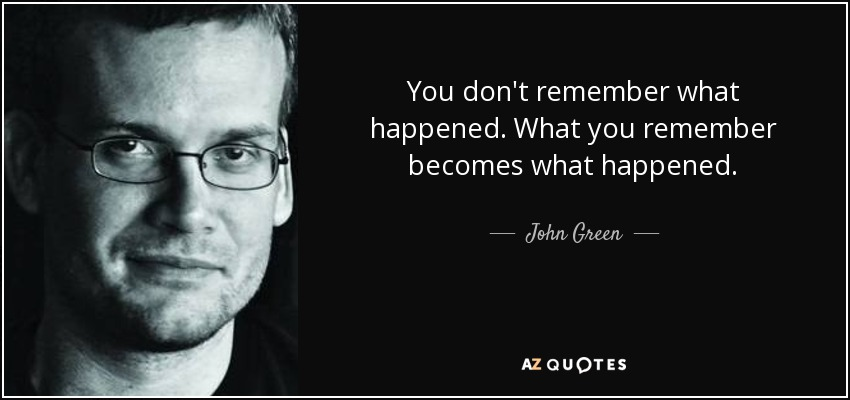
By telling yourself the story that you've been traumatized rather than you've overcome or grown creates a narrative in your mind of what the world is like. A specific example that sticks in my mind was in the Dan Harris interview with Gabor Mate, where he talks about the trauma of his youth leading him to strive and become a therapist. Its a true story, but is that story he tells himself more true than a story of gratitude about your success in life and a desire to let go of the suffering that striving causes any less true? And which story in the present lends itself to a happier more meaningful state of mind?
person