
Best Of
Re: A Buddhist teacher admits ... BUDDHISM HAS FAILED!
Second in the series ...
To save the suffering sentient beings we have utterly FAILED to save, it is time for ...
A ZEN MOON SHOT!
Traditional means rescued me, I hope you, and certainly so many generations of millions of Buddhists ... but what of the BILLIONS and BILLIONS of this world's suffering beings we have thoroughly FAILED to reach? We have broken our vows so far.
Thus, it is time to add to our meditation and twirling beads, looking toward the Zen of the 22nd Century, respecting the past but not trapped in a museum of the 12th Century.
The old methods are powerful methods, they are to be cherished, kept and nourished, but they reach relatively few, failing to liberate the hearts of most. It is time to begin exploration of technology and the laboratory, medicine, biology, engineering, nanotech, genetics and coming advances in neuro-science, all in extension ... never replacement ... of our ancient Buddhist teachings and wonderful Zen practices.
Please take a moment to hear why ...
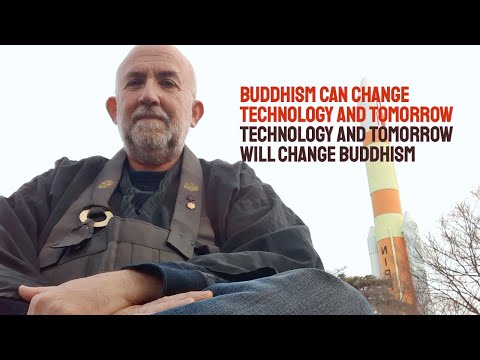
 Jundo
Jundo
Re: A Buddhist teacher admits ... BUDDHISM HAS FAILED!
I think I see where you are coming from Jundo....
As digital communication grows, the Dharma can be spread through online resources like apps and virtual communities, making teachings accessible worldwide.
And with the improved translation technology which is becoming available this can help spread Buddhist teachings to people worldwide by making them available in many languages. This promotes cross-cultural understanding and wider access to Dharma teachings AKA Buddhist wisdom.
And Buddhism's values can influence how we use and develop technology, promoting well-being and ethical responsibility.
Digital Dharma...The shape of things to come...
 Shoshin1
Finding freedom in the words of the enlightened
I have started a little light spiritual reading again, picking up my search for the words of the enlightened, and I have started with a contemplation of why exactly I read them. It is not because of…
- A search for enlightenment. I have come to realise that the spiritual is a unique path, and if enlightenment comes it comes of its own accord like a gift from the universe. Really it is more about meditation. “Sitting silently, doing nothing, spring comes, and the grass grows by itself.” As Osho said.
- A need for progress in a spiritual sense. In reality, there is no progress, we are already that. It is just that we are fooling ourselves by identifying with all kinds of small, limited things.
- A need for a firm path. Wanting to be a Buddhist or belonging to any religion betrays a deeper insecurity, a fear that others know more and that you are better off following in their wake. But truly, once you start on the inward journey, you find that your path does not agree with their path, and you have to let go of where you started out in order to walk your own way.
It all turns around freedom and an increasing maturity, and the words of the enlightened help us free ourselves from those places where the mind has been fooling us. The mind picks up all kinds of little pieces of knowledge during childhood and bases beliefs on that, it becomes embedded in a personality structure, and it’s only later when you hear Ram Dass talk about the masks we wear that you find out it is all delusion and hearsay.
In the Tao Te Ching it says “The man of knowledge learns something new every day, but the Man of Tao lets something go every day.” The words of the enlightened help with this letting go, they destroy your questions, your preconceptions, shake your mind to its very foundations until you realise you’re not that either, that all your thoughts are impermanent and that you have gotten into the habit of grabbing onto them.
Then you become a Watcher, you let go of judgment, of action, of being a doer. And every morning you come across these things in the stages of waking up, in that moment between sleep and awake, following which comes the blessing of the morning. Today is a good day.
 Jeroen
Re: A Buddhist teacher admits ... BUDDHISM HAS FAILED!
If you can explain Dharma in English without using foreign language terms or even the word Buddhism, while making clear its obvious benefits, then you may have something that will catch on. I think that was the great benefit of mindfulness based stress relief, that it presented mindfulness as something new, fresh, without baggage and beneficial. And that is why many therapists got on the bandwagon and promoted it.
Jeroen
Re: A Buddhist teacher admits ... BUDDHISM HAS FAILED!
Idle interruptions from a zafu.
Yes the title of your thread is bombastically eye-catching but this is understandable from a marketing outlook when having to compete with a million other Buddhist books.
I certainly don't envy any Buddhist author on their new book launch on Buddhism's failures, trying to assert that no spiritual materialism was involved in the making of it, because no profit from it accrues to the author. Of course, fame itself is a profit that bests any material profit.
I do not know you personally, (although I have referred other seekers in the past to your site) and so am not accusing you of the above. I only marvel at how difficult a practicing exercise it must be to labor over such love without becoming entangled with its outcome.
From this zafu's view, the world is little more than a stage where karmic inertia continually arises and departs, from former states of congealing to their latter states of dissipation.
The Buddha only offered the means of lessening the attachments and corresponding sufferings that any actor might experience of this stage's karmic chaos.
Expecting Buddhism to be something more than that, or judging it by worldly views as a success or failure, can be a classical defense of one's own spiritual materialism.
Vows can be just as bombastic but in the end, are simply an expressed hope of furthering selflessness over selfishness. I think that the quantifying of such balances are better left to the practitioner observing themself than to the world as a whole. I remind myself sometimes of all that the Buddha chose not to teach about because he said it just didn't apply to ones walk along the path towards suffering's cessation.
In Gassho
 how
how
Re: A Buddhist teacher admits ... BUDDHISM HAS FAILED!
Maybe your claim is intentionally sensational to grab attention? In my mind I was asking, what is the counterfactual? What would the world have been if there was no Buddhism? Its an unanswerable question.
My other main thought was this may be a pitfall of transferring the Dharma to the west. The western mind tends to be more externally directed. Buddhism is an internally driven path. Judging the success of Buddhism by how much of a pure land our world is, I think, misses the mark.
I also worry about becoming authoritarian in the pursuit of perfecting the world. If people don't willingly go along with your plan to make their lives better, how much will you compel them "for their own good"?
 person
Re: A Buddhist teacher admits ... BUDDHISM HAS FAILED!
I think Jon Kabat-Zinn's work in bringing meditation to the masses has been a powerful move in this direction. Also, I've long followed the Dalai Lama and his meeting with scientists in the Mind and Life conferences. I think that is also a way Buddhism has made efforts at easing the suffering in the world.
I think what is getting under people's skins here is the "Buddhism has failed" slogan. In my opinion its hyperbolic and a symptom of a problem in the culture at large, that of sensationalism and playing to our baser emotions.
A young girl was walking along a beach upon which thousands of starfish had been washed up during a terrible storm. When she came to each starfish, she would pick it up, and throw it back into the ocean. People watched her with amusement.
She had been doing this for some time when a man approached her and said, “Little girl, why are you doing this? Look at this beach! You can’t save all these starfish. You can’t begin to make a difference!”
The girl seemed crushed, suddenly deflated. But after a few moments, she bent down, picked up another starfish, and hurled it as far as she could into the ocean. Then she looked up at the man and replied,
“Well, I made a difference for that one!”
person
Re: A Buddhist teacher admits ... BUDDHISM HAS FAILED!
@Jundo said:
But I do not believe that the mission and Vow to rescue all sentient beings, though numberless, is yet done. Do not only look "internally," but outwardly too ... beyond in or out.
I think you can’t rescue those who don’t want to be rescued. The most you can do is make sure they know of the possibility of inner peace and freedom. Many people are too busy living the lives that society sets out for them — partner, house, children, career — and they don’t even know of the Dharma.
Certainly it’s always going to be the case that some portion of the population is going to choose not to engage with the Dharma, and so you could say that the mission to rescue all sentient beings is a never ending treadmill. If you look at the Christians they have a long history with proselytising and missionary work, and they work on the desire for pleasure (“heaven”) and the fear of pain (“hell”), and many of those people aren’t necessarily benefitted by a new religion.
The Dalai Lama once said, “don’t become a Buddhist, but become a better whatever-you-are”. He doesn’t feel that the only path to inner peace and freedom is through the Dharma. People becoming Buddhist may separate them from their family who think they are no longer ‘saved’. The whole impulse to rescue people is suspect.
Jeroen
Re: A Buddhist teacher admits ... BUDDHISM HAS FAILED!
I watched the whole video. The premise here seems to be that there aren't enough Buddhists in the world, despite all those centuries of vigorous bead twirling, so Buddhism is a failure. But it's going to be OK, maybe, because now there are iPhones, and also we can buy this new book.
$
Whether selling your book on this site is appropriate is for others to determine, but I do have a few questions. Let's say there are some 500 million Buddhists inhabiting the planet. Maybe that's not enough. But there are fewer than 1 million physicists. Is physics therefore a failure? Is it failing 500 times worse than Buddhism is? Should we try to sell more physics books?
Is spreading to more and more people the measure of success? I think it might be a more useful metric of "success" for cancer than for Buddhism.
Lest this sound flippant, I am actually perfectly sincere in the perspective I'm presenting. Our amazing world is rich rich rich in ideas, the ideas within Buddhism being among them. To me, success is ACCESS to those ideas. Think about it: Buddhism has been preserved and amplified over the centuries. Centuries! Seriously, that's a miracle to me. We don't have to all adopt Buddhism. But if we'd never heard of it and couldn't explore it and think about it and incorporate the parts we find inspiring or useful, then THAT would be a failure.
Peace, brother.
Steve_B
Re: A Buddhist teacher admits ... BUDDHISM HAS FAILED!
After some years away, I come back to see a statement the "Buddhism has failed". As far as I can tell, failure can only arise when some sort of success is aimed at. What, I wonder, is the "successful outcome" enshrined in the Dharma? As far as I can see - and my vision is, admittedly, limited, any such outcome is personal. It cannot "fail", it can only carry on from here until rebirth ends.
I hope that an image from Christian iconography does not offend but I am reminded of the Stations of the Cross where Jesus falls over and over. The point is that he gets up again.
