Best Of
Re: The Medical Model of Mental Illness
Seeing the video set me on a path and another good piece I came across is this one from the Atlantic.
I WAS WRONG ABOUT TRIGGER WARNINGS
Has the national obsession with trauma done real damage to teen girls?By Jill Filipovic
My own doubts about all of this came, ironically, from reporting on trauma. I’ve interviewed women around the world about the worst things human beings do to one another. I started to notice a concerning dissonance between what researchers understand about trauma and resilience, and the ways in which the concepts were being wielded in progressive institutions. And I began to question my own role in all of it.
Feminist writers were trying to make our little corner of the internet a gentler place, while also giving appropriate recognition to appallingly common female experiences that had been pushed into the shadows. To some extent, those efforts worked. But as the mental health of adolescent girls and college students crumbles, and as activist organizations, including feminist ones, find themselves repeatedly embroiled in internecine debates over power and language, a question nags: In giving greater weight to claims of individual hurt and victimization, have we inadvertently raised a generation that has fewer tools to manage hardship and transform adversity into agency?
...Applying the language of trauma to an event changes the way we process it. That may be a good thing, allowing a person to face a moment that truly cleaved their life into a before and an after, and to seek help and begin healing. Or it may amplify feelings of helplessness and hopelessness, elevating those feelings above a sense of competence and control.
“We have this saying in the mental-health world: ‘Perception is reality,’ ” Jain said. “So if someone is adamant that they felt something was traumatizing, that is their reality, and there’s probably going to be mental-health consequences of that.”
Martin Seligman, the director of the Positive Psychology Center at the University of Pennsylvania, has spent the past 50 years researching resilience. One study he co-authored looked at the U.S. Army, to see if there was a way to predict PTSD. Unsurprisingly, he and his fellow researchers found a link to the severity of the combat to which soldiers were exposed. But the preexisting disposition that soldiers brought to their battlefield experiences also mattered. “If you’re a catastrophizer, in the worst 10 or 20 percent, you’re more than three times as likely to come down with PTSD if you face severe combat,” Seligman told me. “And this is true at every level of severity of combat—the percentage goes down, but it’s still about twice as high, even with mild combat or no obvious combat.”
In other words, a person’s sense of themselves as either capable of persevering through hardship or unable to manage it can be self-fulfilling. “To the extent we overcome and cope with the adversities and traumas in our life, we develop more mastery, more resilience, more ability to fend off bad events in the future,” Seligman told me. “But conversely, to the extent that we have an ideology or a belief that when traumatic events occur, we are the helpless victims of them—that feeds on itself.”
Seligman also found that some soldiers who experienced severe trauma could not only survive, but actually turn their suffering into a source of strength. “About as many people who showed PTSD showed something called post-traumatic growth, which means they have an awful time during the event, but a year later they’re stronger physically and psychologically than they were to begin with,” he said. But that empowering message has yet to take hold in society.
...Most of the experts I spoke with were careful to distinguish between an individual student asking a professor for a specific accommodation to help them manage a past trauma, and a cultural inclination to avoid challenging or upsetting situations entirely. Thriving requires working through discomfort and hardship. But creating the conditions where that kind of resilience is possible is as much a collective responsibility as an individual one.
If we want to replace our culture of trauma with a culture of resilience, we’ll have to relearn how to support one another—something we’ve lost as our society has moved toward viewing “wellness” as an individual pursuit, a state of mind accessed via self-work. Retreating inward, and tying our identities to all of the ways in which we’ve been hurt, may actually make our inner worlds harder places to inhabit.
“If everything is traumatic and we have no capacity to cope with these moments, what does that say about our capacity to cope when something more extreme happens?” Ungar said. “Resilience is partly about putting in place the resources for the next stressor.” Those resources have to be both internal and external. Social change is necessary if we want to improve well-being, but social change becomes possible only if our movements are made up of people who believe that the adversities they have faced are surmountable, that injustice does not have to be permanent, that the world can change for the better, and that they have the ability to make that change...
Sorry if I pasted a lot of the article, it was hard to find an essence without taking it out of context. The article has more in the way of solutions and nuance.
 person
Re: Accentuate the Positive or Eliminate the Negative?
@IdleChater said:
@person said:
Is one way more beneficial such that we are justified in advocating generalized advice to adopt one over the other?Why do either? Anything, you do, like accentuate, or eliminate, gives rise to karma. Karma results in suffering and rebirth.
Why not the cultivation of equanimity instead?
Really I'm about synthesis and balance. My predisposition is from one direction more than the other. One I think its important to acknowledge where your bias is and two, in the world of the pointing finger, precision of language and ideas helps point us in the right direction. Maybe it isn't helpful for everyone but I find juxtaposing the poles helps me find the place of integration.
And yes, ultimately transcendence of the dichotomy is the goal.
person
Re: Accentuate the Positive or Eliminate the Negative?
@marcitko said:
However, working simultaneously on eliminating one negative thing and accentuating one positive thing seems to also work for me - maybe the positive thing gets positively fuelled by the released/alchemized energy of the eliminated negative thing?
I like that, it kind of help solidify a related thought I'd had. In my experience a focus on the positive leads to a wasting away and eventually a falling off of the negative. I imagine the reverse might also be true, by unraveling the negative it stops acting as a mental drag and gives more energy to the positive?
person
Re: The Medical Model of Mental Illness
Absolutely. Do you know the website Mad in America? There are a lot saner perspectives on mental health out there, rather than what psychiatrists are taught as medical doctors.
Also I’d point out that the “chemical imbalance” theory of mental illness has long since been disproved — basically when you ask a specialist whether they have ever found the chemical that is imbalanced, they end up admitting that no, actually they didn’t find that. It is just a short explanation that survives because it’s easy.
Again, diagnosis is just a shorthand for a bunch of symptoms. For a lot of mental health issues it is much more relevant to ask a patient about what happened to them. The story of what affected someone’s life can be much more revealing than just a list of symptoms.
 Jeroen
The Medical Model of Mental Illness
I came across this video describing the way we've moved to a medical model of mental illness and how, though well intentioned, is showing down sides. I think I've been having this sense that the way I hear many people talking about mental illness these days that something was off. I've now spent more than half my life meandering along a spiritual path and learned time tested Buddhist approaches to addressing issues of mental health before being introduced to western psychological thinking.
Anyway, like the video, I'm not outright negating all of western psychology in its current forms. Its just saying that we're still learning and there is an unintended consequence of learned helplessness in the way people are relating to their mental illnesses. Rather than say you have depression or are depressed, say you are experiencing depression. The last option holds out the possibility for change and allows for positive growth.
person
Re: All things Sport(s)
Dutch football’s classic match between Ajax and Feyenoord was abandoned a little after the halfway point when fans started throwing fireworks onto the pitch… Feyenoord were leading 3-0 at the time. I’m sure Ajax will get some repercussions from this, and they were already having one of the poorest starts to a season in living memory.
Jeroen
Re: Letting go of games
More questions?
Is life not like an Adventure game itself? Were we not all originally born with a blank mind? Is not the object of life to acquire the knowledge so that all of what we do and what we say is successful, works for us. When things work well are we not rewarded with feel good? And when we fail, and our doings and sayings are not working for us, are we not punished with feel bad? Is the object of life not to get passed failures and turn those into successes? Are there not winners and losers in this game?
If life is a game itself and games are fun, why not just play that one?
Pete.

Re: Distress vs Eustress
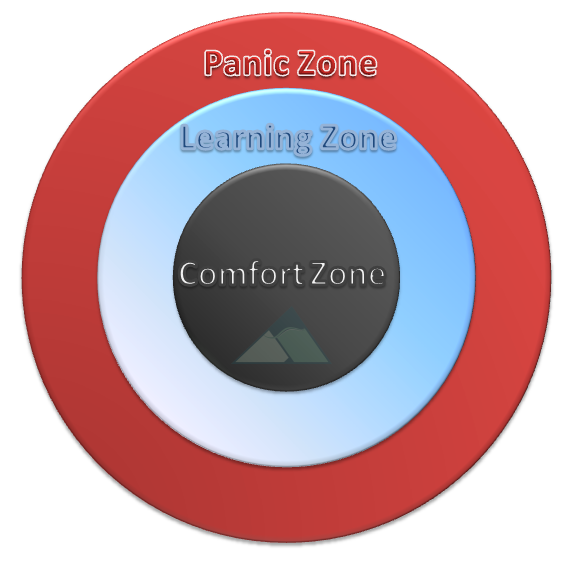
Comfort zone - the realm of the Gods: enlightenment is not possible.
Panic zone - the hell realms: enlightenment is not possible.
Learning zone - the middle way and the rocky path to enlightenment.
 Fosdick
Re: Letting go of games
I’ve just been revisiting this thread, there are a lot of good posts in it. It surprises me that it just took an invitation from my cousin to turn all the talk of game ethics on its head and suck me back in… Phew, close call.
I think you’re right though @person when you talk about the dangers of disaffected males. Society is not well structured as it is, I’ve just read Gabor Maté’s book The Myth of Normal: Trauma, Illness and Healing in a Toxic Culture in which he talks about some of these things.
@FleaMarket said:
Here in much of the US people are not looked upon by leaders and peers in a positive way. We are often referred to by our own government as consumers, by our own bosses as liabilities and expenses, and the depth of our connection to friends is measured based on what value we can provide to them.
I think in a way those disaffected people still find much value in games, where they can be heroes and saviours of the common people. It’s one of the good things that games are still doing for society, keeping things from boiling over.
The thing is, does it turn into gaming addiction, with a lot of the accompanying symptoms of social isolation, long hours behind screens, poor diet and physical problems? That is also not an ideal way to live, and only a short distance to an opioid addiction.
The only option I keep returning to which holds any real value is going forth.
For me it is what connects me to the spiritual path. The pursuit of truth, freedom and happiness is ultimately much more important than games. And even now, twelve years later, I still feel the effects of my breakdown back then, I’m not as healed as I thought, still more sensitive to a lot of things than I was when I was thirty.
Jeroen