Best Of
Direction and the Path
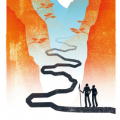
We often refer to being "on the path", or "advancing along the path" and other phrasings that indicate a sort of point A to point B paradigm at work.
I wonder if this is a less than ideal outlook.
It's nearly impossible to live in the world without some kind, of duality in thinking - good/bad, on/off, right/wrong, yin/yang, yes/no, self/other, Lobster and serious ( JK, Lobster  ), and that sort of thing. Put another way, distinctions.
If we read the Heart Sutra, we can draw from it, the distinctions we rely on, even with attention paid to The Path, are in emptiness, without any real substance. Any effort to act upon those distinctions would then be futile. That's not to say that the N8FP is futile, but to view The Path as something that involves effort & progress, may very well be.
So what's left, if trying to stay on The Path, is futile? Well, we have our practice. With Shamatha, we calmly abide in the present. The distinction of being on or off the path, or headed in a right or wrong direction, becomes unimportant. Irrelevant perhaps?
Re: “502” error on this site
We had the same problems with the server backups taking up too much disk space. I got it running again but the underlying problem maybe isn't really fixed, so if it happens again just be patient and I'll kick it back online as soon as I notice. It's not a serious problem, just inconvenient that it keeps cropping up.
 Linc
Linc
Re: Direction and the Path
I really like the yin/yang depiction of duality. The form it takes has meaning, its not simply one side light and one dark. They flow into each other, increasing and decreasing. The view it represents isn't meant to be a binary even though the terms of each are binary. And the dot in each points to the fact that each contains the seed of the other within.
The yin yang symbol represents the interconnectedness of the world, particularly the natural world. There can be no positive without a negative, no open without closed, no light without shadow. The yin yang symbol itself portrays that interrelatedness. Looking at the symbol, you can see it doesn't have a straight line going through the center to represent the divide between yin and yang. Inside, the dividing line is a soft S-shape. It shows how yin and yang are connected and constantly flowing into and out of each other. At the top of the symbol, as yang swells, yin contracts. At the bottom, yin swells as yang contracts. The ideal situation is when there is an equal balance between the two, as that is when harmony is achieved.
In a similar way the path isn't some direct, linear progression that at one moment one isn't in and the other they are. The "Path" meanders, expands and contracts, moves forward and back.
Some systems of Buddhism kind of start at the end and ask the follower to familiarize themselves with that state. Others move gradually along, increasing the capacity of the practitioner along the way until they are ripe for deeper teachings. Each seem to have merit and some paths, I'm sure, are more suited to some than others. The best medicine is the one that treats your specific ailment and is the one you will actually take.
I'd also add that the Buddha advised us to leave the raft behind once we crossed to the other shore. The point of the path isn't the path itself, the point of the techniques we use aren't the techniques themselves. Once you're able to add 7 and 12 together in your head, no need to continue counting them off on your fingers.
 person
Re: Direction and the Path
The metaphor for the path that I’ve grown to like is “a gradual unfolding and revealing”. Generally with enough insight the Buddhist path is like a flower that opens, you see more and more as you move through the process, you don’t really need to do anything but to keep looking and adjusting normally to what you see. Not sure if that gets you where you want to go but it is what seems to be happening to me.
 Jeroen
Re: Healthy Habits
Most of the time we need to learn the techniques before we can forget the techniques and be creative. Its possible to jump right in from the start and make something valuable and unique but we can also spend all our time recreating the wheel.
Like anything though we can interact with the teachings, or habits rigidly or creatively. People have differing dispositions and will benefit variously, depending as well on where one is on their path, rather than there being one true way for all people at all times.
person
Re: Healthy Habits
@Shoshin1 said:
I see practicing the Dharma as a form of mind training/sharpening ones skills( or if you like real intelligence) so to speak ...nothing more ...nothing less....
I think zeroing in on real intelligence, as Shoshin is doing here, is a very important point.
But real intelligence is really not so easy to define, and I think lack of clarity in the definition leads to some of the disparities in thought/expression we're seeing in this conversation. But I think we'd agree that intelligence and creativity are two different things. Even if we can't define them with precise semantics, I think we all understand the difference between them.
And it's that word, creativity, that I think belongs in some of the thoughts above. If I were to take rigid disciplined training in a specific realm, assuming that I would be inclined to put up with such, then I think intelligence would help me in the training, or at least not hinder the training and not be impacted/reduced by the training. But creativity, on the other hand, would more likely be vulnerable to training, in a negative way. If I am trained "do it THIS way" or "think about it THIS way" then that is mutually exclusive with creativity but synergistic with intelligence.
I'm not saying formal training is bad; quite the contrary. In many many instances it is the only viable path. For example, many decades ago I trained in calculus. I didn't CREATE calculus of course; I'm not Newton or Leibnitz. Calculus was very well developed, and the methods of teaching it highly refined, long before I ever walked into that classroom. My task was simply to become schooled in its ways.
Some marvel that The Beatles were able to create such rich beautiful music despite a complete lack of music training or even the ability to read and write notation. But The Beatles themselves said that their creativity was specifically BECAUSE of their lack of training. No formally trained musician would ever have started that staccato Em violin riff in Eleanor Rigby with an A on the downbeat. We have that beautiful piece in our world because of creativity and a lack of training.
I don't think there's a universal Yes or No whether training is valuable or desirable. It depends on the desired outcome. If I want to create a grand painting in a new style all my own, and I have a vision of it in my head, then I'm not going to put up with you standing next to me telling me how to blend the colors on my palette. On the other hand, if I want to pass the geography exam, then yes, please do tell me all the questions that will be on the exam, and all the answers, and I'll memorize them before the exam; no creativity needed. Thank you professor.
So, how does this apply to Life? I think the Middle Way is for when you just want to get peacefully down the path without abrading your shoulders on the fringes. De-dukkhanate your vocabulary, stay on the centerline, keep smiling, lay off the late parties and intoxicants, and get a haircut. I think for most of us, this is the best path for most of the things we encounter. But if you want to BUILD a path, rather than be guided down the old one, then don't let yourself get molded by rote. Bump into walls. Bash through them. Revel in the ecstasy. But you won't want to do this for everything (some people won't want to do it this way for ANYTHING). For most things, just listen to the shaved-head guy in the robe, and things will go more easily. He is passing the wisdom of the centuries on to you. Heed well.
 Steve_B
Re: Healthy Habits
Where some find joy in a structured garden, others find it in the wild mess. Weeds to some, flowers to others. In the end, on this planet, Mother Nature trains all.
Today I don't think structure is for me. Though I find those who keep it admirable.
Re: Healthy Habits
Discipline is freedom. Flexibility is freedom: rising early, sleeping enough, eating well, exercising regularly (or at least keeping active) and meditating daily. Sounds as clear as water being essential for life!
Some people might do otherwise and lead great and happy lifes, but the following guidelines are a good starting point.
Some people will benefit, some will not.
This is our world. Nothing constant, constant change; yet amongst all these waves a few regularities do arise.
 Kotishka
Re: How to die?
Dying is easy.
How to live without suffering is the hard part.
Quoting Mark Twain-
I do not fear death. I had been dead for billions and billions of years before I was born, and had not suffered the slightest inconvenience from it.
Re: Buddhist quotes
"Zen always aims at grasping the central fact of life, which can never be brought to the dissecting table of the intellect"
~DT Suzuki~
 Shoshin1