
Best Of
Re: Differentiating between necessary and unnecessary
@FleaMarket said:
Good question @Nugai. I'm unsure of their necessity in existence though I am sure that practice aides in their reduction and eventual cessation. A thought occurs to me, are we only aware of existence due to such things in the first place?
Well this is what I was thinking. Thich Nhat Hanh often has this saying, "No mud, no lotus". In other words in order to know joy, we must have suffering. In order to be compassionate with must know pain. If delusion and attachment didn't exist, there would be no mud, therefore no lotus. Just my current thinking!
 Nugai
Nugai
Re: Differentiating between necessary and unnecessary
Dear friends of new improved 'concentrated Buddha' (now with added dharma),
There I was in a continual and eternal and relaxing ignorance … when I realised 'ignorance is bliss'. Or…
'Samsara is Nirvana'
Which came first the chicken or the egg? And how does an egg get to the 'far shore' of the for sure road?
Answers to the usual address for a chance to win our open prise drawer … 

 lobster
Re: Just for fun: the random, useless announcements thread!
I'm welcome @yagr
… most of us are … as long as our intentions are nibble … eh noble/pure/good
In dharma 'Mind' includes emotion … and much more. Our sphere of experience, body, projected and interpreted, instinctual reactions, subconscious motivations, speech and sensory awareness, intuition/gut feeling etc. All 'Mind'.
Never mind is where we are headed or rather 'be' headed.

lobster
Re: Ego must go
If I follow the emotion experienced I encounter feelings such as frustration and concern.
The emotions have a mind of their own, so too the body. So too the subconscious. In one sense it is 'all Mind'.
There is also
a superconscious/integrated/emptiness/stillness/God mode/Buddha Nature/
… many names, ultimately 'nothing special' … and yet …
This too comes and goes, ebbs and knows, flows away and into an emptying ocean of wonder …
lobster
Re: Differentiating between necessary and unnecessary
One thing you are looking at is mind… all the elements that are unnecessary are in the mind, they are conjectures, figments of thought, misunderstanding. What you are trying to arrive at is a correct understanding of truth, which can be defined as “that which is”. A very worthy effort, to remove the things which are delusion, and to keep the things which are true.
In a way, when looking at the truth as “that which is”, everything that is, is necessary, and everything that is not, is unnecessary. It is tempting to consign the contents of all human minds to the “is not” column.
 Jeroen
Re: Ego must go
@FleaMarket said:
@Jeroen said:
It is said, the mind is just your thoughts, or the ego doesn’t exist.I had not heard this line before but it connected with me in a way that begs further investigation. Seeing the ego as non-existent or in the same realm as thoughts is rather relieving and fits in to other elements floating around in my understanding.
Yes, it rather struck me the same way. “The mind is just a bundle of thoughts” was what I came across, and the ego is an illusion, a distortion made up of past disappointments and injuries.
It rather supports a view that has been forming in me that as children we are much closer to the source of life, the original being, the luminous nature. Then as we live trauma’s slowly accumulate and make us what we are later in life, wiser but no longer as innocent or pure.
The task of a spiritual seeker is to make supple again what has hardened, to remove blockages so that life’s juices can flow, to cherish the things in us that have been damaged, to stay close to loving and laughter.
Jeroen
Differentiating between necessary and unnecessary
I had a reflective conversation with myself today after listening to a bit of H.H. the Dalai Lama's "How to See Yourself As You Really Are" on my morning walk. I want to see if it holds up so I'm submitting it to the group for help with examination and assistance.
Q: If all existence dependently arises from causes and conditions, and the definition of necessary is that which is unavoidably determined by causes and conditions, when is there ever a thing which is not necessary?
A:That which arises through misconception of things existing inherently in and of themselves is not necessary. Ignorance is not necessary. Delusion is not necessary, attachment is not necessary, the hindrances are not necessary. The identification of one thing apart from other things is not necessary.
Q: How then does one become continuously aware of these unnecessary elements in all aspects?
A: One becomes continuously aware of these unnecessary elements through practice. Specifically practice of sustained concentration and practice of deepening insight into the nature of things. The deeper one's insight into the nature of all things and the greater one's sustained concentration, the more readily one can see that which is necessary and that which is not necessary.
Q: How then does one practice sustained concentration and deepening of insight?
A: Practice of sustained mindfulness of an object such as breathing builds sustained concentration. Practice of sustained concentration and investigation on a specific object deepens one's insight into the nature of that specific object.
I should mention this dialogue comes from my own self still ignorantly trying to determine what I should be doing other than what I am currently doing and being unable to yet see beyond this obstacle.
Thank you in advance for any insights and discussions.

Re: Ego must go
Ego must go
Thus have I heard...
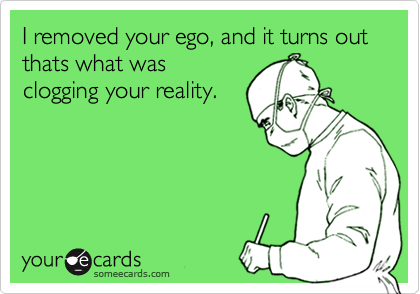
"By trying to get rid of something, one is unconsciously granting it reality"
Which reminds me...
"One is simple one's experience...
One's ego is the abstraction from these experiences...
One's ego should be viewed as a convenient analytic device"
Hmm The Ego...Can't live with it ...Can't live without it there has to be another middle way...
 Shoshin1
Re: Ego must go
@FleaMarket said:
Not knowing when to act, when not to act, and what to act on and what to not act on is giving me quite a headache lately.
That is true. It is easy to say, not too lose, not too tight, but in reality there are a number of different factors that come into play, such as the right amount of determination, being able to set aside the impulses various hindrances generate, and so on. It is an accumulation of progress on the path to reach the point where the analogy of the strings on a musical instrument even makes sense.
What I would say is being relaxed, doing one thing at a time and observing whether that was beneficial or not is generally a better approach then trying to do three things at great speed and getting confused about what’s happening. Go slow, one step at a time, like a walking meditation. And don’t forget, more often than not easy is right.
Jeroen