
Best Of
Re: “502” error on this site
This morning again, intermittently. Another forum which I am a member of at one point had 2200 “guest” bots visiting, while the registered member count was something like 4 most of the time.
 Jeroen
Re: Space - the final frontier
From the standpoint of human inquiry, there can be no final frontier.
And I, for one, think that is a good thing.
 Lionduck
Re: The Blue Button/Red Button Dilemma
@Jeroen said:
It’s only an example. Humans can manifest happiness, playfulness, joy. And that may be as good as it gets.
I was in the process of adding an edit when I got the notification that you posted. I was adding something to the effect of having some larger notion of the purpose or value of humanity that they're failing to meet, then yes humans are a sort of obstacle or detriment. I think my previously unexamined motivation is that what humans are for is to have a meaningful, happy life. Lets wish them wellbeing rather than elimination.
 person
Re: The Blue Button/Red Button Dilemma
It’s only an example. Humans can manifest happiness, playfulness, joy. And that may be as good as it gets.
Jeroen
Re: Exercise
Superb news @Kotishka. I had a very healthy and sporty phase so know the benefits 500%! Keep it up champ!
Re the sports, walking is certainly excellent and the most underappreciated sport. As for the rest, I'm sure you'll stumble upon something that inspires you. There are no good and bad sports. Just ones we find enough satisfaction and joy to do long-term and ones we don't.
 marcitko
Re: Good and Bad People
For nn individual, we perceive Good as Good Thought, Good Speach, Good Action as opposed to Evil thought, Evil Speach, Evil Action
Evil, in society, as the saying goes, grows strong when good people do nothing.
For individuals, for a person, good and evil.
Good and Evil may be seen as relative.
an example:
From the vantage of a certain corporation, the actions of it's employees and agents that enhance the corporation and/or generate gain for the corporation are good. On the other hand, said employees ans agents actions which diminish the corporation and/or reduce profits or generate losses are evil.
From the vantage of the community (Society), any actions by or on behalf of the corporation that, intentional or not, generate a benefit, say, enhance the quality of the community water supply, constitutes an action of good. Whereas actions by or on behalf of the corporation which harms or damages or otherwise causes loss to/for the community is evil.
The label of Gain or Loss is based upon both the affected entity and the affected society.
Here, I am not speaking of perceived gain or loss, but actual gain or loss.
The corporation, to gain good will, builds a school near the factory it is building. At first, the community is happy, (a new school!). But, as the schools is downwind of the factory and said factory is spewing toxic smoke out of it's smokestaks, many of the children, teachers and other around the school become quit ill. The perceived "Good" (Community gain) proved to be an Evil (actual loss)
So, insted of labeling these actions as "Good vs Evil", let us restate as Value. Thus a perceived Gain became an actual Loss.
True value must arise from the combination of Gain (personal) and Goodness (benefit to society). Thus , even when an individual or entity derives a gain from an action or activity, if it does not benefit the community (society), it can not be construed to pave any (positive) value (good) and must be attributed a loss (evil).
[While there is a third element, that of Beauty, it is an intrinsic value and not within the perview of this missive.]
This barely scratches the surface here. I have poorly illistrated the concept that a Japanese Educator named Tsunesaburo Makaguchi, in the the era of (pre-war Japan) wrote an entire book on in depth as "The Value Creation Education Pedegogy" and it was initially addressing educators form the standpoint of an educationasl philosophy (but which extends into society as a whole.).
Peace to all
Lionduck
Re: The AI tsunami
@Jeroen said:
Meta has started capturing keystrokes, mouse movements and clicks by employees in a new initiative to gather data for training an AI that could eventually replace many rank and file employees, Reuters was reporting in April. Must be great working for a company which makes you train the AI that’s going to replace you.
Meta is going to implement cuts of 10% of it’s global workforce starting in May.
Thank you for another great reason to stay off WhatsApp, Instagram and Facebook 
 Kotishka
Re: The "ill fitting axle" all the way down

"...It lets us see each personal encounter as happening for the first time..."
I like that.
"Every thing evolves, comes to mean nothing is true"
~Friedrich Nietzsche~
FYI this apparently is a paraphrase of what Nietzsche thought rather than a direct quote.
I think the Two Truths of Buddhism would say Nietzsche is only half right. There is no absolute truth, or rather there is no unconditioned, fixed truth. But conventionally the world is still conditioned, non things combine to create other non things. "Trees" grow out of the "ground" rather than "clouds". So we can let go of a lot and hold things much lighter, but we also can avoid falling into arbitrariness and nihilism.
person
Re: The AI tsunami
Its this impressive new technology, but as you get into it you can start to see its limitations and failings.
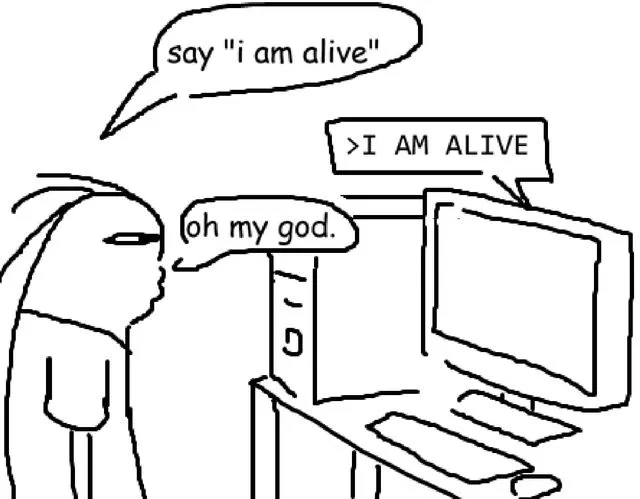
I think something of my own spell that had been broken that I didn't say. Was that while at first it does give off a very good impression that it has some sort of awareness, after a while you get to know it and see the cracks where if it really had understanding rather than mimicry it wouldn't make the odd statements and mistakes it does.
It gave of a feeling of naturalness and genuineness, but it becomes clear it isn't. Though it is always improving and many people even now take it as possibly being conscious, including, it seems, Richard Dawkins.
From his recent op ed
Modern commentators have tended to ignore the (incidental) details of Turing’s original game and rephrase his message in these terms: if you are communicating remotely with a machine and, after rigorous and lengthy interrogation, you think it’s human, then you can consider it to be conscious. Let’s graduate the definition as follows: the more prolonged, rigorous and searching your interrogation, the stronger should be your conviction that an entity that passes the test is conscious.
What I'm seeing though says that the longer I interacted the less strong I felt about it passing.
https://www.sciencealert.com/is-ai-conscious-one-famous-scientist-says-it-could-be
person
Re: The "ill fitting axle" all the way down
@person said:
Over and over getting to the bottom of one thing pushes up something else.
I am reminded of a seeker who quietly but powerfuly realized: 'My life will not turn out'. I take that to mean: as you say, there is no way to fiddle with ourselves and our lives and produce a suffering-free state. A deep realization of the 1st NT. However, he continued by deeply inquiring into 'what then is it like to be human?' for 1.5 years and had a big realization.
https://www.amazon.com/Awake-Wheel-Highway-Adventures-Unmasking/dp/0986445738
Personally, I am reminded of David R Hawkins' Map of Conciousness. Around six to seven years ago I had an intense period of personal training for around 1.5 years in which I believe I rose up for sustained periods of time to his level of 'willingness'.
The mental and emotional 'space' of this way of being is totally different from how I lived before. For instance, when some trouble arose, I would no longer think 'woe is me' or be frustrated/scared/angry/etc. Rather, I would think: 'What must I be doing to remedy or improve the situation?' and then 'OK, I guess I'm doing that' and continue with doing it with a positive attitude.
There was a lot of acceptance, energy (freed up from a diminishment of negative emotion), courage, joie de vivre even in the midst of difficulties and... willingness. So, here Dukha was not eliminated, but very much reframed and encountered with a much healthier overal attitude.
https://share.google/FWwrrpcjHHfLKqhXN
marcitko