Rise Above
 person
Don't believe everything you thinkThe liminal space Veteran
person
Don't believe everything you thinkThe liminal space Veteran
Just taking a moment to hype the new book by Scott Barry Kaufman. He's a Columbia professor of psychology, a very highly cited scholar (nearly 12,000) focusing on intelligence creativity education personality and well-being, long time host of the #1 psychology podcast The Psychology Podcast, author of 9 books including titles like Transcend: The New Science of Self-Actualization, Wired to Create: Unraveling the Mysteries of the Creative Mind, and Ungifted: Intelligence Redefined. as well as a burgeoning professional mentalist.
Its called Rise Above: Overcome a Victim Mindset, Empower Yourself, and Realize Your Full Potential.
An empowering call to reject the victim mindset and become the hero of your life.
Does life feel smaller than it used to? Does it seem that the people around you have taken a step back from doing hard things, preferring to stay in their comfort zone? In the era of TikTok as therapy, it’s tempting to see ourselves as damaged and powerless—defined by our past traumas, our emotions, and the struggles we face. But it’s more important than ever to rise above the limiting beliefs and widespread anxiety that puts us in boxes, lowers our expectations, and holds us back.
In this empowering book, renowned psychologist Dr. Scott Barry Kaufman unpacks the dangerous myths and misleading buzzwords swirling around the popular imagination—revealing the truth about managing our emotions, the double-edged sword of self-esteem, the surprising gifts of sensitivity, and, ultimately, the power each of has to overcome challenges and to shape the course of our own lives.
Urgently needed, Rise Above speaks to what ails us, offering not just empathy, insight, and a dose of humor, but also actionable solutions to own your life and reach your full potential.
Here he is being interviewed by Jonathan Haidt about the book on his own podcast.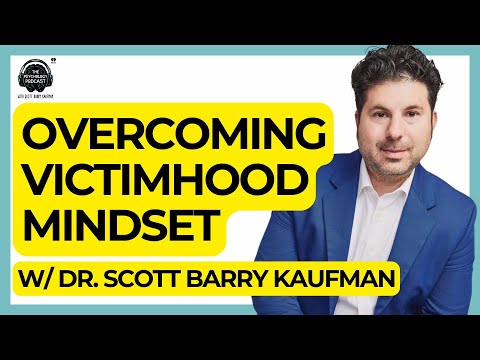
Comments
Hmm. Not sure if I like the title. The idea of empowering yourself to Rise Above the victim mindset to me feels like it applies to a small subset of the public. I think there are very nearly more entitled narcissists out there then people with a heavy victim mindset. Still listening to the podcast.
I'll be curious to hear any thoughts on what they talk about.
They do wander a bit in their subject matter. I thought they talked a bit at cross-purposes, with the interviewer going one way and the subject another. Interesting sections on trauma and the zeitgeist, mental health and ADHD, neurodivergence and so on.
I thought the first review on Goodreads was interesting ( here ) in that it pointed to a kind of right wing narrative in the book, in that all the examples Kaufman uses of the victim mindset are of left wing liberal “snowflakes”. While in effect the right wing has its own victim mindset, looking at for example the idea that if it wasn’t for all the immigrants deserving Americans would be able to succeed better, but Kaufman doesn’t cite those cases.
Of course it is an idea popular with the right wing, that one shouldn’t focus on one’s traumas but should instead be ‘tough and rugged’ and this ties in with the trend towards citing Stoic philosophers, who are often thought to have a similar mindset. I see it as kind of a spectrum, in recovery from a traumatic event there comes a certain point where one has to let go of the trauma, otherwise you start identifying with it and perpetuating the idea of it, and that isn’t healthy.
In short I’m a fan of a certain amount of Stoicism. There should be a healthy balance between the extremes of ignoring one’s emotions, and being so caught up in them that any small disturbance is labelled a ‘trauma’. It is good to be in touch with emotion, to be aware and emotionally intelligent, but it can be taken too far, and it is important to be resilient to stress and life events.
There were some other comments that Kaufman had some more extreme right wing thinkers like Charles Murray on his podcast. It’s interesting, recent discussions here between you @person and @shoshin1 have made me more aware of political bias in the discourse of American influencers and on social media.
I thought that review was pretty spot on. It kind of highlights a point I try to make about how polarization makes things worse. Being in touch with your emotions or looking to outward causes for suffering gets left coded and half of people reject it out of hand, telling someone they have agency to change their life gets right coded and half of people reject it out of hand. Its like we can't have a meaningful discussion about any sort of balance or nuance anymore and people just aren't getting half of the story.
Scott has been doing his podcast for like 10 years now so I'm sure he's had on lots of people. I do remember him having Jordan Peterson on a long time ago, before JP became famous and controversial, I think they talked about creativity. Not sure what he talked about with Murray, SBK is an intelligence researcher so I imagine it was along those lines as that's what Murray is most known for. Knowing Scott I'm sure he challenged him on his race conclusions as he is well informed on the topic.
I need to rephrase. Only like 10%-20% of the population is either far left or far right that are probably engaged enough to have that reaction. The 60%-80% in the middle are better able to take things as they are. The megaphone of social media makes it seem more extreme as it lets the loudest take control of the narrative. But that in turn creates an increasing polarization.
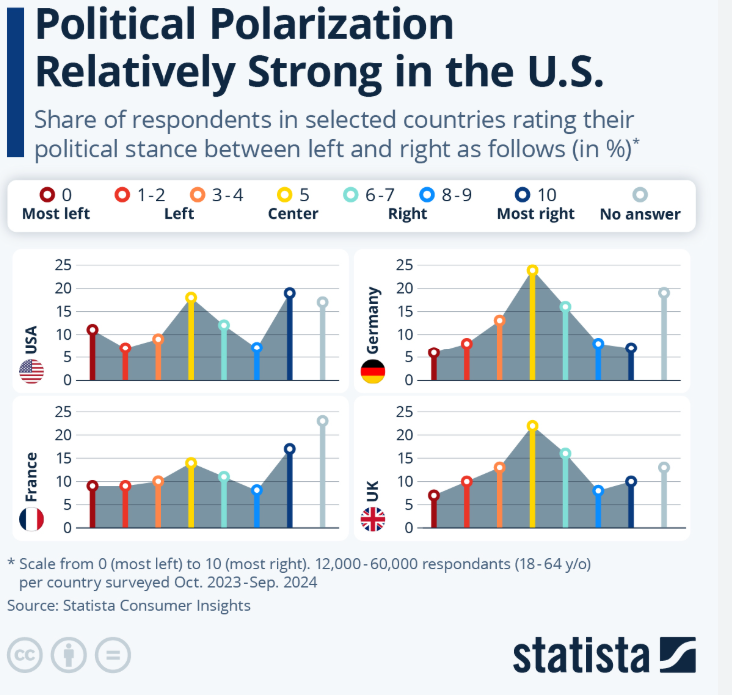
It boggles the mind that there are just as many people who identify as far right as there are centrists in the USA.
And France, and probably Saudi Arabia and Indonesia, maybe India
I used to wonder why so many people held Right Wing positions directly and overtly detrimental to themselves and their families. Then I was unitentionally exposed the one-sided flood of attack ads and deliberte disinformation and misinformation with no room, no space allowed foe any counter arguments or contrary (to the rt wing) messaging of any kind. It waa both a shock and an awakening. It explains much about why people keep voting for candidates and issues that only harm them and never help them.
Almost all of this (in the US) traces back directly to Ronald Regan abolishing the Fairness Docrtine in which the FCC required the holders of broadcast licences "both to present controversial issues ofpublic importance and to do so in a manner that fairly reflected differing viewpoints."
The Right Wing was poised to pounce upon that removal and, with Mr Murdock in the lead, did just that. The Moderates ad te Left were caught competely unprepared, were overwhelmed, and have been playing catch up ever since.
Exactly so @Lionduck
It is propaganda paid for by the vested interests (not ours)
Welcome to the rebellion/Real World/engaged Buddhism etc
I would never recommend something like FOX News for a good conservative perspective, I think it is propaganda precisely because it isn't interested in allowing any real counterpoint. Its also why I don't think the solution is to offer its opposite information silo's.
I'd say there are reasons beyond being stupid, misinformed dupes that lead to people to vote conservative. Many wealthy progressives vote against their own interests because they care more about their values than what's in it for them. I think the Harvard economist Thomas Sowell gets to the heart of the values distinction, such as an unconstrained vs constrained view of humanity.
I would love it if our politics could find a way to dialogue and compromise, but I honestly don't hold out much hope. I advocate for my approach with a hope that it might make a difference. I think more likely we'll have to get well bloodied, broken and tired of fighting before we're ready for a better way and I continue so there is a path already established for people to follow when that time comes.
Is there any communications hub that you would recommend as having a good conservative perspective, @person? What I know of American conservatives is largely people like Steve Bannon and Alex Jones, Fox News and that’s about it.
Thanks for the question, it got me thinking more how to respond. I think I have more of a philosophical outlook than an overtly political one so I'm guessing when I say conservative I'm getting more at first principles than actual policy, though there is certainly overlap. What I mean is something like the phrases, "tradition isn't the worship of cold, dead ashes. It is the transmission of life preserving fire" (though I would say it can be the worship of cold, dead ashes) and "Tradition is a set of solutions for which we have forgotten the problems. Throw away the solution and you get the problem back. Sometimes the problem has mutated or disappeared. Often it is still there as strong as it ever was.” There is an underlying principle behind wanting to maintain a system that I think is important and why I value conservatism as a part of the political world. To this end I recommend the article I linked in the above post about constrained vs unconstrained visions.
More practically I don't think I actually listen to too many singularly conservative voices. What I mostly do is listen to civil cross partisan debates and discussions. When bad ideas and misinformation will likely be challenged the speakers are less likely to go there. Things like Open To Debate and Left, Right and Center. I also find it fun to listen to Jon Stewart and Mike Rowe (the Dirty Jobs guy) back to back, they're basically the same person, a 60ish white guy with working class sensibilities (slightly older versions of myself) but rather different politics. Now that I mention it I think I'd recommend Mike Rowe's The Way I Heard It as a good example of a conservative who cares deeply about the world and not only makes efforts himself (he has a very active foundation helping people find work) but regularly has on people making a difference in their communities through things like river clean up, or outreach to help give people opportunities. Or just because he's an entertaining story teller.
I find people with a real sense of tradition interesting, because my father broke with his father after they clashed on the topic of religion, and my mother joined him in this, so it was basically the two of them in their early twenties in a student flat in the Netherlands where they had me.
So all my life I have been largely cut off from a sense of family tradition. The only part of it that survived was the informal summer family feast, which was often held in the home of one of my mother’s brothers or sisters and would feature a barbecue and various fish dishes.
What took its place was Osho and sannyas and the communes, when my parents were in their thirties for a decade or so.
But this kind of politics and conservatism doesn’t really exist in the Netherlands. The VVD which is our right-of-centre large party is more of a party with merchants principles and wanting sensible economic management. The PVV which is our far right party is kind of a populist front with not much principle to it, it just follows a politician named Wilders.
Those were the two examples that came to mind at the time. My point is more about the positive values that underlay political views. I'm not trying to say every political position is of equal value. I think what I'm trying to say is that I don't think there is one way and one set of values that good people should follow and if only we all did that the world would be great. I think there are a myriad of positive values in the world and they often conflict with each other and I think the tension and back and forth produce a better world than a homogenous march towards one set alone. Or something like that.
@Jeroen
I do not consider people like Steve Bannon and Alex Jones, Fox News to be conservative.
I do consider them to be Far Right or espousing Far Right, restrictive and oppressive agendas. and, of course, they are not open to any counter view or discussion.
I grew up in a very conservative county. The view of folks like Bannon in that county were considered so far right that they were dismissed as extremist wackos by the conservatives.
It is their apparent lack of empathy, compassion, mercy, or concern for the common people, especially for the "Lower Classes" and the religious and social minorities, that greatly concern me.
We have been dragged so far to the Right that our Progressives would be considered Moderate , possibly Right leaning in countries such as the Netherlands, possibly on par with the VVD.
I do fear for my country and our peoples.
But I never give up hope for this nation and all those affected World Wide by those alleging to be our leaders.
I find this an interesting notion. I’ve grown up with a very minimalist upbringing, in a space of de-programming and not conditioning. I was encouraged to throw out society’s values, and I certainly wasn’t given new values such as “Be tough and rugged” or “Work hard”. Politics was totally not a focus.
So for me, the concept of any values as being positive is a bit of a stretch. I’ve picked up a few things which I consider sound pointers to life - an understanding of money and what it buys, self-sufficiency, living from the heart - but I certainly don’t have a system of values.
You could say I question that politics has values, it seems to be largely corrupt, once you look at the actual politicians.
Our left is rather fractured, there is one big left party and the rest are small. Green Left / The Labour Party have 25 seats out of 150 in the Second Chamber, which is our parliament. But we also have parties like the Party for Animals (3 seats), a Muslim party (3 seats), a Farmers Party (7 seats), a Party for the Over 50s (no seats). It’s a brightly coloured gathering.
Quite a few Dutch parties are less than 30 years old. It used to be in my youth that Labour and the Christian Democrats were the largest groups by far, but now they are reduced to about 10 seats each.
Governments in the Netherlands have for years been a coalition-based affair, all based on a thing called ‘the agreement to govern’ which sets out what the government is going to do over the four year period leading up to the next election. Usually the agreement takes about three months to form, after an election and the formation of a coalition government.
I think you're talking about a more concrete version of what I'm talking about, I mean more like what you care about than a set of instructions. Following your heart is a value, being honest, kind, wanting to be efficient and avoiding waste in the way you go about life, do you let go or build up. Much of this is inborn and much of it is picked up socially.
For example when it comes to personality and politics the personality trait of conscientiousness is most correlated with the right and openness to experience most closely correlated with the left. If you value being clean, orderly and productive you're more likely to relate to the politics of the right and if you value trying new things, difference, creativity you're more likely to relate to the politics of the left.
Buddhism is political. Just so you know. Now back to the waffling...
https://en.wikipedia.org/wiki/Buddhism_and_democracy
Everything is political, but politics isn't everything. Subverting everything to serve political ends ruins the purpose of so many things, including spirituality.
Oh yes it is
Oh no it isn't
Gosh I am so empowering and empowered now...
PS. Don't believe everything you think
I guess I'm not trying to say don't be political, politics is important. What I'm trying to say is turning things that have other ends in mind towards political goals degrades the value of that thing. To me, Buddhism comes first, if a Buddhist wants to engage politically and uphold Buddhist principles they'd have to it in a way that is different than the political world does. Much more like the force healer than Luthen Rael in the Andor series.
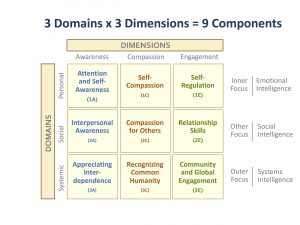
Spirituality works on a different level or domain than that of the political world and the practices and goals can be in conflict. Force, aggression, coercion can work on the outer level, but degrade our inner world. Contemplation, reflection, "not knowing" help our spiritual development, but are too passive and uncertain for political movements. I'm not sure these can ever fully be reconciled in one individual, what is empowering at one level is disempowering at another. Society as a whole has room for both, but I think what I'm arguing is they don't mix well.
I’m not so sure of that. I rather think that nothing is truly important — so don’t believe anything that you think. Or at least, nothing is important enough to let it take up residence in your thoughts, and disturb your peace.
You may be right here, I was trying to be generous and accommodating to some degree. Buddhism does have views of the invisible world such as karma and rebirth that I tend not to fully take on board. I say from time to time, though maybe not explicitly enough, that I've abandoned the renunciation and mystical thinking of the path. I'm trying to live a worldly life that still adheres to the teachings, but I suppose at some level that whole endeavor fails because it ignores the invisible aspects of the teachings.
That said, my perspective is don't believe everything you think, not anything you think. Everything speaks to questioning your beliefs and interrogating your perceptions, to me anything speaks either to cynicism on a worldly level or perhaps an enlightened perspective on the spiritual level, which I am no longer seeking. From another perspective not caring about anything other than peace of mind smells a bit like the paradox of intolerance. If you don't care about what goes into your mind, or what you surround yourself with in your world that peace of mind will be disturbed too. So some level of caring about the world or your mind makes sense up until some level of enlightenment I would think. Or from yet another perspective there is the quote by Padmasambhava, "Though the view should be as vast as the sky, keep your conduct as fine as barley flour." Meaning ultimately nothing is truly important, but conventionally there are important things.
Perhaps what I'm clinging to and have need to let go of is the idea that the spiritual path is a distinct thing with parameters and ideas and that its worth preserving. That is an attachment, no argument there. I suppose I'm not really willing to do that, if you have a good argument for why I should I'm open to hearing it.
I think that’s very interesting, because a lot of the early stages of Buddhism are about Right View, which is about getting the concepts straight in your head and dropping unnecessary things. Now you have a very long history with Buddhism and still say you are a Buddhist but no longer adhere to “the renunciation and mystical thinking of the path”, it seems to me difficult to reconcile? For me they are the most attractive parts of the path.
Not to criticise your Buddhism @person, I’m sure a lengthy introspection led you to this point, but perhaps the intellectual life outside Buddhism has started to carry you along in other directions? Often psychologists want to be seen as scientists and this colours their work and output.
If you no longer chase the idea of attaining the Buddha’s enlightenment, then what is the point of the spiritual path?
Which I feel like I'm doing. I'm debating about what is and isn't right view and what should and shouldn't be adopted.
This is a good question for Western Buddhism as a whole as most who practice in the West don't really follow them. I just set it on the back burner as many Tibetan teachers have said to do and take the practice to live a better life in the here and now. If karma and rebirth are true then I'm hoping that will be good enough. If not, I suppose off to the hell realms for me... 😓
Yes, this is what I'm saying. I'm looking to other ways of living. I kind of think the balance of Taoism may be closer to what I'm attempting, though still using Buddhist practices. I've been more seriously considering Zen as a path recently (which is some sort of blend between early Buddhism and Taoism). Early on in my Buddhism I had the view that trying to live in the world was destined to failure. That it was like trying to balance on a knife's edge. You try to gain a foothold one place and the other foot slips, on and on, there is no safety. I had in my mind that I would renounce and become a monk, but that never happened and I eventually conceded that it probably never would. That I'd be better off trying to make an attempt to live more fully in the world while still attempting to live in a spiritual manner.
My story is more about I was the sort of person who believed all the things. Psychics, aliens, ley lines, etc., etc. Time and again the things I believed in showed themselves to have big flaws and to not be true. Including believing in the invisible world of demons attempting to possess me, which was in fact a psychotic break which I now believe was brought on by working for 2 months in the home of someone with mental health issues of their own. I didn't realize it at the time but I'm sensitive to the emotions of others and readily take them on. So anyway, in essence I'm very open and intuitive, I take in a lot and needed some way to discern what is valid and what isn't. So that is why I think a rational, scientific approach is important in deciding what is true and what isn't.
A happy, meaningful life. Enlightenment simply isn't on the table for me unless I leave the world behind and focus on that. I can't rule out karma and rebirth, so if it does continue perhaps I'll continue on the path of eons and get there at some point. If anyone is open to supporting me financially to pursue enlightenment, I'd be open to considering it.
We seem to be approaching things from opposite ends @person… you were the person who believed all the things, while my education and university study (from about the age of 14, post Osho communes) were scientific and practical to a fault. You’ve come to believe in strong rational and scientific underpinnings, while I have been struggling to move away from science and am going more to a mythical point of view.
The thing that I learnt was that science and rationalism makes you discard much of the older wisdom. Science likes to propose that it is the best thing since sliced bread, but truly the ancients had much of interest in their traditions. Things like the relationship between magic, language and psychedelics. And how that manifests itself in the invisible world.
You’ve had an experience with psychosis, in a way that is an opening into other realms, an awakening which isn’t guided in the right channels. The whole selection process for shamans is based on this ‘sickness’ which marks people for initiation, those who stand partially in one world and partially in the next.
I don't wholly reject unseen things and try to avoid throwing out the baby (wisdom) with the bathwater (magical thinking), I also reject the type of hard scientific materialism that says we know the only things that exist are the material things we can see and study. I'm really interested in the nature of consciousness and how that is very mysterious and unexplainable through material, scientific means.
Its that there are myriad beliefs about the invisible world and unexplained phenomenon. How do we decide which ones are true and worth following and which ones aren't? Like religions they often have conflicting views, so it simply isn't possible for them all to be true.
It’s a very good question. I think most religions from the agricultural period of man’s development were not very pure in how they approach the invisible world. I see glimmers of truth in shamanism, in theosophy, perhaps in Emanuel Swedenborg’s writings.
But modern man’s history goes back 300,000 years. Industrial man is barely a century old, and seems determined to wipe out all trace of what went before, by modernising the planets surface. If modern, thinking man has been around that long, imagine what civilisations may have gone before, what wisdom had accumulated in ancient times.
I think if you can keep in mind that your beliefs are only sort-of true, then you’re doing quite well. That is true for the invisible world, where things have multiple natures and appearances, but it is also true for science, where any scientific model of the world has limits and can be proven untrue again.
People like to teach that they know “the truth” about something, but the real truth is unknowable. Perhaps Walter Russell is right and the universe is made of crystallised light. After all, aren’t matter and energy equivalent, isn’t e=mc2?
I like the phrase "less wrong", rather than true or right when it comes to the pursuit of knowledge. To me it kind of says, this is our best understanding right now, but we're always learning and discovering more, while also acknowledging that its not all just a coin flip, we do have some verifiable understanding of some things.