
About control: to pursue it or not?
 Jeroen
Not all those who wander are lostNetherlands Veteran
Jeroen
Not all those who wander are lostNetherlands Veteran
It seems to me that the question of whether to strive for control is a difficult conundrum. At times one needs control, of the body and of the mind, and it could be said that striving for control is a defining human characteristic. When you are a baby you don’t have control of your bowels, or of your muscles, or of much else in your life. But when you get older, you learn to walk and run. When you are still older you learn to kiss, and you lose control of your love life.
But this is kind of my point. Control in the wider sense seems to be a futile pursuit, there is much that comes and goes without asking your permission. An illness, a death in the family, a car accident… life doesn’t seem to lend itself to control. Those things where control comes naturally are welcome, like one’s limbs and muscles, but the rest I’m very dubious about.
The question then comes, what do you do with more esoteric concerns? For example, we are said to have a number of subtle bodies. If in meditation one finds one has access to something like that, should you seek control? You might find that once you had control that you didn’t have the senses to make proper decisions in that body.
Comments
This reminded me of the serenity prayer
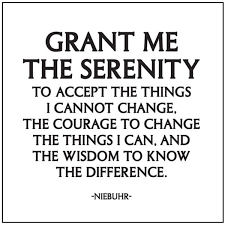
Some things seem worth it to gain control while others are better to let go of.
But then what is wisdom? What is its aim? If it knows the difference it must have a way of deciding for or against something.
Control implies that you want to influence something. A baby learns to control bowels and muscles and learns to walk and run in order to control where they go and what they do there. A person controls their love life in order to find a partner and manage their family and home life. People want to control their work life in order to have the lifestyle they want.
What kind of control would you want over subtle bodies? What do you want them to do or not do? If you don't have any aim or goal control seems something you would not want.
Coming from a background of being too lazy and unfocused, I much prefer control and the phases of my life when I was systematically "winning over myself" a.k.a. learning to control myself.
Free will can be trained, like a muscle, and ever more things can be controlled.
Life, not. But our response, yes. Body, emotions, speech, thought: all of these can be controlled. And what a difference they can make!
There's that saying "go with the flow". Sure, if you're already blessed with wonderful habits. But if not? I vote for "go against the flow" a.k.a. "win over yourself" again and again and again and again. It really does work.
"Only the disciplined ones in life are free. If you are undisciplined, you are a slave to your moods and your passions." Eliud Kipchoge (Marathon GOAT).
PS. If someone has a different background, maybe an A-type personality always on the gogogo that tries to control everything, maybe they will have an opposite view to the above.
We have choice. To strive for control is to fail to see choice. Chaos is always present. When we understand choice vs control, we gain true control. True control does not come from directing everything. That is an impossible task. For we cannot see everything and that which we do not see or are not aware of is beyond control.
When we have choice, we are fluid, we can adapt readily to our situations of the moment. We can adjust for alternatives, we are free. We are not bound by the need of total control. We can not control the river. But we can choose to use it's currents, it's characteristics to navigate it, utilizing those currents, making the river our highway instead of our nemesis. In human interactions, in our internal interactions, choice is the ultimate control. We can maneuver within the flow of interaction. Thus we have control, not of the others thoughts or actions, but of our own which enables us to navigate the rivers of interaction.
Put another way, a ship upon the sea has no control over the sea. The ship's pilot, however, chooses the speed, direction and overall relation to the sea to navigate the ship upon the sea.
Thus we see that Control is an illusion, an impossible task whereas Choice is a reality our control is actually our ability to choose, regardless of the circumstance. What we may seek as "Control" is actually Choice - We have the "control" of choice. Control is the illusion while choice is the reality.
Peace to all
An interesting point of view, but I’d say that it only works up to a point. If you are disciplined and apply yourself you will find you are harnessing certain drives, you have an ideal in mind. You are shaping yourself to this ideal.
I did this at one point in my life. I was employed at Microsoft in the UK, and worked at a place where I was surrounded by beautiful and smart people, and I wanted to be like them. So I went on a fitness journey. I joined a gym, a very upscale one with swimming pools and jacuzzis and saunas for after exercise. I went three, sometimes four times a week and did sessions of one and a half hours of mostly cardio.
I ended up going from 121 kg to 89 kg in a year or so, and became fit and muscled for the first time in my life. I literally reshaped my body to be this new different person. But it was a facade, a chase after an ideal powered by my passion. Discipline helped me get there, that is true, and discipline can help you ignore your needs and achieve physical mastery.
In the end I found life is a dialogue between one’s passions and moods, and the larger influences of life. You can discipline yourself, and it’s a useful thing to do so, but if you don’t live in harmony with your passions you end up missing out on an important part of life. Fulfilling passions teaches you that all these things are fleeting and impermanent, and that leads ultimately to wisdom.
The spiritual path is where I ended up after this phase in my life, which led me to Buddhism and the mixture of beliefs I am still examining. In a way it’s the culmination of my life’s passions, the point at which all the passions are dropped, the end of one journey and the beginning of another.
Very well said @Lionduck
Yep I chose to say that. I can control what I boost. Interact with and how.
There is indeed little we can do about samsara (chaos) without a control template. For many of us that is the three jewels. Not the trillion distractions of an undisciplined chaotic mind/body/emotional body (or ignorance as Buddhists call it)...
https://vividness.live
Agreed, its all about the balance and direction. Disciplined towards what? If you're too loose, tightening it up a bit is good. If you're already tight, more discipline isn't the way. And then what are you disciplined about? Disciplined to meditate daily or eat better is different than being disciplined at the gun range or poker table.
So it isn't like discipline or letting go are good or bad in themselves. They're skillful or not as medicine in relation to what any individual needs at the time.
I think you are right, after some thought. I like the wording better, in any case… choice is more human, whereas control seems related to power and ego. To seek after control is to seek after a kind of power, which is a fool’s errand.
Control is also a more static impression than choice. Choice is dynamic, and a very much wider beast than the idea of being controlling.
Thanks @Lionduck.
True but only if you are a Taoist mistress/master or crazy. Are you any of those? No? Do you wish others to think you might be? Probably. However how we are seen is based on what we are not what we pretend or like to imagine...
In art, in painting, without control you just make a mess. If you exercise too much control, you make a different kind of mess. Life seems much the same. You must discern how and when to exercise control, and when to just let things flow as they will. There is no instruction booklet for this, no verbal formula, there is only mindfulness. No instruction manual for that either?