
Some troubles with new sila efforts
 marcitko
Veteran
marcitko
Veteran
Dear friends,
Practising sila/morality/virtue is very important and uplifting for me. All Buddhist (and most non-Buddhist) teachers agree that sila is the foundation of both deeper insight and a happy, productive, and peaceful life, for both self and others.
My impediment, likely all of my life, but certainly during the past 15 years, has been to be too conflict averse. I see how this impediment arose as a result of some suboptimal parenting, but knowing this does not resolve it yet.
How these two interact is that when I try to practice a new form of sila, I sometimes encounter criticism, and am discouraged, sometimes giving up on the idea. The second situation is that I am averse to enter into a conflict, even a minor one, to pursue my chosen course of sila.
This is not a problem when I am more or well-established in a certain form of sila. Then, I can laugh it off or think "just your opinion, whatever".
An example of being criticised. My dad and I made an "alliance", with which we were both tremendously happy, that we would do less work for my flat renovation, but we will instead pay taxes on the work. In my country, in the domain of apartment renovations, while avoiding it is illegal, paying taxes is in practice sorta kinda optional. Enter mom, with a torrent of insults both on our characters and idea. The idea, previously seen as firm and beneficial and kind and a source of great joy and peace, I suddenly saw in a murky way, and lost my sense of purpose and direction around it. We still continued, but in a hit and miss way, and without the previous energy.
-An example of not wanting conflict. During the past two days, I was "offered" a lower price if we could not issue a receipt twice. It's strange because this rarely happens. These were small bills, in a photocopy shop, and a key maker. The first time, I did ask for a receipt, where I think the guy thought I was not being "collaborative" and was moderately pissed off by me. The second time, remembering the first, I went along with it. But now it was me who was moderately pissed off.
There are many more similar examples. A few weeks ago, I asked Roshi ChatGPT on the Buddhist view on screwing the state in a situation where the other person would be displeased if you don't, and it came with a strong and unambiguous response that the Buddhist view is to not screw the state, since it goes against many of the precepts, and some of them seriously.
Hence, the questions are:
- How do you (and do you have suggestions towards how should I) deal with being criticised for efforts at new sila behaviours? I have taken to not talking about it, until it is well-established, but sometimes this is not an option.
- How do you (and do you have suggestions towards how should I) deal with situations where it is clear to you what the right thing to do is, and you deeply want to do it, but the other person would be somehow displeased or angry or offended, etc. Maybe here being diplomatic is the way.
Answer: In my overcoming-anxiety school we are encouraged to write our suggested answer after raising a question. This primes ourselves away from the problem and towards seeking a solution.
Thus, my answer is, accepting the difficulties (the criticism or the displeasure of the other), go forward and do it anyway.
And stay as quiet as possible about it, except with people that will likely understand.
Thanks for any input.

Comments
You can think of each difficult interaction as a type of training or sparring. You may lose, but you'll learn something that will prepare you for next time. Being challenged on your views offers incentive to better understand and communicate why you value what you do. What also occurs to me is that similar to martial arts skill the more familiar and skilled one becomes the less forceful one needs to be.
I think this is harder with those close to us, not just due to our history, but if you've been rebuked once it makes it harder to assert yourself later.
Thinking on my own interactions with my mother on something like killing insects. I'll generally just deflect or avoid a confrontation in the moment and continue to act in the way I feel appropriate.
I can relate a bit to your tax conundrum. I work in renovation, while in my experience the roles have kind of been reversed, I get asked occasionally by my customers if I offer a cash discount. I'll just say no, sorry, its all the same to me. This has always been enough though and I've never been challenged on it. My feeling on avoiding taxes is that even if I feel like I'm being taxed too highly, to take action myself, rather than advocating for a lower tax rate, or more tax breaks, is the same as stealing. I think taxes are the dues we pay to live in a civilized society.
Edit: On a bit of reflection I think using "I" statements, talking about how you feel, what you value rather than making a claim about some objective morality helps avoid escalation. So say something like, its important to me to pay taxes or follow the rules rather than "avoiding taxes is stealing!" The first someone may scoff or think you're a fool, but they won't feel threatened like in the latter.
Generally I agree with that. When the government tells me to file my income tax returns, I do so, and when they tell me I owe them money, I pay it. However, I think there is room for a certain amount of self interest. The government also tends to keep raising taxes, not lowering them, in order to feed the bureaucracy, the army, and many other institutions.
I guess what I’m trying to say is, don’t be too hard on yourself. The government screws and uses (and abuses) private citizens as much as private citizens screw the government, and as long as you don’t find yourself contributing to organised crime you may find on reflection that you can find peace with your actions. It’s a personal thing, how far you choose to align moral rectitude with finances, is my opinion.
You can also look at it from the point of view of Right Livelihood. Most explanations of Right Livelihood that I have seen focus on professions not to pursue: poisons, weapons, butchery and so on. The weight seems to be given to the first Precept, not the others (stealing, lying, sexual misconduct and intoxication). If they were to give equal weight to the other Precepts, I imagine a few jobs that might be considered off limits: advertising, acting, writing fiction, marketing, sales, prostitution, hostessing, bartending, etc etc etc.
I don't sweat the 8-fold path. Here's why. I was having coffee with a couple of friends who were translators teaching at Naropa./ One was a translator of Sanskrit and the other Tibetan. The Sanskrit interpreter said something that kinda changed the course or the path for me. They said that a better translation for "Eightfold Noble Path" is "Eightfold Path of the Noble Ones". I said that the two ways of translating are different in their deeper meaning, and they agreed. What it means to me is that the 8FNP is actually the path of the Noble Ones, or Buddhas of the 3 times and 10 directions. It's the path they walk. The rest of us aren't quite there, yet.
I am!
Talking of silly sila sealers and other old orca tails:
https://thetattooedbuddha.com/2016/06/13/journaling-as-a-mindfulness-practice/
Don't want to derail the thread on sila, but the ethics of paying taxes seems relevant. Something may shake out that would be helpful.
Being self employed in a sector where cash can be used often, it isn't too hard for me to fudge on my earnings. I don't do it because it does feel like stealing to me. But there are areas where I'm not fully honest with my reportings to the government. I haven't really explored the difference, but for my feeling its like there is a difference between actively trying to deceive and being lazy about recording something. Also, as a matter of principle a society where its normalized for citizens to avoid paying taxes the social support system weakens and I don't want to live in that sort of place (Greece apparently has this problem).
I suppose the path is always gradual and a novice should concern themselves with simpler things. But there are also the practices of the 6 perfections and the 37 practices of the bodhisattva. So it seems there is a path of practice outlined for the Buddhas of the 3 times and 10 directions already above the 8FP. The 8FP seems like a set of practices for the intermediate practitioner. Also, a path of practice isn't the same as a path of being perfect, one can practice it without sweating it.
@person, my brother from another mother, thank you for your very valuable insight. Consider that I agree with everything you wrote and was helped by someone clearly formulating what I already know but was, for whatever reason, currently shaky about.
This is an area that I haven't really explored well. The question has sparked a bit of interest, I'll probably dive deeper.
Had time for one article this morning.
https://goodauthority.org/news/why-are-some-nations-citizens-more-likely-to-cheat-on-their-taxes-what-we-found-surprised-us/
My views arose in an American context. Its the libertarian right that doesn't want to pay taxes, they make arguments that taxes are theft. Or a more common anti tax argument is that government wastes them or gives them to bad or unworthy causes. So in response to that I adopted a position that says taxes are our dues we have to pay to live in a civilized society and if you don't agree with the way they are being used that is what we have politics for, "taxation WITH representation", it isn't up to you as an individual to decide what you should pay.
My brother has been paid in cash for the majority of his working life and now does gig work and is responsible for reporting and withholding all of his taxes. There are 2 main employment taxes we in the US pay. Income (our salary) and payroll (a portion taken out of a paycheck specifically for social security and medicare). Employers pay half of payroll taxes so self employed people, such as myself and technically my brother have an extra 7.5% tax we are responsible for. Anyway he doesn't pay any of his payroll taxes, what that means when it comes time for him to retire is that since the amount someone collects in social security is based on their highest 35 years of earnings he'll have almost all zeros and puts all that burden of taking care of him on me and our sister. Maybe this isn't all that related except as it informs my feelings on paying into the system and our responsibility to others.
Youd be some kind of dumbass to pay taxes you dont need to....but well done for considering it. With a bit more maturity hopefully you will see the folly of your action.
I suppose this is an example of a rebuke. Care to elaborate on why you consider people dumb for paying taxes and how maturity will change someone's view? I think for myself it would be important to make a case for why it wouldn't be considered stealing.
Wanted to wait for @Angus to respond, but he seems to pop in infrequently.
Looking into tax avoidance a bit. Sentiment varies quite a bit by country, it depends on many factors like what you feel you're getting in return, how corrupt or efficient your government is, how visible the tax is (a VAT isn't as noticeable as a yearly income tax).
From a game theory point of view its kind of like a large scale prisoner's dilemma. The prisoner's dilemma, for anyone unfamiliar, is a simplified example of cooperative/selfish dynamics that play out in life and society. If you act selfishly, while others act cooperatively you win, if you both cooperate you both win but by not as much and if you both act selfishly you both lose the most.
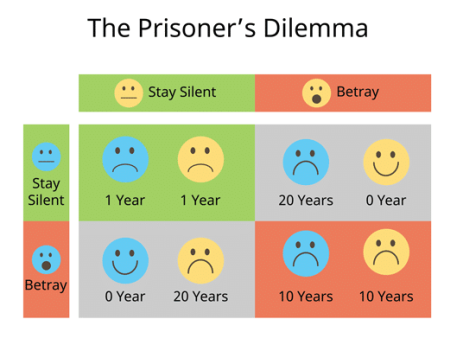

So if I avoid paying taxes while others do, I get the benefits of a well funded society and keep more money for myself. If tax avoidance becomes the norm things get worse for everyone.
It seems like most people got 'hooked' by the examples and lost track of the questions.
For me, the most important thing is to build moral courage and integrity.
The examples I gave are, I believe, very good to do in their own right, but even more importantly are, for me, 'training grounds' for moral courage and integrity.
I wanted to offer something organized, but even after reflecting for a bit all I have are a couple random bits of related information.
-Having ones beliefs challenged often feels to our brain like a physical threat
https://massivesci.com/articles/brain-political-beliefs-reaction-politics/
-Often our beliefs are more about social belonging than intellectual or moral conviction. When people cling to obviously false ideas its often because giving them up would mean giving up ties to an important social group. I imagine it works in reverse in adopting a new set of beliefs.
I operate similarly to how you framed it in the OP, I keep it to myself and act in the manner I believe anyway. I think others don't feel as threatened and can respect your own convictions easier if you're not trying to push them onto others. I don't drink but sometimes find myself in situations where people are drinking. It was harder early on to stand out, it feels awkward and there is a fear of rejection. I don't think I ever said its a Buddhist thing, I think I made up some excuse about not liking how it made me feel (not really a lie). In some ways I probably didn't get invited to parties I might have, but at times I get invited because people want a sober driver.
I’ve come across a number of training grounds of that type…
Life itself: living life in a chaotic, outgoing fashion, where you encounter people in different functions, tends to be a great proving and training ground of morality. Anything that involves money will inevitably put your integrity to the test, and find you balancing greed against morality. This can be avoided by living a life of routine.
Hallucinatory visions: these can be a moral and spiritual pressure cooker. It tends to of its own accord seek areas where you are vulnerable, using your high intentions against you. Until you learn that almost always the best course is to do nothing, and keep quiet.
Books, films and games: any of the storytelling media can place you in morally complex situations, albeit imagined ones. It can be useful to just step outside the story and see what your own personal response would be in a given situation, away from the story’s railroading.
It of course depends on what type of moral courage you are looking to develop.
For whatever reason this thread came up in my mind today. The thoughts that percolated up were that a good portion of our personality is genetic, we're disposed to being introverted or extroverted. Agreeable and disagreeable is another similar personality spectrum. Its often hard to change these traits in a deep way about ourselves (neuroticism <-> emotional stability being the most changeable I'll note as a point in favor of a spiritual practice), but we can develop skills in the other direction. I'm pretty introverted, but need to meet new people and persuade them of my ability professionally often so have developed extrovert skills.
The other reflection I had was that for much of my life people never really confronted me on certain behaviors or when work I did wasn't up to par. As such they never got corrected or improved upon and it led to problems in my life. Since, I've adopted an attitude that its often kinder in the long run to tell someone they need to use deodorant for example. But there are kinder and more tactful ways of doing that.
Then this interview on 10% Happier came up today and felt very relevant.
I too have been thinking about this thread. I started a new job and from day 1 my main responsibility has been to interact with and help an external stakeholder of the company with a track record of extremely dubios affairs in relation to the best practices of the industry. This stakeholder, while being external, is still closely related to the company and the company can fire him. It's clear to me that this stakeholder should have been fired ages ago, but he's too big and important for that, from the perspective of the company.
I'm trying hard to act professionaly and ethicaly but am becoming really pissed off by the situation.
Anger and self-rightesousness? Aha!
I think I will try to seek out counsel from someone within the industry who is both ethical and more senior than me and who is not embroiled in the situation and can thus be objective.
@marcitko
You might find some inspiration/pointers by following the Sila Zen Ox...
https://www.lionsroar.com/searching-for-the-ox-the-path-to-enlightenment-in-10-pictures/
Thanks @lobster, I enjoyed the 'western style' aka clear-to-me commentaries.