
Using thoughts to direct the mind
 person
Don't believe everything you thinkThe liminal space Veteran
person
Don't believe everything you thinkThe liminal space Veteran
Doug's Dharma just posted a video on the instructions the Buddha gave on how to use our thinking mind to sort of steer our way to a more wholesome way of thinking and being. Its been a part of my practice since I can remember, its just nice to have it spelled out succinctly.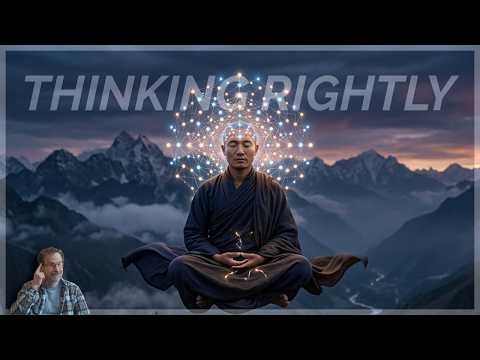
AI summary
This video challenges the common misconception that meditation is about silencing the mind or achieving a blank state. Instead, it explains that the Buddha’s path to enlightenment emphasizes skillful thinking.Key Concepts
Right Thought (Sammā Saṅkappa): As the second factor of the Eightfold Path, this teaches that meditation is not about stopping thoughts, but learning to direct them toward renunciation, goodwill, and harmlessness (0:47-1:27, 9:24-9:55).
Heart’s Inclination: The Buddha observed that what we frequently think about becomes our natural inclination. We must therefore actively sort thoughts into 'skillful' (those leading to wisdom) and 'unskillful' (those leading to harm) (1:38-2:35).
Active Meditation: Using Yonisomanasikāra (wise reflection), practitioners can intervene and redirect the 'traffic' of their thoughts rather than just passively watching them (3:12-3:53).
Techniques for Unskillful Thoughts
Referencing MN 19 and MN 20, the video outlines five techniques for dealing with unwanted, unskillful thoughts (5:42-8:52):Substitute: Replace a harmful thought with a skillful one (like a carpenter replacing a rotten peg).
Examine: Consider the danger or 'bad end' of the thought to create repulsion.
Ignore: Direct attention away from the thought toward other tasks.
Calm: Observe the thought process to slow it down and understand why it is agitating.
Crush: Use mindfulness to firmly hold back the unskillful thought.
Conclusion:
The ultimate goal of Buddhist practice is not to live in a blank, detached state, but to cultivate a mind overflowing with wisdom, kindness, and compassion. Through 'mental martial arts,' we become masters of our own thought processes
Comments
It seems to me this is something you might do in meditation, but not continuously. It seems to lead to the Brahma viharas, the four divine abodes. It’s not something I would do to promote wisdom, because just to determine if a thought is ultimately wise and should be kept might take me five minutes of musing.
From what I know of you, you're perhaps not an insight meditation practitioner? Its not so much something you'd do in vipassana style or mindfulness meditation. But it is the same sort of skill of noticing thought patterns and the movement of the mind. As one becomes more familiar and skilled at the noticing it becomes the sort of thing that one can do more and more in daily life. The redirecting, in my experience, is often something easier to do in day to day life than repeated letting go that is done in active meditation. And as one familiarizes oneself with certain substitutions for thought patterns it does come more easily.
I'm not sure about that connection. My understanding of the divine abodes is that they come about through meditative concentration on those states of mind. Its also said to be a sort of bliss trap, where one can find oneself there thinking they've reached the highest, but are still living in the context of the self and haven't come to final enlightenment yet.
As mentioned at some point in the video I can't remember he mentions the Buddha did say that eventually this technique has a certain level of mental stress to it and ultimately is to be let go of. So it seems its a sort of provisional technique.
I think this is where philosophy, including moral philosophy, comes in. You do the thinking ahead of time in a more rigorous manner so when you find yourself in actual situations the answer is more easily accessible and ideally something you've internalized so the response is natural and spontaneous.
But I think its also worth noting, that this is just one of the path's the Buddha put forward. He taught many different techniques.
As we know mind, perception and 'seeing is believing', confirm that not everything is what we think for example in the '9 Purple Dots' delusion
https://www.schulz-hildebrandt.com/9-purple-dots-illusion/
I use this technique every now and then. I do find it useful, however the title had me wondering if it's the other way around. That is just my bias though as usually during silent illumination meditation, if I catch myself entertaining any thought at all, I return to the breath.