
Best Of
Re: Experience of mantra practice
@Jeffrey said:
I hear in dharma talks often chanting before and after. Like an example people might have heard in the heart sutra "gate, gate, paragete, parasamgati,,,bodhisvaha". There is a meaning to that mantra. Sometimes I find myself spontaneously thinking of a mantra during my ordinary day
Being unprecepted, the other day I had a small glass of port and mature cheddar on digestive biscuits.
That night the nightmares came and also me chanting in my dreams to placate their arising.
This is the mantra I used in my zzz
https://www.shambhala.com/topic/seven-line-prayer/
 lobster
Change is Inevitable ...(Levels of) Suffering Optional
The world as we know it is shifting from an old comfort-zone illusion into a more challenging one.
Dharma practice remains the same, flowing with change as it always has.
The world is changing in unsettling ways.
Dharma practice is not shaken by the change.
Dharma practice is designed for times like these.
Just some food for thought to ponder...
 Shoshin1
Re: Experience of mantra practice
@Shoshin1 said:
In practical terms, mantras and chants are used to clear mental clutter and then focus the mind.
I use 'om mani padme hum' quite frequently when the monkey is especially self-defeating and more rarely as a standalone practice.
 marcitko
Re: Space - the final frontier
Going on a Florida vacation at the end of February. On the itinerary was a trip to Kennedy Space Center. I was hoping we'd get lucky and get to see a launch, its still up in the air whether a potential February launch will happen when I'm there. The exciting thing is that I just looked up what might launch, I was expecting a satellite or something boring, but if one happens it will be the Artemis II manned mission orbiting the moon! Fingers crossed.
 person
Re: "Walk For Peace" monks in the US from Texas to Washing D.C.
And a fairly extensive piece in US mainstream media:
 Steve_B
Re: "Walk For Peace" monks in the US from Texas to Washing D.C.
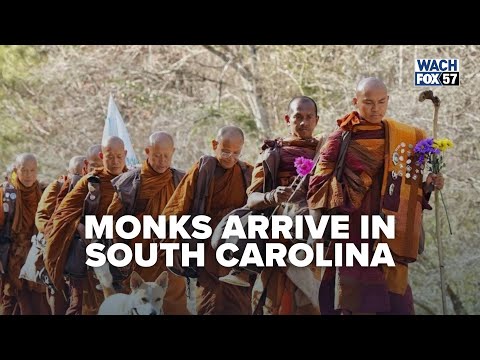
The biggest Croatian news-site just reported on them.
marcitko
Re: "Walk For Peace" monks in the US from Texas to Washing D.C.
Their message is spreading, was sent this today from an atheist...
lobster
Re: Noble Eightfold Path versus 6 Paramitas
That’s an interesting take on things, @IAMFINE … when I was taking my Buddhist foundations course with my local Tibetan temple, there was a lot of emphasis on the N8FP, but much less talk about how the paramitas function to help one.
 Jeroen
Three laughing monks
I came across this story today… it involves monks so worth a repost.
I have heard about three monks. No names are mentioned, because they never disclosed their names to anybody. They never answered anything. In China, they are simply known as the three laughing monks. And they did only one thing: they would enter a village, stand in the market place and start laughing. They would laugh with their whole being and suddenly people would become aware. Then others would also get the infection and a crowd would gather. The whole crowd would start laughing just because of them. What was happening? The whole town would get involved. Then they would move to another town.
They were loved very much. That was their only sermon, their only message; that laugh. And they would not teach; they would simply create a situation. Then it happened that they became famous all over the country. Three laughing monks. All of China loved them, respected them. Nobody had ever preached in such a way that life must be just a laughter and nothing else. They were not laughing at anyone in particular. They were simply laughing as if they had understood the Cosmic joke. And they spread so much joy all over China without using a single word. People would ask for their names, but they would simply laugh. So that became their name — the three laughing monks.
Then they grew old. And while staying in one village. one of the three monks died. The whole village became very much expectant because they thought that when one of them had died, the other two would surely weep. This must be worth seeing because no one had ever seen these people weeping. The whole village gathered. But the two monks were standing beside the corpse of the third and laughing — such a belly laugh. So the villagers asked them to explain this. So for the first time, the two monks spoke and said, “We are laughing because this man has won. We were always wondering as to who would die first and this man has defeated us. We are laughing at our defeat and his victory. Also he lived with us for many years and we laughed together and we enjoyed each other’s togetherness, presence. There can be no better way of giving him the last send off. We can only laugh.”
But the whole village was sad. And when the dead monk’s body was put on the funeral pyre, then the village realised that the remaining two monks were not the only ones who were joking, the third who was dead was also laughing. He had asked his companions not to change his clothes. It was conventional that when a man died they changed his dress and gave a bath to the body.So the third monk had said, “Don’t give me a bath because I have never been unclean. So much laughter has been in my life that no impurity can accumulate, can come to me. I have not gathered any dust. Laughter is always young and fresh. So don’t give me a bath and don’t change my clothes.” So just to respect his wishes, they did not change his clothes.
And when the body was put to fire, suddenly they became aware that he had hidden some Chinese fireworks under his clothes and they had started going off. So the whole village laughed and the other two monks said: “You rascal, you are dead, but you have defeated us once again. Your laughter is the last.”
Jeroen
Re: For the coming year
@Jeroen said:
When you give attention to your breath with friendliness and love, you get to recognise the wisdom of the body. It just breathes in a shallow way, taking in just enough breath to keep the body functioning when you are at rest. It doesn’t breathe deeply or bring in lots of oxygen when it isn’t necessary — it knows when enough is enough.Sometimes I find that the in-breath generates energy and tension, and the out-breath is a moment of release and relaxation, then my in breath is short, and my out breath is long, and I find myself in a tremendous space of let-go.
Breath creates spaciousness in the body… the in-breath expands the lungs and opens the chest, and the out-breath brings release and relaxation, while tension and energy disappear. In a way it is analogous with what happens with the mind, that thoughts too expand and we get an impression of spaciousness in the mind when we just let our attention rest on the breath.
The original nature of mind, the sky-like spaciousness of being, becomes more visible when you are more acquainted with the breath, and the cloud-like thoughts become fewer. This thought suddenly occurred to me after spending some time with the breath after reading the sky metaphor in ‘The Tibetan Book of Living and Dying’. Beautiful…
As I have been doing the year of breath for four months now, some days I have found I remember the breath just once or twice, and some days I spend ten minutes or more just being with the breath. I embrace it with love and kindness and compassion, knowing that some of my thoughts have been unkind, and that is why I hold it like a small baby.
Jeroen