
Best Of
Re: Buddhist quotes
“It has been well said that Buddhism is Hinduism stripped for export.”
— Alan Watts
 Jeroen
Re: Following Osho, Zen Buddhism and Being Rational
@Jeroen said:
Your story of the nun reminds me of what Poonjaji once said about Buddhist monks, “they are entirely dried up inside”, talking about the lack of humour, spontaneity, aliveness that he saw in them. I think it is symptomatic of society’s state that such an approach is seen as beneficial.
He must not have met very many monks.
And there are other approaches to self-realisation than that of the monks.
So are you acknowledging that the monks approach is a legitimate path to self realization?
The difficulty in life is to learn to listen to your deeper self and bring common sense and kindness to that conversation, rather than to steamroll it with a form of discipline and beliefs imposed from outside scriptures. Bring yourself into harmony, allow yourself to flourish rather than imposing.
Every human being is unique, that is why Osho’s Vigyan Bhairav Tantra lists 112 meditation methods, to find one that suits you. Mastery, discipline when relating to the inner self — that is the ego talking about being in control and making you fit a predictable pattern, it is part of grasping and desiring. It is illusion.
Except of course, the patterns you follow.
Spirituality is not about growth and development and long effort, it is about freeing yourself from the chains of conditioning. Becoming sensitive to where you need to let go, and then relaxing the clenched fist, letting go. Truth is truly a pathless land.
In your opinion... You act like there is only one way and one path to follow. All very concrete, certain language for someone into letting go and relaxing.
Which reminds me of another thread idea I'd been mulling over after having a guest on 10% Happier bring up. That of being good vs being right. The former allowing for a pluralism of goods the latter being the one and only correct way.
 person
Re: Following Osho, Zen Buddhism and Being Rational
@Jeroen said:
Thanks @pegembara 🙏It’s difficult to think that millions of Indians, Nepalese and Tibetan Buddhists who believe that the path of guru devotion is a swift road to enlightenment might be wrong, but it could be. I wouldn’t typify the relationship with the guru as one of craving though, it is closer to awe, respect, friendship, caring… it is not something the Western mind is very good at understanding.
It is also a question what attachments one should work at discarding. Attachments to family or loved ones or friends should likely be left to develop naturally, and I think the guru relationship is like that. They give some pleasure, they give some dhukkha, and these things the guru uses to move and motivate you.
Is the goal of being free of dhukkha realistic?
Millions are also devoted to the Buddha and hence the he taught that those who see the Dhamma or Teachings see the Buddha.
It is the Dhamma or teachings that is important.
A true teacher doesn't want you to remain a student or devotee. (S)He wants you to be free,,, the faster you do this the better.
All that comes to be will also cease to be. There are no exceptions.
"It may be that after I am gone that some of you will think, ‘now we have no teacher.’ But that is not how you should see it. Let the Dharma and the discipline that I have taught you be your teacher. All individual things pass away. Strive on, untiringly."
These were the Buddha's last words.
Is the goal of being free of dhukkha realistic?
Most certainly.
There is, monks, an unborn[1] — unbecome — unmade — unfabricated. If there were not that unborn — unbecome — unmade — unfabricated, there would not be the case that escape from the born — become — made — fabricated would be discerned. But precisely because there is an unborn — unbecome — unmade — unfabricated, escape from the born — become — made — fabricated is discerned.[2]
Ud 8,3

Re: Following Osho, Zen Buddhism and Being Rational
@Jeroen said:
If one is to “strive on untiringly” with “the Dhamma and the discipline as your teacher”, that sounds like a straitjacket. How does that lead to being free? It sounds to me like it will shape you into something disciplined, controlled, confined by habit.
In my understanding, its less about the type of life you lead right now, but about where that path will lead you in the end. The discipline of the path leads to real, lasting freedom. Often times things that produce positive long term outcomes aren't necessarily pleasant in the short term. And vis versa.
person
Re: Following Osho, Zen Buddhism and Being Rational
Osho explicitly didn’t want a religion to be created in his name.
LOL
So why do you keep rabbiting/gibbering on about her?
What am I missing?
 lobster
Re: Following Osho, Zen Buddhism and Being Rational
Instant coffee is dhukka in todays world of bean-to-cup automatic espresso machines 🙏
But the question is serious. The body will always present some dhukka, in aches and pains, thirst and hunger, illness, old age… the Buddha set out to solve these, but they are part of natural function and will always be there.
Jeroen
Re: Following Osho, Zen Buddhism and Being Rational
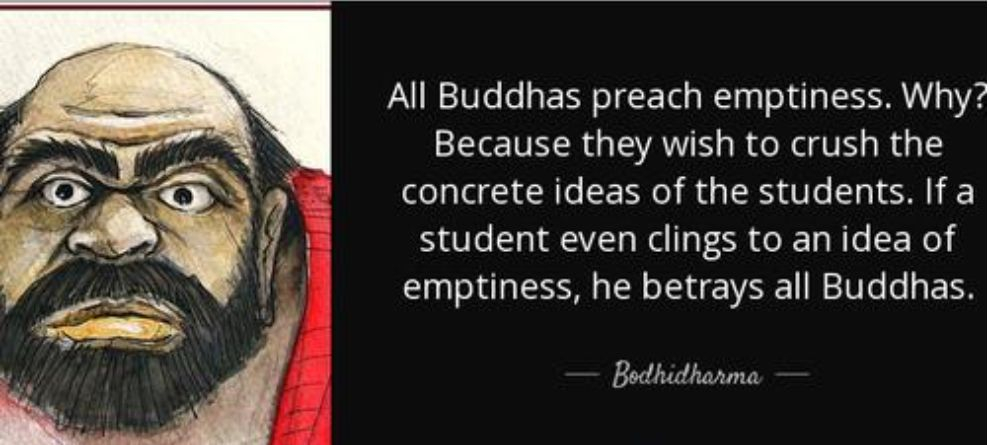
An idea is an idea.
@Jeroen said:
@pegembara said:
That is just a view, opinion, and belief.If you put it like that, it is all just views, opinion and belief — even the sutras of the Buddha. If you live just from your own experience and what you observe from the natural world, you come to very different conclusions.
My conclusion is this.
Whatever you experience, think, or believe in that causes a disturbance that leads to (liking and disliking aka craving...this is not the same as simple pleasant and unpleasant feelings on their own) will cause dukkha. You can know this when your inner peace is disturbed. All you need is to step back and watch the feelings pass. We let the ripples settle.
Attachment(craving) to the guru isn't the way imo.
And yes, even the teachings if held wrongly also cause dukkha but the right teachings will eventually end dukkha.
Re: Following Osho, Zen Buddhism and Being Rational
@person said:
The way I think of the heart vs mind in practical terms is like the heart jumping right to a math solution which may or may not be correct depending on your level of experience and insight.
In my terminology, I think what you are talking about there is more intuitive thinking, and the extended function of drawing conclusions because of it, which is an uncertain business. The same with associative thinking, which can lead you right off the deep end.
Reason is very much safer, small incremental steps, each verifiably following from the last. Allowing logic and common sense to guide you. But these are still thinking modes as I see things, part of the mind.
The heart, to me, is the seat of the emotions. It is about what you feel, not about what you think. And what I’m trying to do is learn to “feel better”, to pay more attention to what I feel. Like my visit to my mother in hospital the other day. Although I was concerned at how she was looking, I felt happy to be with her and to be able to give her a hug.
It is things like happiness, joy, anger, irritation, compassion, sadness… these things are feelings, and by paying attention to them you become more emotionally literate, more in tune with reading your own heart. Your thoughts can trigger feelings, and some feelings almost seem to be thoughts, like hate and jealousy. You can feed feelings with thoughts too, like by thinking certain thoughts you can increase feelings of anger.
The antidote to negative feelings is just to pause, become mindfully aware and wait for it to pass. It rarely takes more than thirty seconds. And so you can also by guiding what you think change your dominant emotions, spending less time on the negative ones and choosing to feed the positive emotions, becoming a happier and more cheerful person.
Jeroen
Re: No Buddhist Quotes
@Jeroen said:
“A good way to tell if you love someone is to see if their presence makes you happy.”
— me
I'll challenge that a bit and say that its a good way to see if you like someone. I can think of family that don't make me particularly happy but I want good for them. The inverse, someone who makes me happy that I don't love, seems harder. But I can imagine something like a celebrity you like, or an entertainer who's show you're at. They make you happy, but they're still kind of a stranger to you and not much thought goes into their well being.
person
Re: All Change ...
All Change ...
Thus have I heard
Change is inevitable, suffering optional
 Shoshin1