
Best Of
Re: Discipline and spirituality
@Jeroen said:
So a new topic, here it is.I’ve had periods where I have been very disciplined — when I got into a new and much more corporate job, I changed my life and started going to the gym three or four times a week, and got really muscled and fit over the course of about a year, lost about 25 kg of body weight, but then I had a mental breakdown and ended up shifting to a much less stressed lifestyle.
That was when I got into a more relaxed way of living. I realised I had overdone it, over-strained myself and had to make a change. There is nothing wrong with living in a relaxed, low-energy style. You can take more time to smell the roses, sleep, reading and writing letters and correspondence to people you know.
My intuition is that there are very few things, if any, that fall into the bucket of all up(or down) side. Its all tradeoffs. So, I'd think there are challenges and obstacles to be dealt with living that way (very relaxed). Things like aimlessness or anomie spring to mind. Also, I think you're living in a bit of a different circumstance than most here. You're essentially retired, (I guess I don't know your household arrangements) with family who are have been able to care for household duties. I think too much stress is problem, and the bigger one in our world today. But I also think too little stress is a problem, and it does seem to be a growing one in some areas of the world. People without direction or purpose.
As has been mentioned in the thread, there is a spectrum between discipline and laxity (wording?). Allan Watts called them "prickly" (disciplined) and "gooey" (lax/undisciplined). The Buddha advised the middle-way. Hence, here to it must be that the middle way applies as the way that brings the best results and least suffering.
An open question is how good any of us are in determining where we place on the spectrum in relation to the middle, hence which direction we should go with full steam ahead.
In our modern way of life, I think a lot of people will go more deeply into discipline first, and then like I did experience a backlash. The current mental health epidemic is a signal showing that, where a very large percentage of people end up taking medication, anti depressants or anti anxiety meds like benzodiazepines. These just mask the symptoms, whereas at their core is an unhealthy lifestyle.
I don't like hustle culture, I think its an unbalanced lifestyle. Some people thrive off creating and doing though. I think they would shrivel up if they were to sit around all day reading or going for walks. I wouldn't recommend a spirituality for them of maximal chill.
I think we can take a leaf from the lives of cats… they sleep an average of 15 hours a day!
We're not cats. Just as we're not sharks and shouldn't keep moving 24 hours a day. The human nervous system is tuned to a certain level of activity and stress, with a broad range between individuals.
Discipline is the art of ignoring your boundaries, of being subject to whatever goals the goal-directed part of your mind puts in front of you. Sure discipline helps you achieve your goals, but it’s not living.
To me its about the environment you do your living in. Do you have the resources and health to be able to engage in life affirming activities. If you don't take care of your life, your life can't take care of you.
A news headline I came across a few minutes ago: “Three quarters of Dutch topsporters suffer mental health problems.” I think that’s very telling, too much discipline and putting too much strain on body and mind is bad for your health.
I agree, too much discipline is bad for you. This is my worldly dharma, life is a balance, going all in leads to collapse and a restart, like the Yin/Yang. Leave the pendulum behind and seek to temper extremes with their opposite. Regularly reevaluate where you are and what needs attention or redirection.
From a deeper spiritual perspective trying to maintain a balance in the long run is a losing effort, impermanence and dukkha will have their way. Some effort into longer term spiritual freedom is a wise choice.
 person
Re: Following Osho, Zen Buddhism and Being Rational
@marcitko said:
@person @JeroenGood discussion.
The practice of discipline is one of my favourite topics. @Jeroen I encourage you to open a separate topic.
For me personally, a period in which I was ever more disciplined brought the biggest (and even previously unimaginable) benefits.
My undisciplined phases brought nothing good and quite some bad.
I struggle with laziness, passivity, undirected effort, going from one thing to the other without producing a result.
I do NOT struggle with being colourful, fun-loving, being able to smell the roses, noticing beauty, joy, etc.
I relate to this as well.
My oldest friend is the reverse. Super-disciplined yet struggling with different issues.
As has been mentioned in the thread, there is a spectrum between discipline and laxity (wording?). Allan Watts called them "prickly" (disciplined) and "gooey" (lax/undisciplined). The Buddha advised the middle-way. Hence, here to it must be that the brings the best results and least suffering.
An open question is how good any of us are in determining where we place on the spectrum in relation to the middle, hence which direction we should go with full steam ahead.
Jack Kornfield tells a story about him seeing contradictions in a teacher of his. When asked about it the teacher replied something to the effect of, "when someone veers to the left side of the road I tell them to go right and when someone veers to the right side of the road I tell them to go left "
person
Re: Following Osho, Zen Buddhism and Being Rational
Good discussion.
The practice of discipline is one of my favourite topics. @Jeroen I encourage you to open a separate topic.
For me personally, a period in which I was ever more disciplined brought the biggest (and even previously unimaginable) benefits.
My undisciplined phases brought nothing good and quite some bad.
I struggle with laziness, passivity, undirected effort, going from one thing to the other without producing a result.
I do NOT struggle with being colourful, fun-loving, being able to smell the roses, noticing beauty, joy, etc.
My oldest friend is the reverse. Super-disciplined yet struggling with different issues.
As has been mentioned in the thread, there is a spectrum between discipline and laxity (wording?). Allan Watts called them "prickly" (disciplined) and "gooey" (lax/undisciplined). The Buddha advised the middle-way. Hence, here to it must be that the middle way applies as the way that brings the best results and least suffering.
An open question is how good any of us are in determining where we place on the spectrum in relation to the middle, hence which direction we should go with full steam ahead.
 marcitko
Re: Buddhist quotes
“It has been well said that Buddhism is Hinduism stripped for export.”
— Alan Watts
 Jeroen
Re: Following Osho, Zen Buddhism and Being Rational
@Jeroen said:
Your story of the nun reminds me of what Poonjaji once said about Buddhist monks, “they are entirely dried up inside”, talking about the lack of humour, spontaneity, aliveness that he saw in them. I think it is symptomatic of society’s state that such an approach is seen as beneficial.
He must not have met very many monks.
And there are other approaches to self-realisation than that of the monks.
So are you acknowledging that the monks approach is a legitimate path to self realization?
The difficulty in life is to learn to listen to your deeper self and bring common sense and kindness to that conversation, rather than to steamroll it with a form of discipline and beliefs imposed from outside scriptures. Bring yourself into harmony, allow yourself to flourish rather than imposing.
Every human being is unique, that is why Osho’s Vigyan Bhairav Tantra lists 112 meditation methods, to find one that suits you. Mastery, discipline when relating to the inner self — that is the ego talking about being in control and making you fit a predictable pattern, it is part of grasping and desiring. It is illusion.
Except of course, the patterns you follow.
Spirituality is not about growth and development and long effort, it is about freeing yourself from the chains of conditioning. Becoming sensitive to where you need to let go, and then relaxing the clenched fist, letting go. Truth is truly a pathless land.
In your opinion... You act like there is only one way and one path to follow. All very concrete, certain language for someone into letting go and relaxing.
Which reminds me of another thread idea I'd been mulling over after having a guest on 10% Happier bring up. That of being good vs being right. The former allowing for a pluralism of goods the latter being the one and only correct way.
person
Re: Following Osho, Zen Buddhism and Being Rational
@Jeroen said:
Thanks @pegembara 🙏It’s difficult to think that millions of Indians, Nepalese and Tibetan Buddhists who believe that the path of guru devotion is a swift road to enlightenment might be wrong, but it could be. I wouldn’t typify the relationship with the guru as one of craving though, it is closer to awe, respect, friendship, caring… it is not something the Western mind is very good at understanding.
It is also a question what attachments one should work at discarding. Attachments to family or loved ones or friends should likely be left to develop naturally, and I think the guru relationship is like that. They give some pleasure, they give some dhukkha, and these things the guru uses to move and motivate you.
Is the goal of being free of dhukkha realistic?
Millions are also devoted to the Buddha and hence the he taught that those who see the Dhamma or Teachings see the Buddha.
It is the Dhamma or teachings that is important.
A true teacher doesn't want you to remain a student or devotee. (S)He wants you to be free,,, the faster you do this the better.
All that comes to be will also cease to be. There are no exceptions.
"It may be that after I am gone that some of you will think, ‘now we have no teacher.’ But that is not how you should see it. Let the Dharma and the discipline that I have taught you be your teacher. All individual things pass away. Strive on, untiringly."
These were the Buddha's last words.
Is the goal of being free of dhukkha realistic?
Most certainly.
There is, monks, an unborn[1] — unbecome — unmade — unfabricated. If there were not that unborn — unbecome — unmade — unfabricated, there would not be the case that escape from the born — become — made — fabricated would be discerned. But precisely because there is an unborn — unbecome — unmade — unfabricated, escape from the born — become — made — fabricated is discerned.[2]
Ud 8,3

Re: Following Osho, Zen Buddhism and Being Rational
@Jeroen said:
If one is to “strive on untiringly” with “the Dhamma and the discipline as your teacher”, that sounds like a straitjacket. How does that lead to being free? It sounds to me like it will shape you into something disciplined, controlled, confined by habit.
In my understanding, its less about the type of life you lead right now, but about where that path will lead you in the end. The discipline of the path leads to real, lasting freedom. Often times things that produce positive long term outcomes aren't necessarily pleasant in the short term. And vis versa.
person
Re: Following Osho, Zen Buddhism and Being Rational
Osho explicitly didn’t want a religion to be created in his name.
LOL
So why do you keep rabbiting/gibbering on about her?
What am I missing?
 lobster
Re: Following Osho, Zen Buddhism and Being Rational
Instant coffee is dhukka in todays world of bean-to-cup automatic espresso machines 🙏
But the question is serious. The body will always present some dhukka, in aches and pains, thirst and hunger, illness, old age… the Buddha set out to solve these, but they are part of natural function and will always be there.
Jeroen
Re: Following Osho, Zen Buddhism and Being Rational
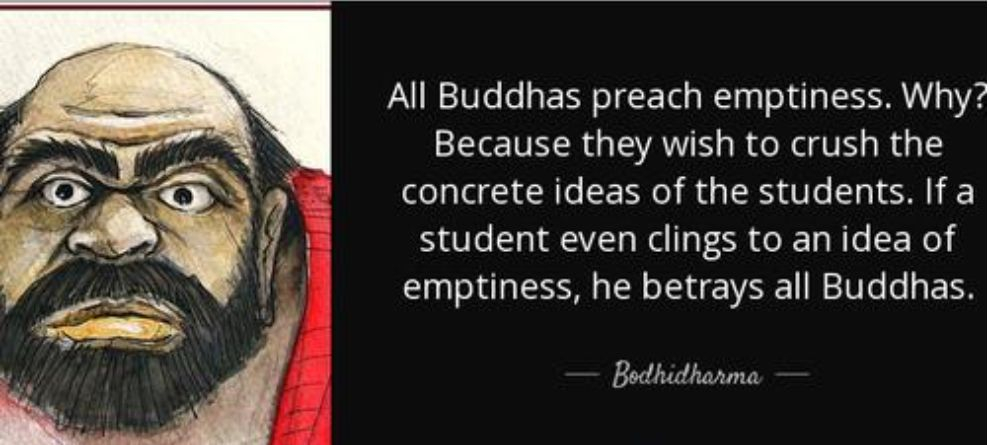
An idea is an idea.
@Jeroen said:
@pegembara said:
That is just a view, opinion, and belief.If you put it like that, it is all just views, opinion and belief — even the sutras of the Buddha. If you live just from your own experience and what you observe from the natural world, you come to very different conclusions.
My conclusion is this.
Whatever you experience, think, or believe in that causes a disturbance that leads to (liking and disliking aka craving...this is not the same as simple pleasant and unpleasant feelings on their own) will cause dukkha. You can know this when your inner peace is disturbed. All you need is to step back and watch the feelings pass. We let the ripples settle.
Attachment(craving) to the guru isn't the way imo.
And yes, even the teachings if held wrongly also cause dukkha but the right teachings will eventually end dukkha.