
Best Of
Re: Letting go of games
Yes, it's a fantasy story and a game through and through. Built on a familiar structure that mimics real life in many ways. And the illusion reveals itself for a discerning eye. Maybe an impossible standard to align with a Buddhist understanding since by their very design, stories and games are meant to engage and entangle the audience within the world. Real life, having a family and a job, and living in a society does the same sort of manipulating which is probably why people find games like this so engaging.
I, too, was disappointed in a lot of the chosen mechanics and missed opportunities for alternative means of playing the game/accomplishing challenges. Though it has been an improvement on previous titles from the studio, and the studio does generally attempt to push games in a more positive direction than other gaming studios. Even if they were to have all those features which allow non-violent progress to build a meaningful sense of purpose around, or even to live a holy life in-game, it's still a purposeless game. It's still building attachments and entanglements to the world.
@person I guess the first two questions that always comes up for me is "What to do instead? and How is that different?". If playing WoW makes a WoW enthusiast feel the same way cleaning a workshop makes a workshop enthusiast feel, what's the difference? A career tradesman may have used-up hands. Maybe similarly a career gamer may have used-up eyes. One displays an accomplishment on the wall or floor, another displays an accomplishment on a forum or profile. They both use up the earth's resources for their own enjoyment. Both can choose to be engrossed in their chosen activity or not.
Here in much of the US people are not looked upon by leaders and peers in a positive way. We are often referred to by our own government as consumers, by our own bosses as liabilities and expenses, and the depth of our connection to friends is measured based on what value we can provide to them. Can't blame people for being disaffected when perceived by others as something that only eats, is a burden, and relatively valueless. If those are the options, then maybe more unsettling is how many people still choose to engage in that way of living. But there is no conventional escape that I can see. It all leads to more strife, not less.
The only option I keep returning to which holds any real value is going forth. Though I don't even really know what that means. Everything else feels like fluff. But I do like fluff. A lot of us like fluff. That's why I keep returning to pick fluff. I think I spent two hours reading and responding to this post and I really enjoyed it. But as you've both, and others, likely stated before, it's also fluff.

Re: Letting go of games
@FleaMarket said:
@person I guess the first two questions that always comes up for me is "What to do instead? and How is that different?". If playing WoW makes a WoW enthusiast feel the same way cleaning a workshop makes a workshop enthusiast feel, what's the difference? A career tradesman may have used-up hands. Maybe similarly a career gamer may have used-up eyes. One displays an accomplishment on the wall or floor, another displays an accomplishment on a forum or profile. They both use up the earth's resources for their own enjoyment. Both can choose to be engrossed in their chosen activity or not.
Its mostly about how doing each activity makes me feel afterwards. I have a lot of activities that provide me enjoyment that most people in society think are pointless or weird. I love story and have seen so many of the serial dramas available on streaming and I love to talk about them with others if they've seen them too. I'm enjoying playing TTRPGs with people, imagining characters, their stories and personalities and the challenge of trying to translate what's in my head in real time to others. Whatever, they make me happy.
I'm sure I have an addictive personality, I was never able to find a balance with video games like WoW or Diablo, etc. I'd hop on as soon as I got home from work and play all weekend, the rest of my life suffered for it. I just redownloaded an old time consuming game of mine Civ 5. I spent a few hours on it and it was just blah. The extra time I have lets me keep a cleaner house, keep my life more organized and managed. The payoff to me feels better for IRL accomplishments.
No judgement on how you like to spend your time. For me, I get too involved and they leave me feeling less well afterwards.
 person
Re: Letting go of games
Some of those pointless weird activities are really the best. Finding wonder in the mundane. I went for a walk today and came across a red-ant hill on the trail and just watched them for a bit. It was pretty cool. The other day after a brief rain I came across a floating leaf suspended by a strand of spider web but no nearby overhead cover for it to attach to. Just dangling and spinning in the wind. (It's still raining in summer here, really weird!)
I certainly remember having the addictive craving for those very same games. Though I think for me the craving came from a desire to escape school, peers, and family. An obsession which lead to mediocre grades and frustrated parents. But isn't it just a stretched rubber band with both sides blaming each other for the tension? From my perspective, "If only they'd played with me." From their perspective probably, "If only he'd done what we asked of him." It's the same but I didn't know any better back then. I barely do now!
Too many potential directions to take this conversation in..
I'm just exploring options in maybe a sort of half-brained way. The questions sound rhetorical but aren't. I'm feeling stuck in the view I have nothing to do and an answer that is to do nothing. But really, I think it's just me letting loneliness proliferate instead of doing something about it. I guess that's why I like games and smoking weed. Imaginary friends to talk to and keep me company. Probably why I enjoy hanging out here so much too. It makes sense, but making sense doesn't exactly resolve much.
Re: Letting go of games
From another perspective, the game places you at the center of an internal and personal struggle. The opening scene is of you kidnapped and trapped while a mind-flayer embeds a parasite into your mind. The following journey is about finding a way to remove it before it consumes your mind. Or learning how to grow it and harness the mind powers.
Of course being a heroic-type game based on D&D, this leads you on an epic adventure which involves many other characters and their stories. One that allows you to decide whether to grow your mind parasite and powers through the guise of being helpful solutions to your roadblocks, or to ignore the inklings/offerings of power and just be a person on the journey for answers and hopefully parasite-removal.
While I'd agree the game world has no real place for contemplation and meditation, and depopulation appears unavoidable in full, I found the writing and dialogue insightful at times. Coming across a conversation or choice or revelation in story that triggers a familiarity with my own life and workings of my own mind.
So I tend to observe the story as one that doesn't exactly take place in a world but in a mind through the familiarity of a world. And while yes it is a game that serves to build worldly attachments rather than cultivate dispassion, I've found occasional moments have caused me to reflect on things like that.
And I also agree, the Buddha would not fight. The Buddha would not play this game nor suggest others play it. It builds attachment and does not lead to dispassion.
Re: Letting go of games
The thing is, the whole game world is crafted to give you very important things to do, to make you significant and heroic. There are many quests where others put their burdens on you, giving you things to ‘fix’ or situations to ‘solve’, drawing on our will to make the world “just so”. It makes you more into a doer.
And what you end up doing is just depopulating the map, killing monsters, goblins and undead left right and centre until almost nothing moves anymore except a few NPCs. It’s like the players role is to make the world safe for the citizens of Baldurs Gate.
My personal inclination is to let things be as they are… why go and upset the natural balances, why be a front for human supremacy and prejudice, why kill all these things? There is no space for contemplation and meditation in that game world. I don’t think the Buddha would fight.
The problem is, the world of D&D contains lots of things that our world does not… the soulless hungering of undeath, brain devouring mind flayers that prey on humans, devils from other planes of existence, evil gods and their chosen. To protect “the people” from these perils we are encouraged to take action, and buy into the concept of the heroic adventure, slaying all manner of wickedness.
But really because of the way experience and levels work in the game it doesn’t really allow you to avoid combat while completing quests, turning it into a kind of stealth game. In theory you could but you would not get very far I don’t think.
 Jeroen
Re: Space - the final frontier
Interesting, I thought I was getting to pretty dark areas. But it looks like I'm only getting down to a 3, maybe a 4.
When I visit rural areas, if I'm driving at night you can see in the distance where the towns and cities are by the light beaming up from the area. It's even more pronounced if its cloudy out.
person
Re: Space - the final frontier
Here is a global light-pollution map: https://www.lightpollutionmap.info
I find it interesting to observe how Europe is swamped in light pollution, how the US and China still have dark parts, and how Africa and Australia are very dark. Latin America is also more light polluted than I would have expected.
This number might be off, but I have read recently that light pollution is increasing by 10% annually. There is the obvious problem to professional astronomy and citizen star-gazing, but I believe an even greater issue is the effect on animals and plants, which rely on a steady day-night rhythm. Also on people's circadian rhythms.
It should be possible to have moderate and sensible lighting. But for some reason, I do not know of any larger cities or countries that have been successful. Maybe they did not try much.
As a rule of thumb we at least want so called cut-off lamps, which point downwards to the ground, and do not light up the sky. Light-pollution is also obviously needlessly costly both in dollar and carbon terms, since we need to produce and pay for all of this light that is escaping into the sky.
 marcitko
Re: Distress vs Eustress
@marcitko said:
With practice and experience, the circles expand.
This is a major takeaway for me as well. That a factor within our control is the degree to which we intentionally face challenging situations. We can change where the line between eustress and distress is.
Taking cold showers, or going to the gym are two small examples. Another example from my own life that has been brought up in the gaming thread. I started playing D&D again during the pandemic, a part of the reason I did that was to socialize more. I have some level of social anxiety around meeting and getting to know new people outside of a professional setting. So even though the thought of engaging socially with others and making a fool of my self trying to poorly role play was stress inducing I stepped into that discomfort and have grown because of it.
I think many of us who have some sort of social anxiety have seen how hiding away often only serves to increase the anxiety. In this context it decreases the line between distress and eustress.
person
Re: Distress vs Eustress
I think this is an excellent distinction. Some associations:
Yesterday in the gym I observed in practice for the first time - or maybe re-observed after forgetting - the difference between pain and suffering. I was doing a relatively difficult weight session (for me) and observed how I was in physical pain, and even a bit of mental strain, but was not suffering. I wanted to do it, I saw the value of doing it, so I even felt happy and proud, as the article suggests.
I am reminded of this diagram from anxiety-curing circles.
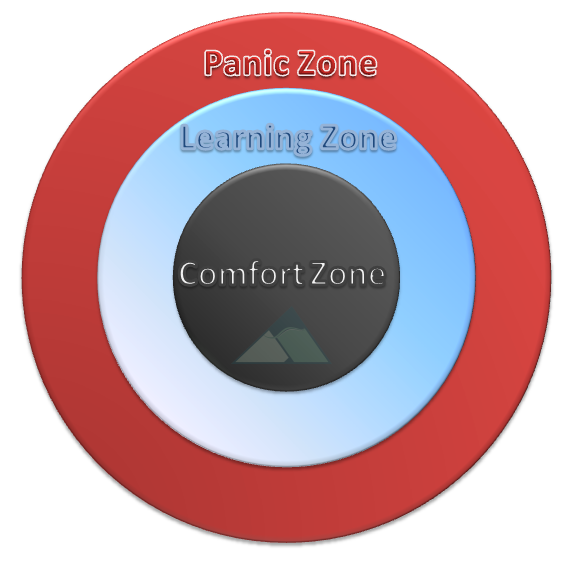
The "comfort zone" is the no-stress and no-growth zone, maybe even the backtracking zone. The "learning zone" is the manageable-stress and growth zone, where we want to be, what I believe the article would call "eustress". The "panic zone" is the overwhelm zone, where the article might say that we are overwhelmed and lack the resources to cope. With practice and experience, the circles expand.
I sometimes sleepover at my mother's. As maybe many mothers do, she tends to want to do everything for me, keep me happy and safe. I observe that even after just a couple of days, I seem to lose a bit of strength and resilience.
In conclusion, I agree with you and the article, it is good to be challenged and to keep growing, and I believe that the best safety is having the internal resources to face challenges. However, to my mind, this does not mean that we should adopt a hyper-individualist attitude, since overwhelm, breakdown, and panic do not lead to anything good. Apparently, as usual, the middle-way applies here too

marcitko