
Best Of
Re: Space - the final frontier
Here is a global light-pollution map: https://www.lightpollutionmap.info
I find it interesting to observe how Europe is swamped in light pollution, how the US and China still have dark parts, and how Africa and Australia are very dark. Latin America is also more light polluted than I would have expected.
This number might be off, but I have read recently that light pollution is increasing by 10% annually. There is the obvious problem to professional astronomy and citizen star-gazing, but I believe an even greater issue is the effect on animals and plants, which rely on a steady day-night rhythm. Also on people's circadian rhythms.
It should be possible to have moderate and sensible lighting. But for some reason, I do not know of any larger cities or countries that have been successful. Maybe they did not try much.
As a rule of thumb we at least want so called cut-off lamps, which point downwards to the ground, and do not light up the sky. Light-pollution is also obviously needlessly costly both in dollar and carbon terms, since we need to produce and pay for all of this light that is escaping into the sky.
 marcitko
Re: Distress vs Eustress
@marcitko said:
With practice and experience, the circles expand.
This is a major takeaway for me as well. That a factor within our control is the degree to which we intentionally face challenging situations. We can change where the line between eustress and distress is.
Taking cold showers, or going to the gym are two small examples. Another example from my own life that has been brought up in the gaming thread. I started playing D&D again during the pandemic, a part of the reason I did that was to socialize more. I have some level of social anxiety around meeting and getting to know new people outside of a professional setting. So even though the thought of engaging socially with others and making a fool of my self trying to poorly role play was stress inducing I stepped into that discomfort and have grown because of it.
I think many of us who have some sort of social anxiety have seen how hiding away often only serves to increase the anxiety. In this context it decreases the line between distress and eustress.
 person
Re: Distress vs Eustress
I think this is an excellent distinction. Some associations:
Yesterday in the gym I observed in practice for the first time - or maybe re-observed after forgetting - the difference between pain and suffering. I was doing a relatively difficult weight session (for me) and observed how I was in physical pain, and even a bit of mental strain, but was not suffering. I wanted to do it, I saw the value of doing it, so I even felt happy and proud, as the article suggests.
I am reminded of this diagram from anxiety-curing circles.
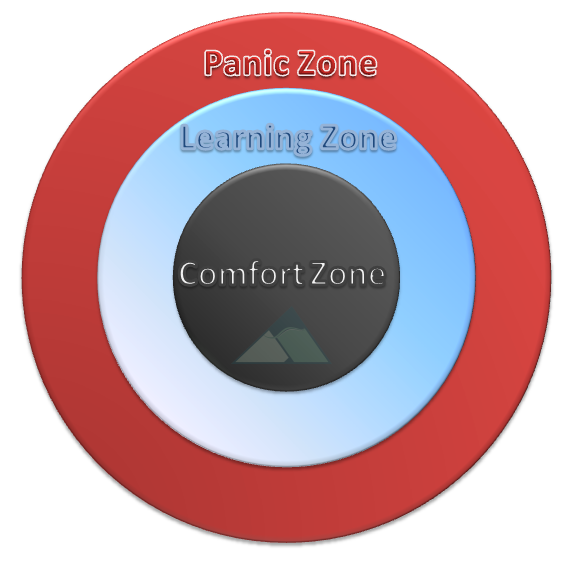
The "comfort zone" is the no-stress and no-growth zone, maybe even the backtracking zone. The "learning zone" is the manageable-stress and growth zone, where we want to be, what I believe the article would call "eustress". The "panic zone" is the overwhelm zone, where the article might say that we are overwhelmed and lack the resources to cope. With practice and experience, the circles expand.
I sometimes sleepover at my mother's. As maybe many mothers do, she tends to want to do everything for me, keep me happy and safe. I observe that even after just a couple of days, I seem to lose a bit of strength and resilience.
In conclusion, I agree with you and the article, it is good to be challenged and to keep growing, and I believe that the best safety is having the internal resources to face challenges. However, to my mind, this does not mean that we should adopt a hyper-individualist attitude, since overwhelm, breakdown, and panic do not lead to anything good. Apparently, as usual, the middle-way applies here too

marcitko
Re: Distress vs Eustress
My experiences from my working life were that there was a certain amount of “positive stress” which could spur one on to do better work. But if you go over the line and life piles a lot of stressful circumstances on you, it can become sharply negative, your body and mind may rebel against things.
 Jeroen
Distress vs Eustress
I was introduced to a new concept today that helped clarify things for me. Positive (eustress) vs negative (distress) stress.
https://www.medicalnewstoday.com/articles/eustress-vs-distress#summary
For a while I've been embracing the value of challenge and difficulty in their ability, and I'd say necessity, to improve mental and physical health. The human mind and body are built to react positively to certain levels of stress. Like the immune or skeletal system, live too long in a sterile or gravityless environment and these systems degenerate and break down. I think there is truth to this regarding our mental well being too. Remove all challenges from someone's life and they become incapable of coping with the inevitabilities of life, or something like how really beautiful people don't have to try as hard for attention and they develop comparatively boring personalities.
Many people face real struggles in life that wear them down and degrade their quality of life. Being able to make this distinction between types of stress helps.
The main distinction between the two has to do with the level of resources, both external and internal, the individual facing the stress has to meet it. From a Buddhist perspective in developing a compassion practice wishing for people to have the internal resources, such as resilience and confidence to face life's challenges, has been more conducive to building compassion for me than things like wishing for things like safety. We all can do things in our lives to increase our ability to meet difficulty, changing distress into eustress. When I get overwhelmed by situations I consciously turn my thinking from worry into focusing on the things I can do to improve the situation and my mental health improves.
person
Re: No thought being true
In my experience there's a real interplay between thoughts and feelings. The feeling in the body gives rise to certain thought patterns and those thought patterns reinforce the feeling state. By letting go of thoughts at times, seeing them for what they are and dropping into the bodily feeling, those feelings begin to release and wind down.
And not identifying with thoughts and having compassion for the difficulty of thoughts that do arise are both really excellent practices in my experience.
I think a better word than false for thoughts is illusory. A mirage is illusory, the details of the appearance can be more or less correct but on closer inspection it all dissolves away. Like 2+2=4 and 2+2=5 are both thoughts, one is more true than the other but they are both illusory.
person