
Best Of
Re: What makes these people so different?
I'd agree there are far more lives destroyed than those who overcome, and extreme suffering is certainly not necessary but it can be a means to an end. In a sense the Buddha, first given all his greatest desires, went and nearly starved himself to death and suffered a great deal. The result of that attempt was being able to cross off that pathway as a potential pathway and earnestly try a new way without having to wonder, because he experienced it and knew. He'd experienced and knew, both the attaining of great desires and the near-death suffering. Knowing doesn't solve much on its own. Something has to be done with that knowledge. It has to be applied somehow, examined in such a way it leads to the striving and flourishing.
When I'm stuck, if I examine my behaviors, I usually have toxic waste running through my mind. Replaying bad memories, imagining bad people getting theirs, wishing it would be different, wondering if I deserved it and so on. It's a big enthralling mental/emotional horror story. This spills into behaviors and actions when left to proliferate. Eventually seeking some form of self-soothing or being jolted aware when someone far less deserving receives my unfortunate misdirection of frustration. It stems from what I'm entertaining in the mind which I'm not always aware of.
So maybe after knowing the experience, the next component could be being aware of what the mind and feelings are doing with that knowledge. Being an observer to the mind and feelings rather than enthralled participant. If so, how does one practice being an observer to themselves and their behaviors?
What I did initially that I found helpful was to start by practicing 3rd-person-view observing. Having come from a gaming background, many games you play your character with 3rd person perspective. The camera sort of hovers behind them as they run around the world and do stuff. This provided me a jumping off point to view myself in my mind as if in 3rd person mode. So maybe for me the question of how to practice is to experiment and explore using things I'm already familiar with.

Permission to throw a tantrum
Ever give yourself permission to throw a tantrum? Sometimes I do that and then I mindfully(usually) beat my chest and huff and puff and say things like "I knowww I knowww I knowwwwwww" until eventually I pass by a mirror or have expelled enough out of the system and just burst into laughter at the silliness. It's really one of the greatest things. And might count as exercise. Would it count as feeding my demons?
https://www.lionsroar.com/how-to-practice-feeding-your-demons/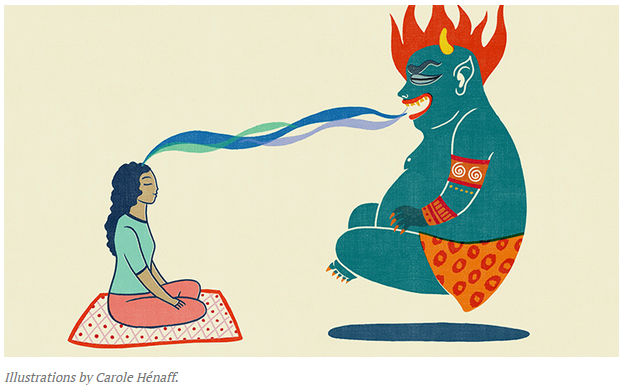
I delivered someones bad karma today. They caught me off guard and we shared a look. Mine was of surprise and pity, or maybe embarrassment. I felt bad because I judged them in that moment based on society's standards and not on what matters. And they saw. They wore my look with confidence and dignity. I'm grateful for that small consolation. Maybe it was them who delivered mine.
Re: Gabor Maté and Ayahuasca
@Jeroen said:
@Kotishka said:
How do you keep your mind at peace while the world is out of order?In Hindu philosophy there is the idea that the world is illusion, maya. That is one way to keep the mind at peace, although not one that I personally find satisfying. A key facet is the idea that nothing truly matters. An advanced Buddhist practitioner also arrives there, via the path of letting go of desires and fears, once you have given up your desires and fears you have perfect equanimity, perfect peace.
I'm not that knowledgeable about Hindu beliefs, but you've only captured half of the Buddhist view.
“Padmasambhava said: ‘Though the view should be as vast as the sky, keep your conduct as fine as barley flour.’ Don’t confuse one with the other. When training in the view, you can be as unbiased, as impartial, as vast, immense, and unlimited as the sky. Your behaviour, on the other hand, should be as careful as possible in discriminating what is beneficial or harmful, what is good or evil. One can combine the view and conduct, but don’t mix them or lose one in the other. That is very important.
‘View like the sky’ means that nothing is held onto in any way whatsoever. You are not stuck anywhere at all. In other words, there is no discrimination as to what to accept and what to reject; no line is drawn separating one thing from another. ‘Conduct as fine as barley flour’ means that there is good and evil, and one needs to differentiate between the two. Give up negative deeds; practice the Dharma. In your behaviour, in your conduct, it is necessary to accept and reject.”
~Tulku Urgyen Rinpoche
...his transmitted teachings were very clear in pointing out the two salient and complementary aspects of spiritual practice that necessarily must go hand in hand if one’s efforts are to bear fruit – right view and right conduct. The successful integration of these two qualities is essential for the realization of a true spiritual maturity in which the aspirant is liberated from the poisons of ignorance, envy, greed, hatred, arrogance, and emotional contraction...
https://theconsciousprocess.wordpress.com/2014/05/06/view-and-conduct/
 person
Re: Vassa Dhamma Challenge
@SuraShine said:
After a particularly horrendous two weeks where I’ve berated myself for leaving Pathology and seriously considering going back, I’m joining this quest late.Yesterday and today so far, have consisted of me getting so upset to the point of tears, that I have had to constantly remind myself of my Bodhisattva vows and calm down. Currently on my third headache in two days so I need to refocus and meditate my arse off.
This is just my personal experience, but I have found that I either cannot make decisions or make lousy decisions when in the thick of emotional 'attacks'. For me, it takes a patch of clearer emotional 'weather' to see things a bit more clearly and see the - often then obvious - best course of action. I find that for me the best way to access this calmer state is physical exercise. It has at least two benefits: I get a respite from my mind for the duration of the exercise and also feel calmer and better the rest of the day. I sometimes think of myself as the 'sports guru' since I find so many benefits 😊
 marcitko
Re: What makes these people so different?
I personally know someone who suffered abuse at the hands of a priest when he was young, then joined the Green Berets in Vietnam and suffered tons of trauma there. He's the only one left out of his 100 some group that hasn't either died over there or killed themselves after coming back. He's had many struggles with his PTSD and continues to suffer to this day. But he is probably the kindest, gentlest person I know.
My curiosity isn't merely an intellectual pursuit. I think knowing the answer to what makes people resilient and capable of rising above will help give us tools that can help others live better lives.
I think over the years I've also increasingly embraced the idea of anti fragility. That humans need some level of stress and struggle to really grow and flourish. Or the Japanese notion of kintsugi, or what Ajahn Brahm says about the bent and crooked trees seem more beautiful to him than the straight trees. A line from a show I've been watching expressed gratitude for the pain and stress of life rather than regret or aversion, "I'm grateful for my pain, its what's brought me to where I am today."
To be clear, I'm not saying pain is a good in and of itself. Only in conjunction with the repair does it provide a benefit.
person
Re: What makes these people so different?
I have experienced great hardship - mostly in the realm of mental health troubles.
I know what happens if you do nothing, do not struggle to better your situation and yourself. Nothing happens, it even gets worse. I did this for (far too many) years.
I know too firsthand what happens if you do struggle to better your situation and yourself. Slow progress at first, uneven progress, but longterm benefits that you could not even dream of.
So, for me, the possibility of bettering our situation and ourselves is not in question, I know it can be done. Even if 'authorities' say that it cannot be done, it still can be done.
What to me is an open question is why some people start struggling and why some make moderate and some massive efforts.
All of the great success stories of overcoming hardship that I have read - and I love and seek them out - have apparently included great effort over a long period of time, starting with one small step, and then another, and another... until it snowballs into a beautiful life.
marcitko
What makes these people so different?
From another thread. I wanted to explore without taking away from the original topic.
@person said:
@Kotishka said:
Pd: one case I can share is the following family. Missing father (fighter for Frente Polisario) and a mother that could not take care of them. Environment of war, horror, and poverty in Western Sahara. They tried their luck emigrating to Spain. One stayed. The others returned.
1. Became a soldier at the Frente Polisario.
2. Became a drug addict and homeless.
3. Studied in Rabat and ended up becoming a university philosophy professor.This last example surprised me. He managed to defy all odds and predictions. He managed to break what seemed to be his determined path. Not everything is as fixed as it seems, but the power that those "structural configurations" might have upon humans is a possible and, unfortunately, common reality.
My sister is really into those stories by people who have had horrific childhoods only to escape and break the patterns, like in your last example. This has raised the question in me that I've never really gotten an answer to. What makes these people so different, that they're able to do this with their lives? I think this is kind of what positive psychology is trying to answer, not just what our pathologies and traumas are that cause us misery and stress. But what are the positive qualities that bring people striving and flourishing.
If only looking for just the positive qualities its easy to miss the neutral or hide from the negative ones. I think its those regular neither positive nor negative qualities that lead to the striving and flourishing. Mainly the qualities of knowing and of heart release.
Two aspects of knowing come to mind that can help lead to positive change.
One aspect could be the knowing of one who's suffered one of the worst things imaginable. When you've experienced it, you know. You know when you've felt the worst thing possible, that you've felt it. You know it. That comes with a sort of power of knowing the experience of the thing. Others who've never experienced it can only know it intellectually. They have to imagine the experience and most are dearly afraid of actually experiencing it. People think about their greatest fears often. But the ones who've gone through it don't have to be afraid of the imaginations like others. They know. I think there's a relief that comes with that knowing where others feel anxiety. Its in that relief the heart has an opportunity to open. Because it already took the wound and knows it. It doesn't have to be afraid like others.
Another aspect could be the knowing of one who's experienced their greatest desires. Imagining and achieving greater and greater desires are what drive a lot of people. People have desires for different things but the infatuation and imagination is similar. Some people get their greatest desires. In getting their greatest desire there often isn't much else left to do but go for it again. Why settle for a lesser desire when your greatest one is accessible? So again and again and again until that greatest desire becomes meaningless. And then again. They know the experience of having their greatest desire in abundance and all the details of what that really means. People who haven't experienced it can only know it intellectually. They have to imagine the experience and many can't do much else but imagine the experience of achieving their greatest desires.
In both cases the neutral quality of knowing allows for a freedom from some of the mind's greatest fixations. Greatest fears and greatest desires. And when you free up that many resources, you can do a lot with em. Like focusing on striving, or flourishing, or just on the breath.
Re: Gabor Maté and Ayahuasca
I was reading the "No Buddhist Quotes" thread and the latest quote by Mate stood out.
“The logic of worldly success rests on a fallacy: the strange error that our perfection depends on the thoughts and opinions and applause of other men! A weird life it is, indeed, to be living always in somebody else’s imagination, as if that were the only place in which one could at last become real!”
― Gabor Maté, The Myth of Normal: Trauma, Illness, and Healing in a Toxic Culture
He talks about the problems of individualism in one breath and then here he says impositions from others are false and that real being is all about us. I don't get it, it sounds completely absent from any sense of living with other people. Like, its really important to have connections and community, but we all should live like we're the only one who's views matter.
What I mean is, when being in community we need to be aware of and consider other individual's and the group as a whole's interest. It doesn't seem possible to me to be fully genuine and be in community, unless that necessarily small community also happens to align with your own authenticity. If you're a member of a motorcycle club, there is some expectation from the group that you come riding a motorcycle and don't want to join in by driving your Prius. You can join a Prius group instead, but at some point have to interact and cooperate with the motorcycle club. At that point there needs to be some sort of accommodation and the community's interest imposes constraints on us.
Its possible I truly don't get it, the attitude is pretty alien to my mind. But that doesn't mean I'm right. Is there another way? Am I missing something? Is there a way to be fully authentic and be part of community? I'm genuinely asking.
person
Re: Gabor Maté and Ayahuasca
Trauma is not really a blaming of the world for one’s troubles though. It is incorrect coping, often because the person doing the coping does not have the skill or context to correctly relate to what is happening to him. That trauma exists and malforms our lives is beyond doubt, it’s just whether you choose to be kind enough to yourself to see it.
There is such a thing as toxic positivity, which is thinking that is insensitively positive, and in effect blinds you to what is really going on.
 Jeroen
Re: Gabor Maté and Ayahuasca
There are structural situations which make certain decisions or scenarios much more likely. There is still some autonomy as not everything is solid and determined. Your self-concept is modeled by what surrounds you, by what you engage with, and your own specific dispositions. This goes from your temperament, to your parents, to your local and global sociocultural milieu which composes your reality.
I have seen people repeating patterns that trace back to their parents, and these to their own parents. It reminds me of kamma and habits (unskillful actions) which are inherited and copied. To help them realise these connections does alleviate and provide a path towards change. This does not mean to blame the world and adopt the role of victim. This ends up making people spiteful, angry... a full of new unskillful means!
The story of an annoyed Yama comes to mind. I refer to it constantly: the Lord of Death hearing two people suffering from their misdeeds, blaming their past kamma. Yama replied: it was you that commited those actions!
🙏🏻
Pd: one case I can share is the following family. Missing father (fighter for Frente Polisario) and a mother that could not take care of them. Environment of war, horror, and poverty in Western Sahara. They tried their luck emigrating to Spain. One stayed. The others returned.
1. Became a soldier at the Frente Polisario.
2. Became a drug addict and homeless.
3. Studied in Rabat and ended up becoming a university philosophy professor.
This last example surprised me. He managed to defy all odds and predictions. He managed to break what seemed to be his determined path. Not everything is as fixed as it seems, but the power that those "structural configurations" might have upon humans is a possible and, unfortunately, common reality.
 Kotishka