
Best Of
Re: Why I’m not keen on the bodhisattva vow
@Jeroen said:
The vow goes something like this: I vow not to accept enlightenment until I’ve helped all other sentient beings into nirvana.
This is a very difficult matter, because different Buddhist traditions interpret what exactly it is to be a "bodhisattva" quite differently. The "shepherd-like oath" is a specific framing of the bodhisattva path that comes from specific currents in Mahāyāna. It is not universal to Mahāyāna, and it is taught generally in a Tibetan/Vajrayāna context.
Even the matter of Bodhisattva Avalokiteśvara being the "model" for the shepherd-like oath is not universal. Outside of Tibet, in the wider generally East Asian tradition of Buddhism, the Bodhisattva Avalokiteśvara has the powers and status of a Fully-Enlightened Buddha precisely because he is a Fully-Enlightened Buddha. In the distant past, the Bodhisattva Avalokiteśvara was known as Saddharmapradīpa Tathāgata. Due to the powers of his Buddhic oaths, instead of entering into Parinirvāṇa, when his life-faculty became exhausted, he spontaneously produced the body of the Bodhisattva Avalokiteśvara as a vessel for his oath and took birth within it.
Karma follows the doer through the air.
It pursues him among the rocks.
It accompanies him into the depths of the earth.
It enters the waters of the ocean with him.It lays upon the lit pyre with him.
It ascends into the air with him.
It pursues him always and everywhere.
The shadow of karma is indestructible.The oaths of the Bodhisattva follow him through the air,
into the mountains, into the earth, the woods, and the ocean.
They accompany him always and everywhere.
The oath of Bodhi is indestructible.
As a Bodhisattva, it were better if you were a Buddha. A Buddha is in a far better position to be of service to those bound in saṃsāra. In many forms of Mahāyāna, there is no "shepherd-like oath," and this is just one reason.
The entire metaphysic that underlies the shepherd-like oath presumes that, once a Buddha attains Parinirvāṇa, his body and mind disappear, him being dead, and he cannot aid living beings. This is the reason why, in these kinds of Mahāyāna, the Bodhisattva actually attaining Bodhi, actually becoming a Buddha, is a disaster. So much work still left to be done, and the worker has abandoned the job site, an abandonment in the form of Parinirvāṇa.
Other kinds of Mahāyāna Buddhism explain that Parinirvāṇa is not extinction, and thus there is no need to avoid attaining Buddhahood in these traditions. The Buddhas can continue to aid living beings after Parinirvāṇa.
In the Lotus Sūtra, Old Prabhūtaratna lifts his throne into the heavens, and Śākyamuni lifts the Mahāsaṃgha up with it. Enthroned above, Śākyamuni expounds the Dharma:
Many aeons have passed since I attained Bodhi,
countless hundreds of thousands of millions of aeons,
endless thousands of millions of trillions of asaṃkhyeyas of aeons,
uncountable innumerable inestimable incalculable aeons.Always, I have taught the Dharma.
Countless millions of livings beings
I have caused to enter into the buddha-path
over these countless aeons.In order to liberate living beings,
I masterfully manifest Parinirvāṇa,
yet in truth I do not pass into extinction.
Always, I abide here preaching the Dharma.Although I always abide here,
through many godly psychic powers
I lead the living beings into an error:
(in that) though I am close by, I am not seen.Many see me passing into extinction.
Widely, they worship my śarīradhātus.
All of them, filled with yearning,
are yearning to gaze upon my heart.When a living being truly surrenders,
becoming genuine, straight-minded, and gentle,
and (he) wholeheartedly desires to see the Buddha,
he becomes selfless and charitible in this body and life.At that time, I and the Mahāsaṃgha,
entirely without exception, appear upon Gṛdhrakūṭa
where I, at that time, speak to them, saying:"I always abide here, but not in extinction.
Through the masterful application of my powers,
I appear to manifest extinction and non-extinction.
In distant lands, there are living beings
prostrating to me, trusting in me, rejoicing in me.
I return to abide at those places
in order to speak of the Supreme Dharma.
You, not hearing this that I say,
all call me ‘extinct’ and ‘destroyed.’
I see the many living beings
as drowning in strife.
That reason why I do not reveal my body
is to cause them to strive and yearn.
Because they have been caused to yearn for my heart,
they then go forth to hear the Dharma.
Via my godly psychic powers, it has been like this
for asaṃkhyeyas of aeons.”I always abide upon Gṛdhrakūṭa,
yet I have many other abodes.
When living beings see themselves taken
by the great conflagration that burns the aeon,my Pure Land is nevertheless peaceful,
always crowded with the gods
as they rain down mandāravā petals,
scattering them over the Buddha and the Mahāsaṃgha.My Pure Land is imperishable,
yet the masses see it completely aflame
with worry, terror, and rage.
These things they suppose it is brimming with.These many suffering living beings
because of wicked deeds and predestined fates
fare on for asaṃkhyeyas of aeons,
never hearing even the names of the three Jewels.All who cultivate virtue and merit,
who are gentle, genuine, and straight-minded,
all of them will behold my body
abiding here and preaching the Dharma.For the sake of these many living beings,
I disclose that the lifespan of the Buddha is immeasurable
and that I remain so that the Buddha can be seen.
To others, I say that the Buddha is rare to encounter.The power of my wisdom is such.
The light of my wisdom endlessly shines.
My life spans countless aeons.
I remain, continuing to practice the saving of beings.You venerable sages,
do not give rise to doubt concerning this.
Dismiss all that causes you to doubt in this.
The Buddha speaks the truth, not lies.I am like the physician schooled in many remedies
who, to treat his mad son,
truly lives but says he dies.
This cannot be called 'wicked speech.'I am the father of the world
and the physician of the many suffering invalids.
The common man is inverted.
I truly live, though I say that I cease.If I am always seen,
beings’ hearts produce arrogance, self-indulgence,
heedlessness, and attachment to the five desires.
They fall into evil paths.I always know which living beings
walk the path and which do not walk the path
and I accordingly echo their capacities,
disclosing the Dharma (to them) in manifold ways.Always, I naturally arouse this determination:
"By what means will this living being
be led to enter into Supreme Bodhi
to quickly acquire the body of a Buddha?"
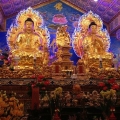
Re: Why I’m not keen on the bodhisattva vow
I come from a tradition which does not deny or delay attaining Buddha in being a Bodhisattva. Rather the Bodhisattva practice is aiding others in their progress even as we strive to achieve Buddha. Also, upon attaining Buddha, we do not renounce Buddha as we continue to aid others in their striving for Buddha.
Picture a large plateau atop a steep hill. The hill is difficult o climb Upon reaching and standing upon the plateau is to achieve Buddha. The Bodhisattva is giving others a hand in their climb as he/she ascends. The Buddha is atop the plateau reaching down to give all a hand in their ascent to the plateau. The difference in the actions of a Buddha and the actions of a Bodhisattva are virtually indiscernible.
Everyone climbing the hill and assisting others is himself/herself performing the actions of a Bodhisattva as they proceed up the hill.
Everyone has the potential of Buddha.
Everyone is capable of the actions of a Bodhisattva.
Peace to all
 Lionduck
Re: Wim Hof - Feel the Cold and do it Anyway
Last night I took a 2 minute cold shower right before getting into bed. It was really grounding settling into the sensations of the body, it'd probably make a good practice to do afterwards all the time. Get out of the shower and lie down to focus on bodily sensations for a few minutes.
 person
Re: Moments of happiness
It might be a useful exercise to flip that view up on its head. Happiness isn't necessarily the end all be all of a well lived life.
For example, I don't find a whole lot of happiness in work. AND it does provide me with stable housing and food, plus the freedom to engage in activities that do bring joy. In addition, it adds meaning to my life in that I'm valued by others and make a small positive impact in people's lives through it.
Sitting in front of a computer doesn't make me feel particularly happy, it can often even detract from it. AND the knowledge and perspectives I gain there allow me to have meaningful discussions and contributions to the world around me.
I deeply enjoy family gatherings and beautiful vacations. Those can be a bit fleeting though, so I try not to put my hope in happiness on them too much. Real happiness, in my view, is dependent on one's overall outlook and spiritually cultivated emotional state, more than the experiences we have.
Also, meaning is incredibly important in the quality of one's life. And things that give us meaning don't always bring us happiness.
https://www.theatlantic.com/health/archive/2013/08/meaning-is-healthier-than-happiness/278250/
If you were to try and make the next twenty years the best of your life, what would that look like to you?
I'm as conflicted as ever. On the one hand a part of me would like to devote myself more fully to a life of spiritual practice. On the other hand most of the activities I find enjoyable sort of clash with the overtly spiritual life.
A fantasy, or dream, I have of maybe retired life would be to have the resources to be able to live out of an RV and move about this large country of mine, living more in nature and experiencing different communities.
person
Moments of happiness
Just the other day my cousin and me were discussing getting older. I said, I’ve become 50 this year. And he said, so make the next twenty years of your life the best yet! Which made me think, what makes any decade better than what came before? What makes me happy about a year or a decade?
So when I look into my memory, and I consider happiness, all kinds of moments come to the fore: family feasts, moments of expansive oh-wow views on holiday, beach walks, moments drinking coffee with my dad. The dharma. Some of these moments are holiday moments or moments of adventure, walking on mountain peaks or moments in beautiful places. But many are not.
Its also clear to me what moments do not immediately come to the fore: work, offices, achievements, time spent behind the computer. Even time spent on a forum apparently doesn’t register in any significant way as a deeply happy experience. Movies and tv don’t seem to register either.
If you were to try and make the next twenty years the best of your life, what would that look like to you?
 Jeroen
Re: Why I’m not keen on the bodhisattva vow
Interesting, @how… certainly for one who thinks there is no self, the whole vow makes no sense. I’ve not yet found a self, and looking inwards so far shows me only things that are devoid of self, yet there is a presence that I would tentatively call ‘I am’. However, if I can observe it, it cannot be the self. So perhaps I am the observer? But what about action, say making a limb move? An observer who can instigate actions, that finally result in the limb moving? That’s as far as my mind has gotten.
Various people say there is much more to be understood, that we and the universe are one. And I can grasp this, that without all the rest of the universe I would not be here, and that without me being here all the rest also would not be. We are one. But the expansion of consciousness I have yet to experience, I have been told it is possible.
Jeroen
Re: Understanding the do'er?
The do'er equates to the I am and makes it's bike wheel or chakra or sense gate or monkey mind the dominant being. Or dower do'er, ego, impediment etc.
Good advice from @how.
We attend to the sitting, eating, watching, hearing and thoughts BUT with equanimity rather than indulgence.
How? This way …
https://www.buddhistdoor.net/features/bare-awareness-or-bare-attention/
 lobster
Re: Understanding the do'er?
Awareness is fundamentally non-conceptual before thinking splits experience into subject and object...It is Empty and so can contain everything, including thought...It is boundless ...And amazingly it is intrinsically knowing
Yes it would seem that awareness is the key...

 Shoshin1
Re: Understanding the do'er?
What you wrote can be a functional and experiential breakdown of meditation when viewed through the sense gates.
Whatever we cling to, are repulsed by or deliberately ignore will affect how we experience any phenomenon, with suffering being the inevitable result.
I would only suggest to watch out that the do'er doesn't end up getting shunned within your own meditative process and that all the other sense gates are simply given the same equal stage spacing that this former star performer was formally commanding.
 how
how
Re: How much personality do we hear in a speech?
The subtlest of subtexts of any conversation becomes apparent when met by true equanimity.
This was the foundation of much of the Buddha's Dharmic success with others and was the primary source of his skillful means as a teacher,
but
a fostering of a predetermined intent to uncover the subtext of another's conversation more aptly belongs to the realm of the phycological than to what the Buddha called the path towards suffering's cessation.
how