
Best Of
Re: Buddhist View of Justice
Buddhist View of Justice
At a Dharma talk many moons ago the Dharma teacher made this interesting point:
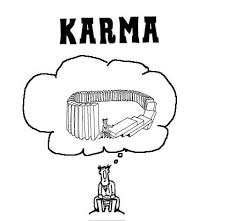
If people truly understood that their actions inevitably bring consequences "for every action there is a reaction", those of sound mind would act responsibly, not out of fear of punishment but out of wisdom. A society guided by this awareness might have little need for police, armies, or courts. Ethical behaviour would come from inner awareness rather than external enforcement.
However because human beings are still imperfect and often unaware, social structures like laws and institutions remain necessary.
Understanding karma can be seen as a path toward a more peaceful society.
A peaceful journey of 1000 kilometers begins with the first wholesome karmic step.
 Shoshin1
Re: Buddhist View of Justice
I don't know about such. I know genital mutilation can be culturally / religiously motivated and I can imagine sexual abuse being more rampant in some cultural circumstances, but never heard of the specific example, nor seen any data about it. I have very specific ideas about all the factors that come into play from the nurture side of the story when people engage in abusive behavior like such. I can point fingers to society all day long and write several pages on how all our monsters are just products of their environment and I guarantee that even if some of you are hell-bent on seeing this issue in black and white, it'd all make sense. But at the end of the day, there is agency, there is personal responsibility and everyone is very much responsible for their own behavior. There is a collective fault for pushing people to the edge, after all, we are all conditioned to be pleasure-oriented, from a young age to measure one's worth in success in romantic relationships and libido among other things. But choices are still made and those choices have consequences.
 RobinH
Re: Buddhist View of Justice
It's a shame wealth and power shields people from consequence, because it only adds to this blind outrage, yet it fails to be constructive. I believe Epstein himself ended up on the registry a while back, yet it didn't stop him from building a network of abuse further. While others like that sometimes got murdered by their neighbours (hailed as heroes), he was still shaking hands with the elite and doing his operations from his private resorts. People are rightfully upset, that politicians and authorities choose to make exceptions when it comes to the privileged, but then again, people think they can take everything that's wrong with these things and pack it into the word "pedophile" (a clinical term) while refuse to acknowledge that the reason for abuse, any kind of abuse is much more universal: ignorance. Ignorance of privacy, of bodily integrity, of boundaries, of agency, of healthy developmental needs. Anyone who learns to avoid these and how to: can be kind to others and anyone who fails to avoid these can do great harm, even if they believe their motivations are pure as snow and they have the support of society behind them.
RobinH
Re: Buddhist View of Justice
I am not a Buddhist, as in I've yet to commit to the Dharma, but few things upset me as much as the way society, generally reacts to the suffering of those who they deem deserve it. I often encounter footage of people, sometimes teenagers given life sentences, breaking down in tears and the most average people I walk past the street are cheering and celebrating. Now more and more states are loud about extending the death penalty for this and that and I can tell, after all the damage they do, people still yearn for more, like live tv entertainment executions. It is rather traumatic for me and such intense hatred often makes me lose my will to live.
A life behind bars is wasted. A life taken is wasted. Any family that person had is broken, torn apart. Any family they could've had is lost. If I die because of someone else's fault, how could such devastation honor my memory? They shouldn't remain a danger to others, of course, they should be properly rehabilitated, but I recognize no justice in making people suffer. If they come to regret what they did, they should be able to try and make up for it in some way. And if they don't come to regret it the justice system fails a purpose that is core to its existence as far as I'm concerned.
RobinH
Re: Buddhist View of Justice
This is pretty much my own personal view of justice. You describe a cause and effect situation if people seek revenge. I believe that negative thoughts, like revenge, can warp a person's reason and possibly even their mind.
I've observed an increase in hubris in people. Hubris was a crime in ancient Athens. It seems to be encouraged in society today. This probably affects the justice system and causes people to abuse it.
I saw a group of women turn on one of their own because she took credit for another person's work. She didn't actually steal it, she copied it and used it as an example of her work. I didn't see how the situation started but it was disturbing to see the degree of anger from people who were not directly involved. One or two people pointed out that the woman was having personal problems and asked the others to hold off on accusing her. Others wanted to punish her to the max. Finally, the supervisor had to put an end to it. Those women were like a mob. Some of the most emotional ones were not the damaged party. Funny thing was, the person who had their work copied was the most gracious.
I don't mean to complicate the question, but here goes. I've come to the conclusion that people who cultivate anger in their actions, come to practice it much like other people practice the 4 Noble Truths,etc. They seem to try and legitimize anger and revenge by claiming it to be righteous justice. In this way they convince others, who might be more compassionate, to follow along. They also corrupt real justice, which should be about constructive repair of a wrong. Who becomes most responsible for the negative effects? The person who inspires the righteous justice or the ones who follow along?
 kayte
kayte
Re: No Buddhist Quotes
When you’re deeply looking at something, you’re loving it. And I think that when you do that, whether it’s with a person or a nonhuman animal or a plant or a tree, it is a way of witnessing and being witnessed.
Ada Limón, “Decentering the Self”
 Jeffrey
Re: Buddhist View of Justice
RobinH I think you make a very good point. Most people’s sense of outrage is more developed than their actual sense of justice, and that outrage spills over into anger and violent retribution. It is well known that people individually can be kind, sensitive, good-hearted, but as a mob can be much more volatile.
I think it’s very interesting with all the information coming to light from the Epstein files, that there has been a lot of outrage but very little actual consequence. It seems that in the structure of society today it is a lot more difficult for action to manifest than in the past. Reputational damage is about as far as it seems to go — I don’t think Deepak Chopra will be selling as many books.
 Jeroen
Re: The Plant Medicine Path
One thing I found very interesting about the interview were Pollan’s comments about how psychedelics and meditation support each other. He said parts of a recent psychedelic vision only became clear in meditation, he was talking about being bumped into by two blimps, one of which was labelled ‘fear’, and that in meditation it became clear to him that this was the fear of losing his loved ones.
Jeroen
Re: The Plant Medicine Path
@lobster said:
Thought this interview might be of interest...https://www.theguardian.com/books/2026/feb/08/michael-pollan-psychedelics-consciousness
Thank you @lobster … this is right up my street, I will definitely buy a copy of the new book when it appears, or sometime soon afterwards. I see that A World Appears is going to be out on the 24th of February, but the initial copies are hideously expensive, 28.99 euros for the paperback if you preorder so I might wait until it comes down to the usual 12 euros.
Very interesting that he considers this new book on consciousness to be present in seed form in the earlier book on psychedelics — it seems to be clear that the psychedelics do illuminate the workings of consciousness to a certain extent. I’m very curious to see what Pollan has to say about consciousness, I have a lot of respect for his journalistic capabilities.
Loved the interview as well, @person, the bit where Pollan says “scientists in print are very clear and definitive, but in person they are a lot more diffident, saying things like, it was a limited study, or, this is what we know now.” Some nice nuggets in there.
A new Michael Pollan book is a treat.
Jeroen
Re: The Plant Medicine Path
@Jeroen said:
The thing is, there is a whole area of human experience which modern life has excised.
Of course, the other thing that modern life has excised is the respect for the invisible world. Most indigenous people hold that there are two worlds, a visible world and an invisible world. The invisible world is mediated by the shaman, but in Europe all the remaining shamanic practitioners and wise women were killed off by a thousand years of Roman imperialism and the subsequent Catholic Inquisition.
That led to an investment in the physical world, the European Enlightenment and the Industrial Revolution which spread to North America, and has lately spread by successive phases of globalisation to much of the rest of the world. The understanding of the invisible world is a social stream that seems to be dying out, and with it a respect for the spirits of wild plants and animals.
Without a respect for the invisible world, can we truly understand our own mind and being? The mind affects the body profoundly, as Gabor Maté’s book on trauma also showed, so do not the spirits that we perceive also affect the mind and the body?
Jeroen