Best Of
Re: Rise Above
I like the phrase "less wrong", rather than true or right when it comes to the pursuit of knowledge. To me it kind of says, this is our best understanding right now, but we're always learning and discovering more, while also acknowledging that its not all just a coin flip, we do have some verifiable understanding of some things.
 person
Re: Rise Above
@Jeroen said:
@person said:
Buddhism does have views of the invisible world such as karma and rebirth that I tend not to fully take on board. I say from time to time, though maybe not explicitly enough, that I've abandoned the renunciation and mystical thinking of the path. I'm trying to live a worldly life that still adheres to the teachings, but I suppose at some level that whole endeavour fails because it ignores the invisible aspects of the teachings.I think that’s very interesting, because a lot of the early stages of Buddhism are about Right View, which is about getting the concepts straight in your head and dropping unnecessary things.
Which I feel like I'm doing. I'm debating about what is and isn't right view and what should and shouldn't be adopted.
Now you have a very long history with Buddhism and still say you are a Buddhist but no longer adhere to “the renunciation and mystical thinking of the path”, it seems to me difficult to reconcile? For me they are the most attractive parts of the path.
This is a good question for Western Buddhism as a whole as most who practice in the West don't really follow them. I just set it on the back burner as many Tibetan teachers have said to do and take the practice to live a better life in the here and now. If karma and rebirth are true then I'm hoping that will be good enough. If not, I suppose off to the hell realms for me... 😓
Not to criticise your Buddhism @person, I’m sure a lengthy introspection led you to this point, but perhaps the intellectual life outside Buddhism has started to carry you along in other directions?
Yes, this is what I'm saying. I'm looking to other ways of living. I kind of think the balance of Taoism may be closer to what I'm attempting, though still using Buddhist practices. I've been more seriously considering Zen as a path recently (which is some sort of blend between early Buddhism and Taoism). Early on in my Buddhism I had the view that trying to live in the world was destined to failure. That it was like trying to balance on a knife's edge. You try to gain a foothold one place and the other foot slips, on and on, there is no safety. I had in my mind that I would renounce and become a monk, but that never happened and I eventually conceded that it probably never would. That I'd be better off trying to make an attempt to live more fully in the world while still attempting to live in a spiritual manner.
Often psychologists want to be seen as scientists and this colours their work and output.
My story is more about I was the sort of person who believed all the things. Psychics, aliens, ley lines, etc., etc. Time and again the things I believed in showed themselves to have big flaws and to not be true. Including believing in the invisible world of demons attempting to possess me, which was in fact a psychotic break which I now believe was brought on by working for 2 months in the home of someone with mental health issues of their own. I didn't realize it at the time but I'm sensitive to the emotions of others and readily take them on. So anyway, in essence I'm very open and intuitive, I take in a lot and needed some way to discern what is valid and what isn't. So that is why I think a rational, scientific approach is important in deciding what is true and what isn't.
Perhaps what I'm clinging to and have need to let go of is the idea that the spiritual path is a distinct thing with parameters and ideas and that it’s worth preserving. That is an attachment, no argument there. I suppose I'm not really willing to do that, if you have a good argument for why I should I'm open to hearing it.
If you no longer chase the idea of attaining the Buddha’s enlightenment, then what is the point of the spiritual path?
A happy, meaningful life. Enlightenment simply isn't on the table for me unless I leave the world behind and focus on that. I can't rule out karma and rebirth, so if it does continue perhaps I'll continue on the path of eons and get there at some point. If anyone is open to supporting me financially to pursue enlightenment, I'd be open to considering it.
person
Re: Rise Above
@person said:
I guess I'm not trying to say don't be political, politics is important.
I’m not so sure of that. I rather think that nothing is truly important — so don’t believe anything that you think. Or at least, nothing is important enough to let it take up residence in your thoughts, and disturb your peace.
 Jeroen
Re: Just for fun: the random, useless announcements thread!
@Kotishka said:
That is very true! Or seeing that there is nothing to be afraid of.
Thus have I heard : 
 Shoshin1
Listening to the heart
I was just having a discussion with a good friend about meaning in life, and she held that for her learning and development held more meaning than proving one’s capability through overcoming challenges. For me that hasn’t been true, if I look at my life the things I was most proud of, that lent me the most confidence, they were creating things of beauty and accomplishing difficult things.
I think that meaning ends up in one’s life automatically, as long as you follow your heart. I find that not listening to the mind but listening to the heart is an art, it’s like finding the silence inside even amidst noisy surroundings, a knack. I haven’t always been equally good at it but most of my best decisions have come from that space.
I said yesterday to my dad, if I have a regret it is that I didn’t make it happen when you proposed that we should go on a tour to Egypt together to see the antiquities a couple of years ago. That may still happen, I held it out for him that if he becomes well enough we will go and do it with the two of us. It’s difficult but I think my mother will be alright with being on her own for a couple of weeks if we arrange the right support for her. And that immediately felt like the right thing to do.
Generally I can only find my emotions and the voice of inspiration that comes from my heart when I’m quiet inside.
Jeroen
Re: No Buddhist Quotes
“The further a society drifts from the truth, the more it will hate those who speak it.”
~Aint that the truth~
Shoshin1

Re: The Plant Medicine Path
My only exposure to 'plant medicine' was through a girl at a long-term group-therapy, who suffered from depression.
She did ayahuasca with some shamans, and reported tremendous benefits.
As these things go, then she wanted more and to my knowledge did it two more times. After the second time, she visibly deteriorated. I don't remember what happened the third time.
Personally, I firmly stay away from such things, prefering lifestyle solutions.
But if anyone does do it, then I agree with Shunryu Suzuki: 'when you get the message, put down the phone'.
 marcitko
Re: Rise Above
@person said:
half of people reject it out of hand
I need to rephrase. Only like 10%-20% of the population is either far left or far right that are probably engaged enough to have that reaction. The 60%-80% in the middle are better able to take things as they are. The megaphone of social media makes it seem more extreme as it lets the loudest take control of the narrative. But that in turn creates an increasing polarization.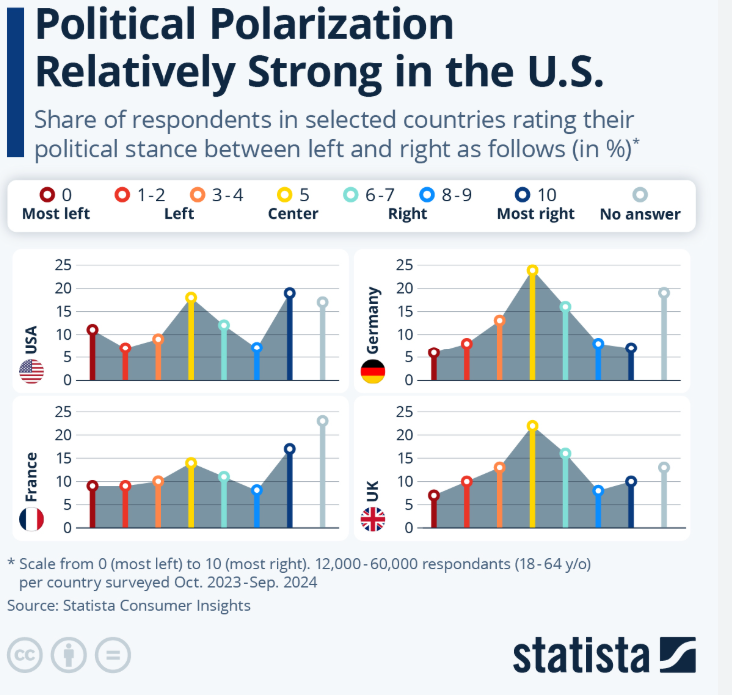
person