
Best Of
Re: Sense and sillyability
before i go do my retreat noble silent search for peace and love i want to add anotation/footnotes to help myself and you in our quest to dissmantle the samsara cycle of attraction and aversion fuel by ignorance. if we can dismanle this nirvana can awake us.
so ty for listening my attempt to change samsara into nirvana ...this lasting peace,love throgh wisdom

Not biting the hook
There's an image that's helped me lately that I thought I would share. Others may have already expressed it. I think Pema Chodron has spoken many times about "not biting the hook."
I think in terms of plastic bait this is pretty straightforward: don't fall for the illusion. But in the case of real worms, it's a little trickier. The worm itself is not an illusion. It's real, it has sustenance, it would allow you to continue your life as a fish.
So the illusion is the fact that this "good" thing is, in some cases, hiding a hook. That is where I get tripped up the most, usually around the arts and music, fine food, and sex. Or even things like self-help books, or something like being lazy on the beach or at the pool.
I could never reconcile the dismissal of those things as illusions because I knew they were real and positive forces. But now I DO understand that I have to look closer at each moment, because this real thing could be hiding a hook.
It has helped me be more mindful.
Of course, the problem with the metaphor is the question of What/Who is baiting and dangling the hook in front of me? What larger force wants to consume me?  (I ask this partially in jest. My main point in posting was reconciliation of considering real, positive things merely as illusions. They're not illusions in and of themselves, they are only illusions if they are hiding a hook, in my opinion.)

Re: No Buddhist Quotes
“I love the Buddha's simple definition of enlightenment as "the end of suffering." There is nothing superhuman in that, is there? Of course, as a definition, it is incomplete. It only tells you what enlightenment is not: no suffering. But what's left when there is no more suffering? The Buddha is silent on that, and his silence implies that you'll have to find out for yourself. He uses a negative definition so that the mind cannot make it into something to believe in or into a superhuman accomplishment, a goal that is impossible for you to attain. Despite this precaution, the majority of Buddhists still believe that enlightenment is for the Buddha, not for them, at least not in this lifetime.”
— Eckhart Tolle
 Jeroen
Re: Quotes - discussion
it seems that man has for a long time been a rather violent animal.
Yes and that violence appears rooted in three things: a protective nature, a survival instinct, and greed, putting profit over people. What we’re seeing in today’s world is mostly the last one. It's often disguised as legitimate: carried out by governments, corporations, or justified under the banners of "development" and "security"
 Shoshin1
Re: Quotes - discussion
Very interesting @person, it seems that man has for a long time been a rather violent animal.
I notice I carry a number of idealised pictures of different societies in my head. Which may or may not be true, they are just impressions from popular culture.
I suppose the only cultures which can truly be said to be nonviolent are those which practice ahimsa: the Jain, the Tibetans, perhaps a few others.
Jeroen

Re: Quotes - discussion
@Jeroen said:
Carl Jung tells in one of his books of a conversation he had with a Native American chief who pointed out to him that in his perception most white people have tense faces, staring eyes, and a cruel demeanour. He said: "They are always seeking something. What are they seeking? The whites always want something. They are always uneasy and restless. We don't know what they want. We think they are mad."
— told by Eckhart Tolle
I think there is truth in this. A lot of white people, a lot of Western civilisation is full of people pushing themselves, wanting things, desiring material gains. That attitude pushes the mind into ruthlessness, and you can see in the history of Western civilisation the desire for empire. In a way this goes back to the merchants mentality of wanting profit.
In a way the story of early history is about mind dominated by belief in the invisible world. Shamans and elders used to be the senior figures in the time man wandered the Earth in tribes, the wisdom keepers of the ancient world. People didn’t have much, didn’t want much, but they had an understanding of the mythical dimension of the world they lived in.
Nowadays people’s thinking is dominated by entertainment, politics, society’s systems, science, learning, mobile phones, computers, television, the internet… all kinds of stuff to do with the modern society. It is a cloud of concepts, thoughts and urges which drags people along, and only by returning our mind to the earlier forms can we shed this.
There is truth in it, but I think you're looking at the past through narrow, rose colored glasses. I think its more that Western civilization found itself on top when the music stopped than it is its uniquely bad. I think to the Mongols, the Aztecs, Chinese history, Imperial Japan, on and on.
Small scale societies are able to live more harmoniously because of the way human psychology works with people you know and interact with regularly. Its the way most people interact with the people they know in their lives today. In my opinion, the problem has more to do with the size and inevitable anonymity of today's world and the culture that creates, rather than the other way around. Small tribal societies were often very exclusionary and violent towards those outside their group.
Also the past was a very violent time, deaths by violence today are like 1 in 100,000 whereas in the past it could be much, much higher.
https://ourworldindata.org/ethnographic-and-archaeological-evidence-on-violent-deaths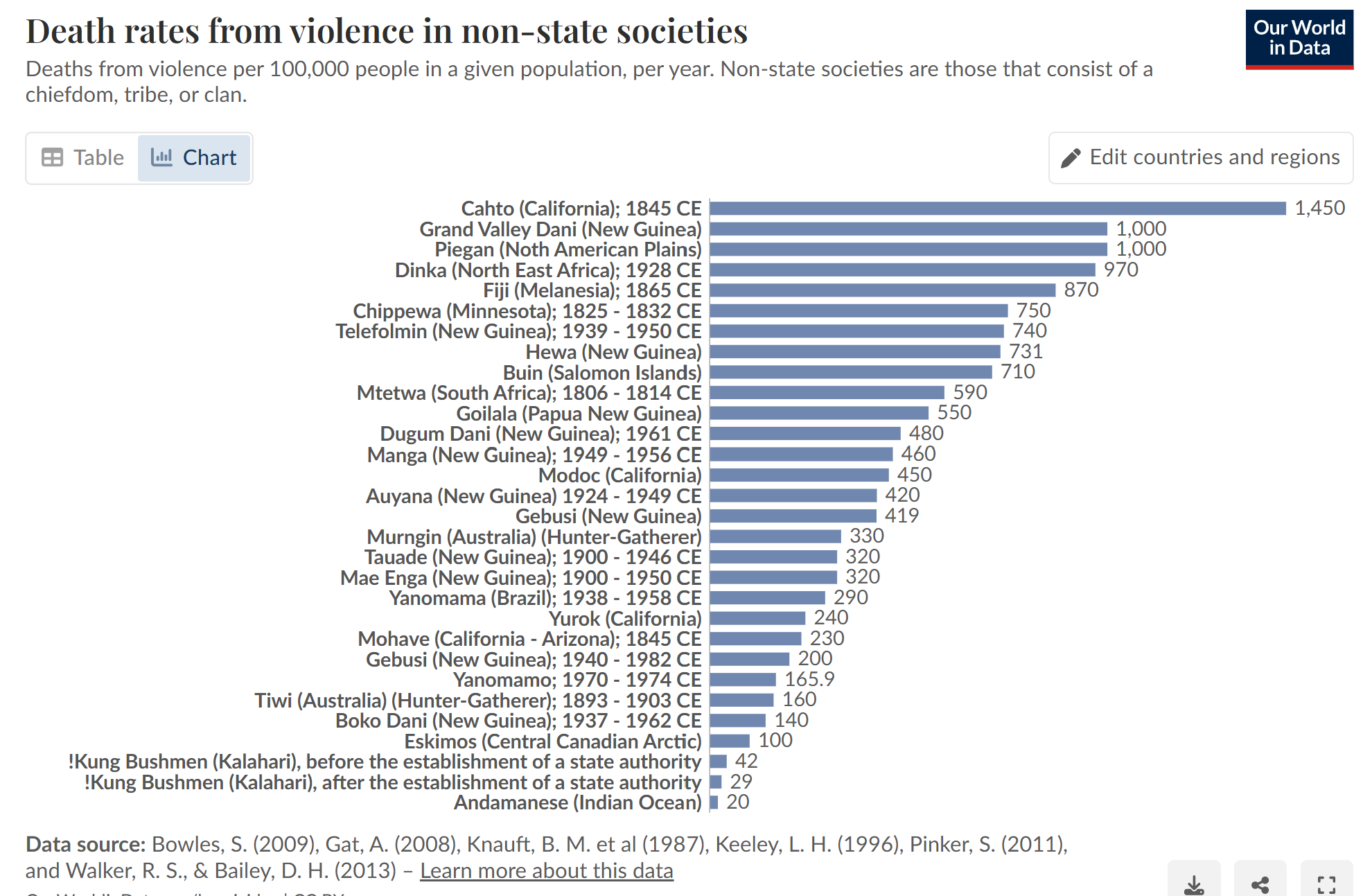
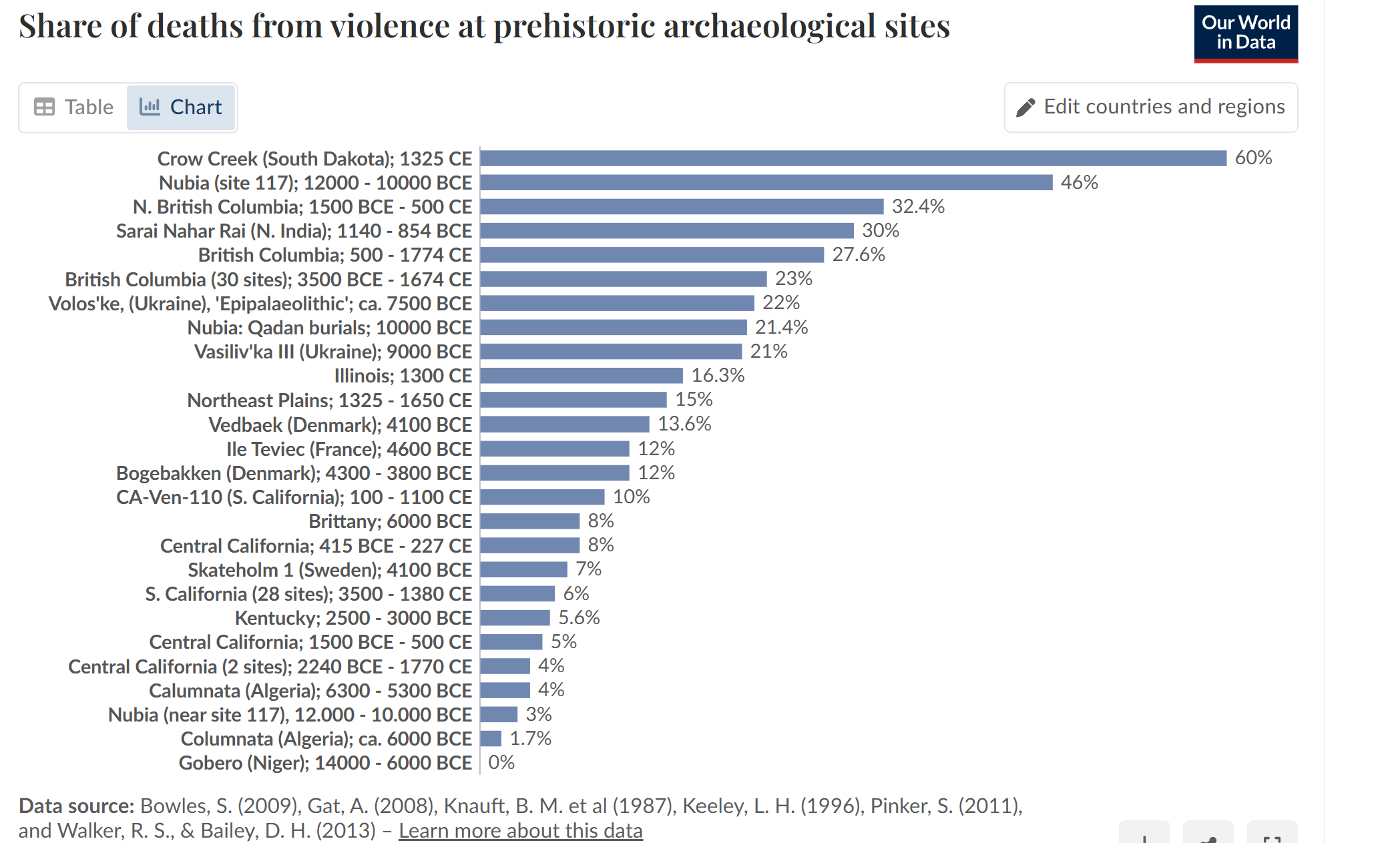
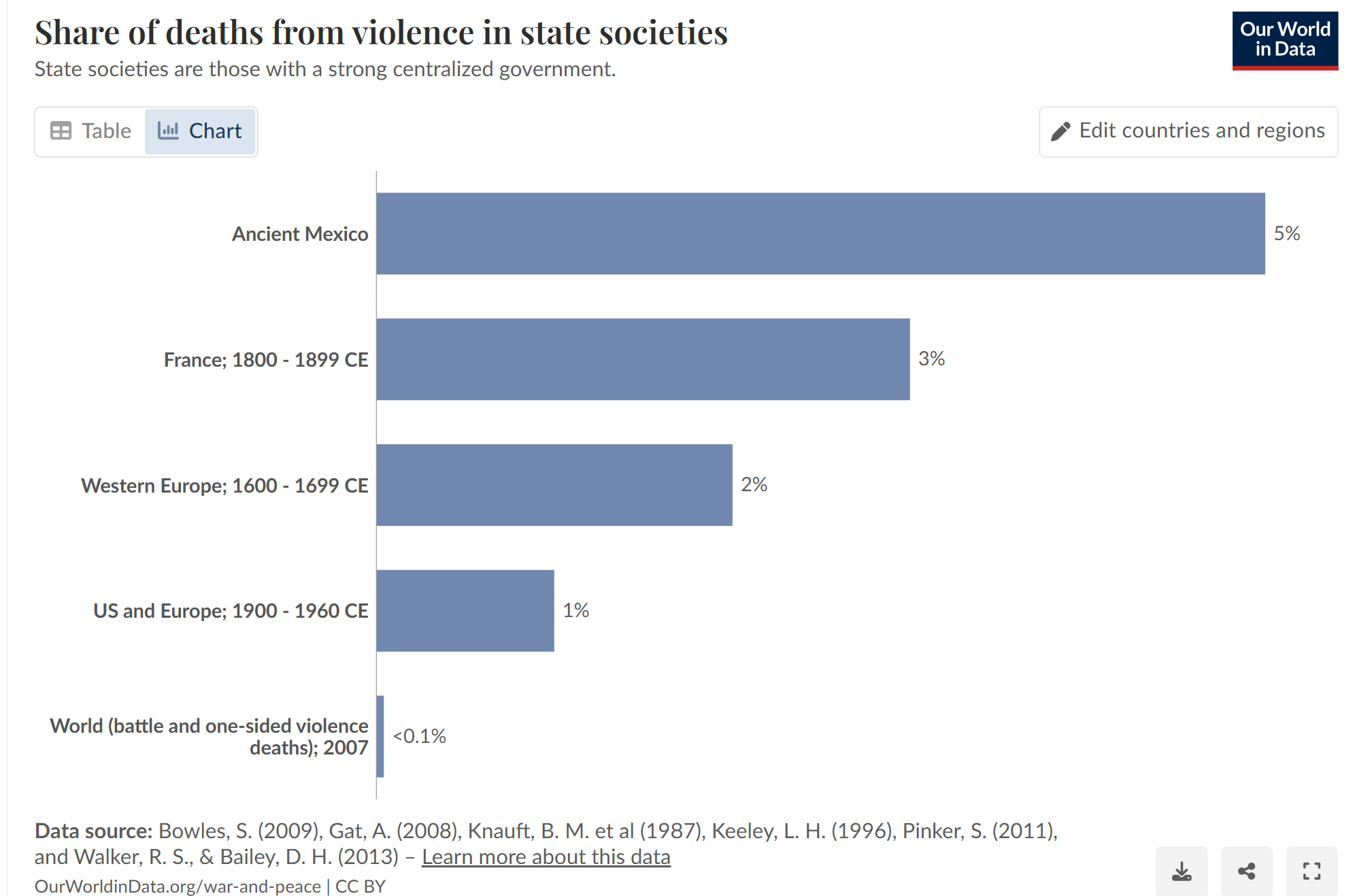
I think we've learned a lot and made progress in many ethical areas, individual rights being a big one, as well as technical advances such as sanitation and medicine.
I'd say learn what we can from what is good in the past, leave behind the bad things, take what we've learned and strive to do better going forward. Seeking to return to an idealized past that never really existed isn't the way.
 person
Re: Rise Above
I like the phrase "less wrong", rather than true or right when it comes to the pursuit of knowledge. To me it kind of says, this is our best understanding right now, but we're always learning and discovering more, while also acknowledging that its not all just a coin flip, we do have some verifiable understanding of some things.
person