
Best Of
What questions Buddhist monks have for Sadhguru
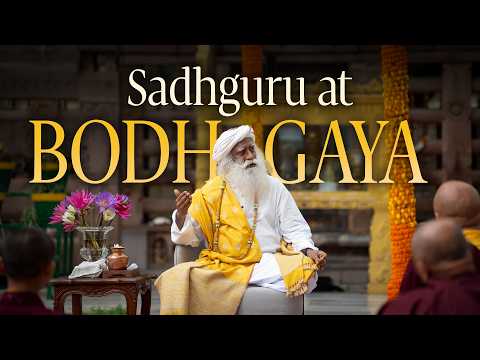
I came across this video of Sadhguru visiting Bodh Gaya, and taking questions from a number of Buddhist monks. It is interesting to see what their concerns are — not how to interpret the Buddha, but how to honour him; how to bring an end to war and conflict; what Sadhguru’s doubts are.
One of the things Sadhguru said was, if we create enough meditators, people who realise they are love, they will elect politicians of similar minds. Fascinating video.
I feel there is much we can learn from videos like this, about the Bodhisattva path, about what to do beyond just our own attainment of peace or our own practice.
 Jeroen
Re: Benefits of a Loving Mind
I sometimes fall into the trap of: not following my way, not correct or react poorly to injustices. For example, I noticed that some of the workers from the hotel that is next to my house have noticed I'm cleaning so they literally dump all their coffee cups and bags there...like expecting me to clean it. They also laugh at me. It makes me really angry to the point of thinking what is the point. If I fly to India or some other south Asian country I will be flabbergasted by what irresponsibility and ignorance multiplied by 10000000000000 can do.
I started this mini metta mantra which is: "Poor them. They aren't aware of what they are doing. Poor me. Intoxicating myself with these poisonous thoughts."
I like to read the Dhammapada when I have a particular hard day. I think it is the metta manual by excellence.
"197. Let us live happily then, not hating those who hate us! among men who hate us let us dwell free from hatred!"
 Kotishka
Re: No Buddhist Quotes
“Be patient toward all that is unsolved in your heart and try to love the questions themselves, like locked rooms and like books that are now written in a very foreign tongue. Do not now seek the answers, which cannot be given you because you would not be able to live them. And the point is, to live everything. Live the questions now. Perhaps you will then gradually, without noticing it, live along some distant day into the answer.”
― Rainer Maria Rilke
 Jeffrey
Re: Benefits of a Loving Mind
Hi August,
Hope you enjoy the forums!
I find practicing metta is best done in the morning after a small extra snooze. For me, metta is part of my nature that comes after sleep, and gradually dissipates after my morning coffee.
So if I practice metta at that time I kind of naturally fall into it and it comes to me easily.
If I practice metta in the afternoon I typically start with thinking about cats and dogs, objects of affection that warm the heart.
Jeroen
Re: I'm Thankful For...
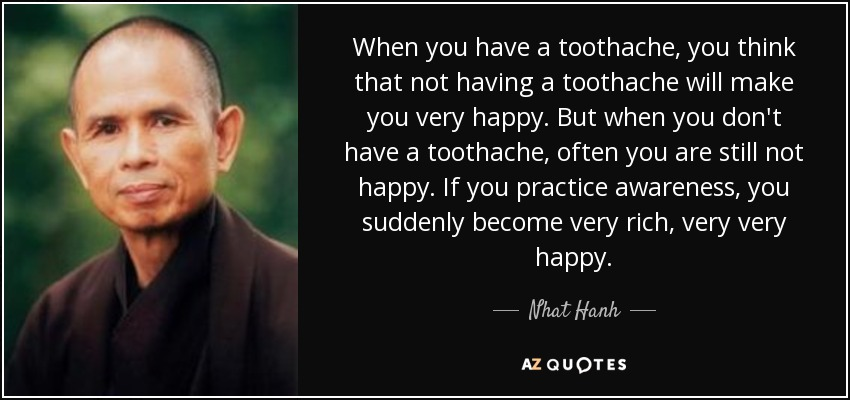
Thich Naht Hahn had a teaching about the pleasantness of not having a toothache. That when we have a toothache all we can think is how pleasant it would be to not have that pain. But once the pain is gone we forget how nice that relief is.
There's a similar passage from Nagarjuna about how pleasant scratching an itch can be, but to be without an itch altogether is even more pleasant.
 person
Re: I'm Thankful For...
@marcitko said:
Maybe I'm driving at the Christian idea to 'carry our Cross'. Yes, there is this bodily problem, but mostly, it's all good. So, I can carry this bodily problem with dignity, acceptance, even peace. Yes, do what I can to heal and help the body, but otherwise not 'attend to the fault' too much or let that derail my state of mind or life.
When I had cancer last year I kept thinking about how everybody says you have to fight it. Fight, fight, fight. I thought, No. This is my body. This is who I am. I chose to accept that it was there for a reason, and try to feel what the reason was, and what was needed to put things back in order. I went through the cancer treatments, but chose to regard them as putting things the way they should be instead of beating and killing the cancer. When the treatments were over the cancer was gone.
I learned a lot about my own resilience and strength. Don't know if that was the purpose, but it is already helping me to face the challenges of aging and the changes that come with that.
 zorro
zorro
Re: I'm Thankful For...
Gratitude is an interesting thing... that can put things into a different perspective.
How many times have each of us thought something like 'if this trouble goes away, I will be happy and not complain any more' (or even ever again, as in my severe pneumonia case).
Yet we find something new to complain about, often even without a new trouble arising.
Coming back to the body...
My currently favorite monk leads body-scan meditations with expressions of gratitude towards various parts of the body. 'Thank you brain, you are a very good brain, may you be strong and healthy for many years to come', etc.
Yet our bodies are not perfect and we all have some physical/health trouble.
However, do we not 'attend to the fault' too much? Missing to even notice the 99% of the body that is healthy and strong?
Maybe I'm driving at the Christian idea to 'carry our Cross'. Yes, there is this bodily problem, but mostly, it's all good. So, I can carry this bodily problem with dignity, acceptance, even peace. Yes, do what I can to heal and help the body, but otherwise not 'attend to the fault' too much or let that derail my state of mind or life.
Hope that makes some sense.
 marcitko
Peace
Peace is hard
War is easy
Peace is constant effort
Peace is dialogue
Peace is a slow, careful cultivation
Peace requires constant attention
To be tended to as a beautiful garden
Or a forest strong yet vulnerable
If neglected
Tended carelessly or lazily
Even a 100,000 acres of trees and grass
may be s destroyed by one glowing ember.
The ember of war
The ember if fear
The ember of hate
The ember of distrust
Be vigilant oh warriors of peace
Be diligent, envoys of compassion
Be strong, messengers of mercy
Carry your strength humbly
Tenders of the Garden
Peace to all
 Lionduck