Best Of
Save a Ghost
I'm sitting here, cup of lemon tea in hand, recuperating from a mild case of flu. I'm feeling particularly nostalgic so I browsed through my bookshelf of past writings. I came across an old story of mine, one of the first ones I wrote with a Buddhist theme, called Master Kwang and the Hungry Ghost. I've posted it here years ago as a gift and if you wish to read what passes for a parable in my mind, go ahead and enjoy. I'll post the link at the end. But tonight, I want to talk about the last koan I worked on with a real Teacher, the one that inspired the story in fact. That koan is: "Save a Ghost."
Now before we begin, let's get something clear. There is no single right or wrong way to "do" koans. They are fascinating study aids and mysterious keys to unlock insight and useless holdovers of a temple hiearchy, all rolled into one. What I'm telling you is one way to look at this koan. This might not be your way, or the way you've been taught we should handle them. That's perfectly fine. Go with it.
Now, a koan that simply says, "Save a Ghost" is plenty mysterious. Say what? Okay, Buddhists are all into that saving all beings thing, but a ghost? How am I supposed to save something that's dead? And save it from what?
So, first step. Deep breath. First thing to realize about koans, every single one of them is about the mind. Is the flag moving or the wind moving? It's not about flags or wind, but the mind moving. So we're not talking about a ghost yelling "Boo!" from the dark closet. We're talking about the mind. The ghost refers to something about our own minds.
What is a ghost? It's something that has died, or been killed, yet refuses to go away. But it's not alive. We ignore it, fear it, don't want it around. "You're dead! Go away. I don't want to deal with you anymore!"
Ah, but now we begin to penetrate the koan. The ghost is in our minds. We all have something, some experience, some emotion or memory that we have decided we don't want to deal with anymore. So we kill it. We refuse to deal with it. As far as we're concerned the issue is dead and buried, the memories forgotten, we've moved on and that nasty business is a thing of the past. But it isn't really. It's a ghost. It pops up when we least expect, refusing to stay properly dead. It haunts us. It is not really a healthy acceptance, is it? Can you think of something in your mind that fits the description?
So how do we save a ghost? We realize it's not a ghost. It's not really dead. In fact, we are the ghost or the ghost is us.
We save the ghost by becoming the ghost. Then it can finally be laid to rest. It's just memories. Part of who we are.
Hope this made you think a bit about your own ghosts and maybe next time you meditate you can say hello to one of them. And now, the story that koan inspired. Everyone enjoy a good ghost story on Christmas!
http://newbuddhist.com/discussion/14373/master-kwang-and-the-hungry-ghost
 Cinorjer
Re: A funny thing happened on the Way to Nirvana ...
When we were in Hawaii, we were a 5 hours time difference from home. So when it was 9am there, it was 4am at home, where my dad was. At breakfast in HI, my sister and I were talking about our dad and if we should call to ask his input about where to spread our grandma's ashes. A few minutes later, he called us, saying he woke up at 4am thinking about us. Apparently, he wanted his input 
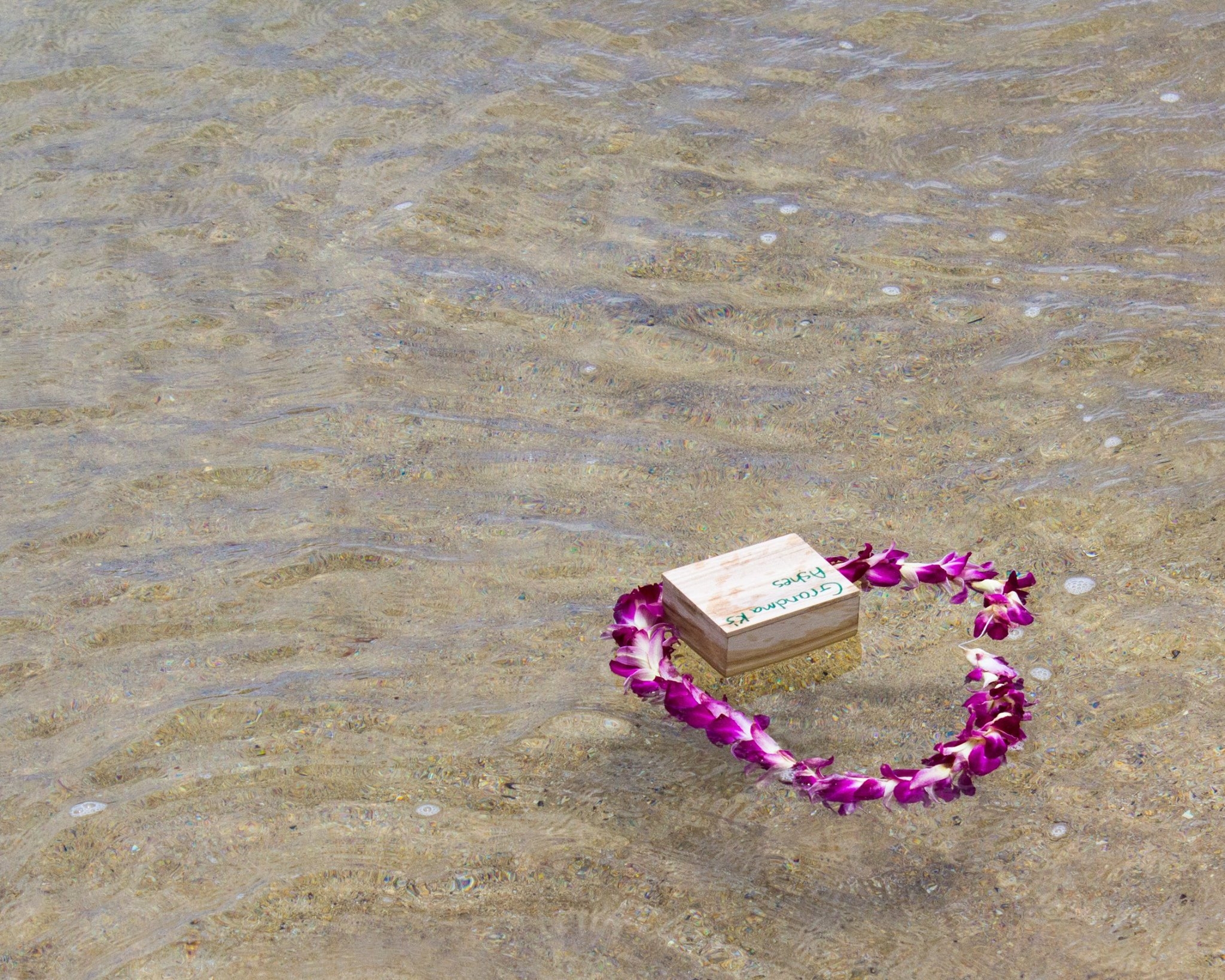
We went on our trip as a trip-of-a-lifetime with the 5 of us, my sister, my mom and my stepdad, thanks to their generous travel rewards that they shared. The biggest part of the trip for me was the opportunity to bring some of my grandma's ashes back to Hawaii. After she was cremated, I went to her house and took some of her ashes. Kidnapped her. I thought my mom might bring her back to HI, as they go twice a year. I never dreamed we'd be the ones to bring her. She was stationed in Hawaii with my grandpa in WWII. She never wanted to leave but my grandpa's family was here so he insisted they return. She never got back. We brought her back That is my oldest, Eli. Most of us took just a bit and scattered her ashes in a way we wanted. He thought she might like to fly on the wind. My youngest, Calvin, didn't want to touch ashes, and opted to put my lei around the box the remainder of her ashes were in. It was an interesting moment. My mom and stepdad got married on the same beach. It was very much a feeling of doing the right thing, even though I felt a little guilty taking some of her ashes without telling anyone else.

 karasti
Re: What do you make of this video?
I think the points he makes are legitimate but he is an asshole. Psychologists talk about developing emotional resilience in dealing with life's troubles, they don't call people pussies and tell them it's all their fault. Also the fact that it looks like it was sponsored by infowars at the end says alot about an agenda that it is pushing, that liberalism is stupid.
My favorite quote is by the ancient Indian Buddhist Shantideva:
“Where would I find enough leather
To cover the entire surface of the earth?
But with leather soles beneath my feet,
It’s as if the whole world has been covered.”
Basically, learn how to deal with shit instead of expecting the world to always be nice to you.
Perhaps I've got it wrong but It kinda implies that we deserve to be unhappy if we haven't done the right things in life and any attempts to lift depression are infact useless.
Different behaviors and actions lead to different results. It doesn't have to be about blaming anyone but it says that if you want better results learn better habits. This is kind of what Buddhism is about with more kindness and less assholery.
 person
Re: Happy Winter / Summer Solstice!
I love that my birthday is during Winter Solstice. It's like the Universe saying "Sorry I cursed you to be born on the shortest day of the year, with corresponding physical height. So how about I throw in the rule that everyone celebrates your existence too?"
That'll work nicely thanks. ???
 Kundo
To All The Young Members ( and lurkers)
Some food for thought…For the "Beginner's mind"
Many of us stumble upon the path at a later age (more old and fragile than young and agile )
So to the teens, early, mid, late twenties, (and into the thirties …I guess) you have all been blessed with a karmic pattern (past life or this life who knows...) that has lead you to the Buddha’s Dharma at such a young age…
It’s a precious gift, full of wisdom, and if used wisely, it will enrich your lives and no doubt, the lives of those whom you encounter along life’s journey ie, the Path…
At times there will be challenges and obstacles to overcome, the Dharma will equip you with the necessary tools to overcome them…but you have to have these three things Great “Faith” Great "Doubt" Great "Determination"...
~Sensei Sevan Ross~
"Great Faith and Great Doubt are two ends of a spiritual walking stick. We grip one end with the grasp given to us by our Great Determination. We poke into the underbrush in the dark on our spiritual journey. This act is real spiritual practice -- gripping the Faith end and poking ahead with the Doubt end of the stick. If we have no Faith, we have no Doubt. If we have no Determination, we never pick up the stick in the first place."
So study/practice and use your gift wisely…. don’t waste it… 
My teacher keeps reminding his students of how precious human life is, and of how fortunate we human are to have the Dharma in our lives…I agree wholeheartedly ….
 Shoshin
Re: Zen koan's understanding
A little bit of personal experience.
As a Zen student, I was once given Joshu's "mu" as a koan to munch on. [A monk asked Joshu, "Does a dog have Buddha Nature or not?" Joshu replied, "Mu" ("no" or "not")"] As a new and dutiful student, I munched. After a year or so, I realized that "mu" might be a very good koan indeed, but two things stood in my way: 1. I didn't like it because it seemed fabricated 2. and as a result, I was deeply reluctant to let the koan in -- to swallow it down to my toes.
So I stopped. And waited. And one day -- because life is like that -- another koan or intellectually-insoluble riddle popped up on my radar. I can't remember what it was, but I remember letting it in and loving it. Perhaps it was -- let's say it was -- "I love you."
Switching to a mathematical assessment, the question probably arose, "How do you 'solve for X' when there is no X?" and with it, "who says there is no X?" This appealed to me. I felt as if I were on friendly, if impenetrable soil. I stuck with it.
And came to the conclusion that koans are naturally-occurring substances. No need to crack a book. As my teacher, Kyudo Nakagawa, once observed, "The Buddha didn't study 1,700 koans [the formal number of koans in the Zen lexicon]."
My take: There is no need to chase koans when koans are eternally buzzing around like a flock of damned May flies.
 genkaku
Re: Up the Dharma
I don't plan to go anywhere.
I have no plan.
I am very happy here and now, in my samsara in nirvana.
I have this routine of reading every morning the Five Mindfulness practices, the Discourse on Happiness, the sutta on the Better Way to live Alone and the Five Remembraces to serve as compass, to give me a sense of direction, to remind me what I stand for.
And every day, there is some new insight to them.
But no enlightenment for me: just inner peace.
https://plumvillage.org/mindfulness-practice/the-5-mindfulness-trainings/
https://plumvillage.org/sutra/discourse-on-happiness/
https://plumvillage.org/sutra/discourse-on-knowing-the-better-way-to-live-alone/
And the Five Remembrances:
I am of the nature to grow old.
There is no way to escape growing old.I am of the nature to have ill health.
There is no way to escape ill health.I am of the nature to die.
There is no way to escape death.All that is dear to me and everyone I love
are the nature to change.There is no way to escape
being separated from them.My actions are my only true belongings.
I cannot escape the consequences of my actions.My actions are the ground upon which I stand.

Re: Bodhi of Christ
I have the feeling people tend to define as closed-minded the people whose ideas don't match their own 
Re: Bodhi of Christ
I can't even reconcile the teachings of Jesus with Christianity let alone Buddha and Christianity but hey.