
Best Of
Re: What music are you listening to?
It is a meditation that is set to music. The meditation music and the instructions go together, and that’s all you need. The youtube video I had above of the Kundalini does list the instructions, which are basic but sufficient: for example for the first stage it says,
Be loose and let your body shake, feeling the energies moving up from the feet. Let go everywhere and become the shaking. Your eyes may be open or closed.
So you just stand and shake, and focus the mind on becoming the shaking. The music is an aid, it provides cues for moving, and usually when the music changes dramatically thats the next stage being announced.
 Jeroen
Re: Buddhist quotes
Some wonderful quotes from our diaspora of dharma delights ❣️
Traditionally when the Buddha awakened, with no quote to be heard, she touched the ground.
Saw the morning star, left the sleeping world and grounded. 🏜️
I am a sukkha/sucker for a happy/hippy ending … 🎭
 lobster
Re: Buddhist quotes
@David said:
Dukkha is the Sanskrit word which is usually translated as suffering. But suffering in a way is too strong a word in English. We can easily say ‘I’m not suffering, I’m fine’. Dukkha is the opposite of sukkha. And sukkha means happiness but it also means a kind of ease. You know when everything is ok, when everything is going well is sukkha. And so dukkha is dis-ease. The fact that everything is not quite right. Everything would be wonderful if only. That there is always if only. There’s an underlying dissatisfaction in our lives which makes everybody try so hard for happiness. And yet with all the amount of effort and time and money and thought we put into being happy, normally people still feel a sense of dis-ease inside that something is not quite right, something which is not satisfied within us.~ Jetsunma Tenzin Palmo
I think Dukkha can be translated as “dis-ease, suffering or discontedness”
 Bunks
Bunks

Re: What music are you listening to?
@Bunks said:
How is this meditation? I am genuinely curious
It’s what they call an active meditation, one which moves the body. The instructions for this one are: 15 minutes of standing and shaking, letting everything go and becoming the shaking; 15 minutes of unrestrained dancing, letting the body move as it wills; 15 minutes of closing the eyes and being still, witnessing; and 15 minutes lieing down, becoming quiet. It is a sequence of things done with the body and mind, and thus could be called a meditation.
The whole idea is that body and mind are one, that one is not able to divide them, and therefore this type of meditation works on the body-mind complex to bring about catharsis, fluency, not-forcing. It was an invention of Osho’s, who said that modern man’s mind was so filled up with things that it needed radically new techniques to bring it to stillness. He created several varieties, including the Kundalini, the Dynamic and the Nataraj. They are typically an hour long.
Jeroen
Re: The ego and illusion
Would ego be the clinging, self important aspect of our individuality and not necessarily the whole of the individual being?
I think most of us know of the Two Truths even if identifying as Therevada. The Middle Way, it seems to me, would be knowing the illusion but using it as a tool for looking deeply together from varied perspectives.
If there was a way we could make it so future generations instinctively know that we are not really separate from each other, we would thrive because we all have unique views and talents beneficial to the rest.
Re: Buddhist quotes
Dukkha is the Sanskrit word which is usually translated as suffering. But suffering in a way is too strong a word in English. We can easily say ‘I’m not suffering, I’m fine’. Dukkha is the opposite of sukkha. And sukkha means happiness but it also means a kind of ease. You know when everything is ok, when everything is going well is sukkha. And so dukkha is dis-ease. The fact that everything is not quite right. Everything would be wonderful if only. That there is always if only. There’s an underlying dissatisfaction in our lives which makes everybody try so hard for happiness. And yet with all the amount of effort and time and money and thought we put into being happy, normally people still feel a sense of dis-ease inside that something is not quite right, something which is not satisfied within us.
~ Jetsunma Tenzin Palmo
Re: The ego and illusion
The ego/self arises whenever there is a grasping of objects as self or belonging to self. There is no security or refuge to be found in this world of form.
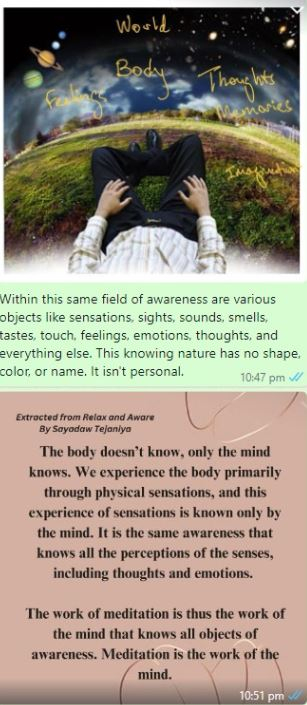
Suffering doesn't arise if you don't cling unnecessarily to the objects of awareness.
The core of the Buddha's teaching is suffering and the cessation of suffering. Using Phra Ajaan Dune Atulo's formulation of the four noble truths, suffering results when the mind goes outside the mind. That is, when we identify with the movement of mind, thought, moods. The antidote to this suffering is to know each phenomena as it arises in the present and to be ready to release our attachment to it. The path of understanding leads to knowing and letting go.
Experience is one thing. Commentary is another. Knowing of both is yet another.

Re: No Buddhist Quotes
/ Thomas Merton /
"People may spend their whole lives climbing the ladder of success only to find, once they reach the top, that the ladder is leaning against the wrong wall."
 Jeffrey
Re: Getting better "blog"
Sometimes we can find ourselves, in the ardor of a practice, acting as if we are a millipede with a washcloth on every appendage reaching out to clean up everything, everywhere, when all that is really called for is to pay attention to whatever mess is immediately presenting in front of us, in this passing nanosecond and is within our scope to actually address.
In Zen parlance, it is the difference between approaching a room that needs to be cleaned with endless plans on how to do it....instead of simply picking up a broom and doing it.
Here, the endless pontifications over our mentality or emotionality that has been a major dominance in our life experience, gets countered by a simple activity, that when done wholeheartedly, offers some new balance into our equation.
I am not really saying much that you have not already realized except to re-emphasize that each moment is a new start, with a new practice, with a new you, in a new universe.
Here, the markers of past hours and days, can't hold a candle to whatever moment you are currently facing.
In Gassho H.
 how
how