
Best Of
Re: The Other Elephant In The Room
Thanks for posting @person,...
I watch the video a couple of weeks ago and watched it again just now....
The ability for both groups to show some empathy for both view points is the key point of the 'middle ground' video...
Something which both the Israeli government and Hamas seem to be in short supply of ...
Empathy vs compassion: A Buddhist perspective
Empathy is what happens when we experience another person’s emotions as if they were our own. When they feel relief, joy or elation, we do too. When they feel depressed, ditto. Neuroscientists tell us that, with empathy, the same parts of our brain are activated as if we were going through the same thing as the other person. Their feelings become ours.
Is it any surprise that if we’re surrounded by the chronically miserable, desperate, or anxious, as empaths we are going to suffer from their torment? But in so doing, we face exhaustion, maybe the impulse to flee, and ultimately perhaps even to lash out at the source of our vicariously induced distress.
Compassion, by contrast, comes from a very different place. Our wish to help the other person is motivated by love, which in Buddhism is defined as the wish to give happiness to others. We understand their suffering because we have suffered too. And based on that empathetic foundation, our wish is to help them get out of their pit, to whatever extent that may be possible. We are not taking on their pain as our own. In fact our experience of reality is ideally one of boundless peace and wellbeing.
As benevolent and calmly objective carers, we can offer far more than if we are caught up in empathetic emotion. Interestingly, this is something that seems to come with medical training. I have no doubt that the medics and psychs who come to our Buddhist centre are compassionate people, but I also know from observation over the years that, in a crisis, they keep their heads. The ability of someone to emote is quite different from their ability to take compassionate action. Emoting may very well be an obstacle!
Neuroscience shows that very different networks of the brain are activated when we focus on the wish to benefit someone else, versus empathising with their suffering. Ground-breaking work by Dr. Richard J. Davison of the University of Wisconsin-Madison using an fMRI machine, showed that when we focus our compassionate attention on the wellbeing of others, we ourselves are likely to experience a state of profound wellbeing.
Two caring people, in other words, may be working in similar circumstances helping others, and while one of them faces despair and exhaustion, the other thrives. The difference could be empathy versus compassion.
 Shoshin1
Re: Space - the final frontier
On the topic of supernovae...
Betelgeuse is considered by astronomers to be one of the stars that will go supernova very soon in cosmic time, maybe even during our lifetimes.
Betelgeuse is the upper-left bright star in Orion and is one of the brightest stars in the sky. It is also called Alpha Orionis, which means it is the brightest (Alpha) star in the constellation Orion.

My previous readings said it would explode within 1000 years, or 100,000 years, but this article says it might be even sooner, within 300 years.
What will that look like? This article says:
_Life on Earth will be unharmed. But that doesn’t mean it will go unnoticed. Goldberg and Bauer found that when Betelgeuse explodes, it will shine as bright as the half-Moon — nine times fainter than the full Moon — for more than three months.
“All this brightness would be concentrated into one point,” Howell says. “So it would be this incredibly intense beacon in the sky that would cast shadows at night, and that you could see during the daytime. Everyone all over the world would be curious about it, because it would be unavoidable.”
_
 marcitko
Re: The Other Elephant In The Room
I watched the whole docu in the end, but found the incessant repetition of violent images from history to be hard to sit through. The images used over the actual talking points are more a history of the media coverage, so there’s a fair share of bodies and blood.
It makes me wonder why I have to know about a 1982 massacre in Israeli-occupied Lebanon and watch the images of that atrocity in order to understand that the Israelis in the US embarked on a program to control the media.
But the other thing to note is the basic bankruptcy of people’s ethics. Both the media, the marketing, the people who do the lobbying, the politicians, they are all motivated by money and not by honesty and truth. The days of the freedom of the press are long gone.
 Jeroen
Re: Everyone sees the world through cultural glasses
@person said:
I believe either now or in your past you were either an immigrant in America or are now an immigrant in the Netherlands.
I was an immigrant in the States, and have my experiences being part of a group in the communes where I grew up. I reckon I’m probably a bit too alternative to be considered a “solid citizen”, which is fine by me.
And, children in the experimental classroom rated themselves as significantly happier.
This is interesting to me. Maybe human beings are happier being part of a tribe.
Jeroen
Re: Two minutes of meditation?
@Ren_in_black said:
It's funny, I read all of these responses and it gets me excited about meditating.Then when the moment arrives, I don't want to.

Ah yes the two minutes of, “I don't want to be doing this”
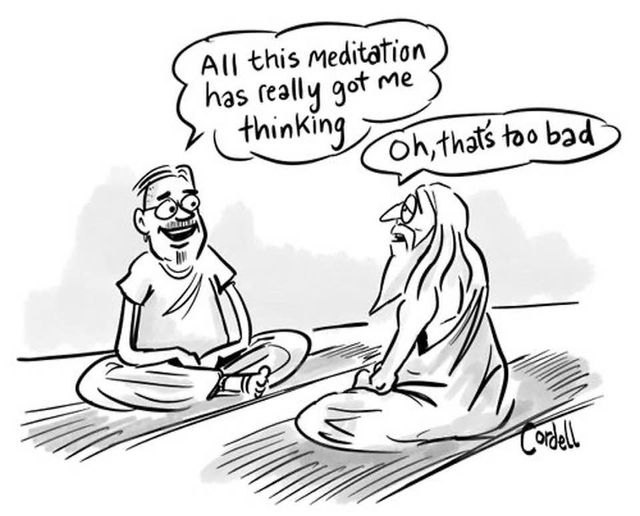
Some people spend ages trying to work out if this is a meditation. It is.
 lobster
It's That Time Of Year Again

Season's greetings...
Remember to deck the halls and not your family this year...
Shoshin1
Re: What Happens When Societies Stop Worshipping God?
@Jason, I really appreciate the insight. Capitalism is the macro version of everything that Buddhism guides people away from. It's craving and clinging on a worldwide scale. It's doomed to fail eventually, because all physical resources are finite, medicine's keeping old folks alive longer, and people happen to really enjoy making babies.
 ScottPen
Re: The Other Elephant In The Room
I think the main problem is most people become reactive beacons rather than critical and compassionate fellow beings.
The media feeds you excessive sensationalism and horror for their own benefit (clicks, reactions, viralisation) instead of thought and articulated conversation like I see here.
Strong points are made, opinions are contrasted, experiences collide; but keeping a good and fluent conversation, utilising logic, compassion, and explaining one's point rather than demanding one's point to be perfect and right...and...most importantly...both sides willing to discuss openly rather than resorting to the "you are with me or against me mentality."
 Kotishka
Re: The Other Elephant In The Room
As I've mentioned before, it saddens me that attacks are on the rise again, affecting both Jews and Muslims. Unfortunately, this was expected given the ongoing tensions. The actions of the Israeli government, led by Netanyahu, have contributed to the escalation,
It is crucial to raise awareness about alleged war crimes committed by the current Israeli government and the IDF against innocent men, women, and children. Silence in such situations can be perceived as complicity with the atrocities. Speaking out against government actions doesn't imply a stance against any specific group of people.
In situations where people oppose government policies, there are diverse views, and some may be extreme . This is a common aspect of democracies, where differing opinions exist.
For many years, the narrative has often focused on "Palestinian Muslim terrorists" and crimes against Israeli citizens, overshadowing the actions of the Israeli military in Palestinian territories. It's important to consider the complexities of the situation, including Israeli military activities and actions of Israeli settlers.
Recent events have shifted public opinion, with increasing awareness of Palestinian civilian casualties and evidence disputing some IDF claims. Independent sources, including reputable Israeli newspapers and eyewitness accounts, have provided alternative perspectives.
It is essential to differentiate between opposition to the Israeli government and its policies and anti-Semitism. Many individuals in the West who criticize Israel's occupation of Palestinian land are not motivated by anti-Semitic sentiments. Concerns for the safety of Jewish friends and family are valid, acknowledging that those in Western countries generally have state protection, unlike the Palestinian people in Palestine.
In times of conflict, the truth often becomes blurred, and extremists on both sides contribute to propaganda that fuels violence.
Shoshin1