
Best Of
Re: Is being empathic a good thing?
My take on it is not that being empathetic is bad. I think the solution for people who are sensitive and empathic isn't to shut oneself off, but to deepen one's practice of no self or letting go. Such that the negative energy has little place to land and can pass through more quickly.
The analogy I relate it to is that of Chogyam Trungpa. That the practice is like the sense of constantly falling but then realizing that there is no place to land.
Yet another way to think about it is that the feelings are even more so not yours. I find when a negative emotion is overwhelming me from an outside source that it still often feels like it is your own experientially and its easy to get caught up in it and spin out, reinforcing the feeling. It is often harder to process and let go of when you're not familiar with the feeling, to me it can feel like swimming upstream. I'll say letting go often does get easier with familiarity. And on the positive side, even with negativity directed at you it does offer great insight.
 person
Is being empathic a good thing?
I was listening to a talk by Joseph Goldstein on the Waking Up app, it was about how we listen. He cited a sutra of the Buddha’s, which I believe was this one…
"In the same way, monks, others may use these five modes of speech when speaking to you — speech that is timely or untimely, true or false, gentle or harsh, with a good or a harmful motive, and with a loving heart or hostility. In this way, monks, you should train yourselves: 'Neither shall our minds be affected by this, nor for this matter shall we give vent to evil words, but we shall remain full of concern and pity, with a mind of love, and we shall not give in to hatred. On the contrary, we shall live projecting thoughts of universal love to that very person, making him as well as the whole world the object of our thoughts of universal love — thoughts that have grown great, exalted and measureless. We shall dwell radiating these thoughts which are void of hostility and ill will.' It is in this way, monks, that you should train yourselves.”
From https://www.accesstoinsight.org/tipitaka/mn/mn.021x.budd.html
Now I have always been rather sensitive and empathic, and when people talk to me falsely, harshly, with a harmful motive and with hostility, it shocks me and I find it hard not to respond. These things can put me out of sorts for days. I’ve tried to ignore an incident like this in the past, but that prevented me from making a response at all, which is not a good thing.
In this particular matter, being soft-hearted, responsive, sensitive and empathic is not an advantage.
 Jeroen
Re: Beautiful article about Shikantaza
The degree that we simply stop manipulating our habituated responses to phenomena, turns out to be the same degree to which we are no longer indulging in suffering's causes.
Here, in a nanosecond of experience, what some might sometimes call being radically satisfied, is little more than a taste of suffering's absence.
 how
how
Re: Moments of happiness
Present for whatever nanosecond that I can exist within. Hopefully, able to face it squarely.
how
Re: Why is winning important to people?
@Jeroen said:
So perhaps winning equates to getting what you want, ultimately? In my life competition has been a largely negative influence, it seems to generate a lot of negative energy.
I think its like I said, it depends on how one engages with it. Is it about sportsmanship and excellence or is it about domination?
I think it probably depends in part on all involved being invested participants. If one person wants a relaxed activity, while another wants a competitive sport, it'll be unpleasant for the former and unrewarding for the latter.
I remember once playing some table tennis in a rec center and having someone I didn't know challenge the winner. They had a very competitive attitude and even though I beat them the game itself was stressful and fairly unpleasant. Compare that with a game of racketball, where I was a bit outmatched (such that I was able to score some points but clearly had little chance of winning) the other player was friendly and just wanted to play. One I won and didn't enjoy, the other I lost and did enjoy.
person
Pilgrimage
In this day and age of videoconferencing and global heating the idea of pilgrimage could be past it. I had the idea of visiting some Buddhist centres in Western Europe well before the pandemic and the list ballooned to 100+ by the time everything closed down. When a friend told me May 2022 that Interrail tickets were at half price I bought one at the last minute. Between that and the 9€ German ticket I clocked up 10,000km (according to the interrail app). I was scrambling day-by-day to plan my route (as Sanghas go into summer mode) and at times could have done with some help from a friend behind a nice powerful desktop but nevertheless I managed to meet with a good few esteemed teachers.
Here are a few other pilgrims who inspired me:
A poster I found along the way: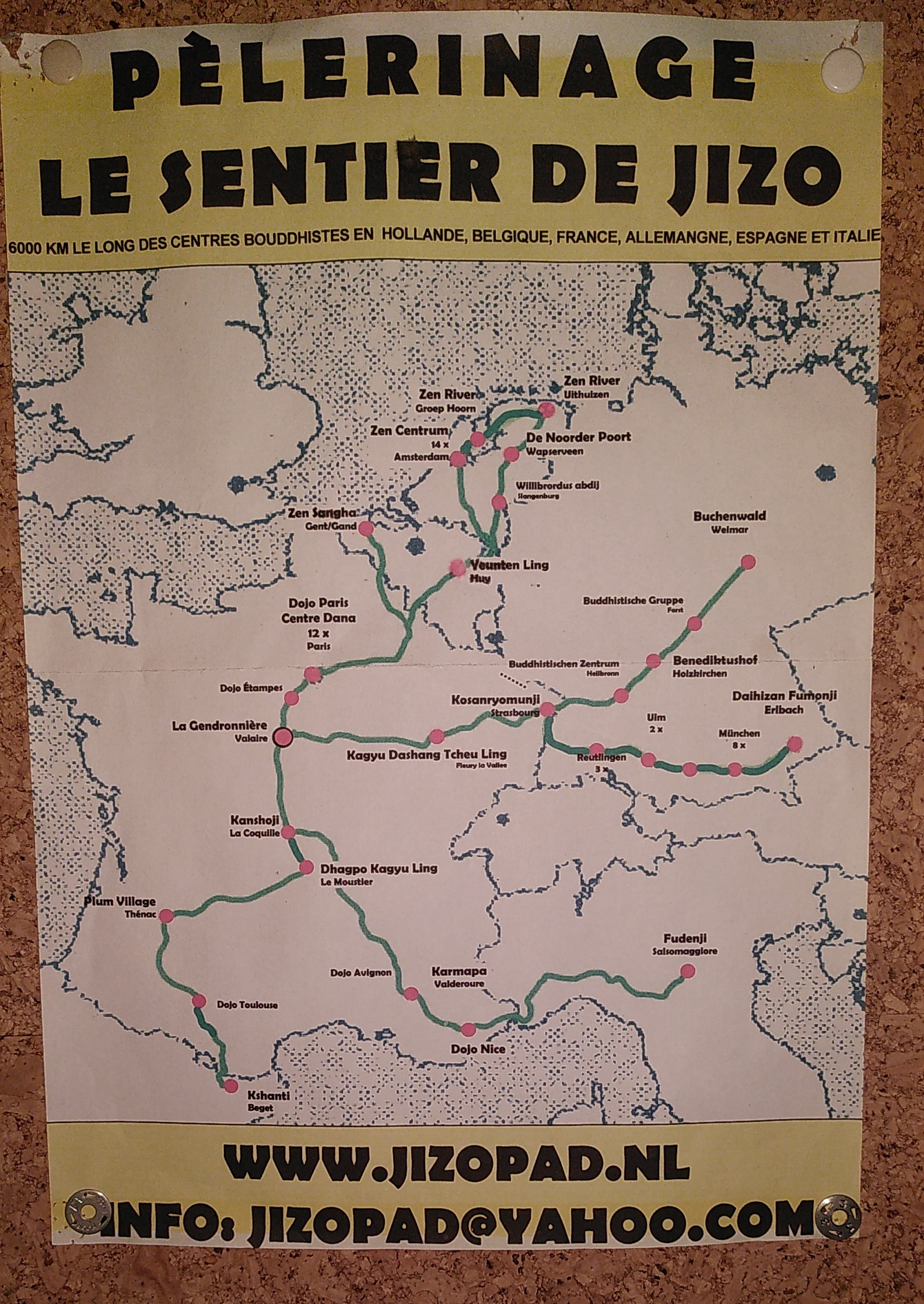 .
.
La via del risveglio, a project by an Italian Sangha to visit other Buddhist temples.
Komyo, a French monk travelling on bike in USA.

The nature of jealousy
Last night I had an experience while I was half asleep… I was going to dig, into a great glowing mass, because “I wanted what they had”. It struck me this morning that this was an insight into the nature of jealousy, that it hangs together with the concept of possessing things, desire, my-making, and perceiving in others these things.
As soon as you acknowledge the idea of ownership, that things that you perceive are owned by people, then you embark on the journey of ego expansion through owning more, of becoming somehow greater because all these things are “yours”. You see that things are other people’s but not yours, and then you are inspired by a thought of how wonderful it would be to have them for yourself.
The truth is that there is no such thing as ownership, not even such a thing as ‘I’. The ego clamouring that it wants more, that it wants to be bigger by ‘owning the things outside itself’, that it wants to do whatever it likes despite the impermanence of the world, is just a shadow of desire, and itself casts off further shadows of jealousy and other darknesses. But the reality is that we do not really own things, we just use them for a while.
I find it so beneficial to explore these relationships… it is like by understanding the way they fit together, I can let go of them. For me, these insights and the working out of them are the true gift of the dhamma, freedom from the chains of the mind.
Jeroen
Re: Is the world still the same
These are simple stories of how the basest of material attachments, that we think we've transcended, can still roam freely under any spiritual clothing.
The meanings of the "mu & kwatz" speak only of where others have awakened from the limitations of their own dreamed storylines. They are only meant to say to a seeker that anyone, anywhere, anytime can find their own awakening. They appear mysterious only to prevent other seekers from mistakenly trying to mimic a form of an awakening that doesn't apply to them.
To discover the mu or kwatz that applies to you, find the very attachment which currently owns you and that you can not yet address. Face it as endlessly & squarely in all its forms as you can.
When freedom from this attachment eventually becomes more important than all of the identity that it offers you, then your own "mu or kwats" or freedom becomes possible.
Here, the practice itself is the mu or kwatz of your awakening.
There are no shortcuts to such an understanding that I know of.
how
Re: Why is winning important to people?
@PeterJTimm said:
Can we not be winners or losers at this game of life?
Indeed, the Buddha has advice directed at his lay followers on ways to manage finances and relationships for more favorable outcomes (winning).
Keep in mind though that winning and losing are among the eight worldly winds (gain and loss). And the ultimate path of Buddhism directs us away from that sort of mindset.
person
Re: Is the world still the same
I like the analogy I've heard a few people state. That the human mind is still on version 1.0 but we're living in world 5.0. Biology moves at a much slower rate than culture and technology.
I think our evolution brought us to a state selected for life in small groups and immediate environments. Today there are so many people living anonymously, we lack that connection in most of our interactions. Our intuitions towards the world are well tuned for what is happening in front of us (our lived experience), but society is so complex and interconnected our intuitions break down and our experience often doesn't match up with actual trends.
person