
Best Of
Re: Rise Above
@person said:
half of people reject it out of hand
I need to rephrase. Only like 10%-20% of the population is either far left or far right that are probably engaged enough to have that reaction. The 60%-80% in the middle are better able to take things as they are. The megaphone of social media makes it seem more extreme as it lets the loudest take control of the narrative. But that in turn creates an increasing polarization.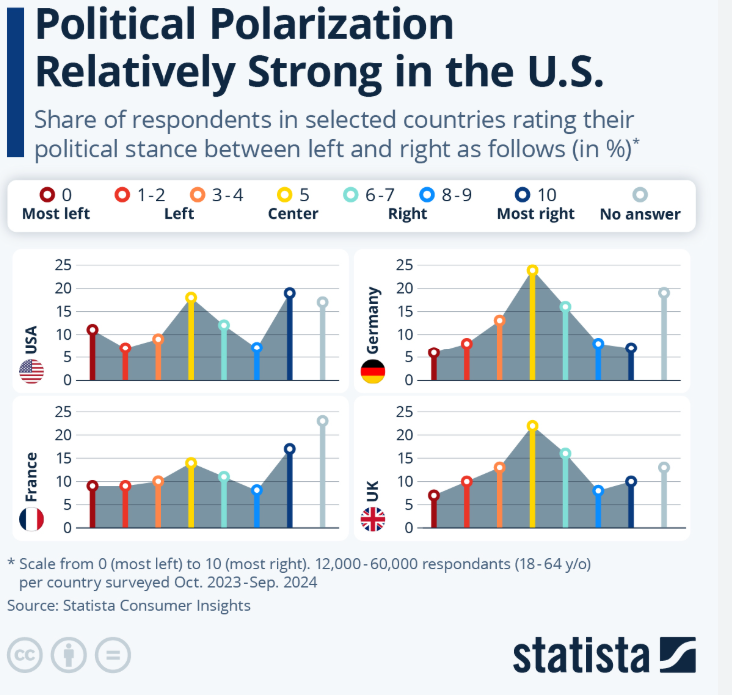
 person
Re: Rise Above
I used to wonder why so many people held Right Wing positions directly and overtly detrimental to themselves and their families. Then I was unitentionally exposed the one-sided flood of attack ads and deliberte disinformation and misinformation with no room, no space allowed foe any counter arguments or contrary (to the rt wing) messaging of any kind. It waa both a shock and an awakening. It explains much about why people keep voting for candidates and issues that only harm them and never help them.
Almost all of this (in the US) traces back directly to Ronald Regan abolishing the Fairness Docrtine in which the FCC required the holders of broadcast licences "both to present controversial issues ofpublic importance and to do so in a manner that fairly reflected differing viewpoints."
The Right Wing was poised to pounce upon that removal and, with Mr Murdock in the lead, did just that. The Moderates ad te Left were caught competely unprepared, were overwhelmed, and have been playing catch up ever since.
 Lionduck
Re: The Plant Medicine Path
It’s interesting. When I was about nine years old someone asked me a similar question, and I answered, why don’t we limit companies to have a maximum size of about 200 people? Of course it is quite a drastic solution but it would immediately change how people approach living and working together.
 Jeroen
Re: Space - the final frontier
I can't seem to re-find a good source, and am too lazy to dedicate more time to it... From what I've read about the NASA budget cuts, they are more drastic in the realm of non-manned programs than manned missions. Regarding actual science, probes and telescopes are the main thing, while manned spaceflight is more of a vanity project.
I guess that if you're serious about cutting state spending, the NASA budget is on the table, fine. However, personally, I would cut it the other way around, slash the manned spaceflight program, keep the probes and telescopes that do most of the actual science.
Just my view.
 marcitko
Re: Rise Above
I thought the first review on Goodreads was interesting ( here ) in that it pointed to a kind of right wing narrative in the book, in that all the examples Kaufman uses of the victim mindset are of left wing liberal “snowflakes”. While in effect the right wing has its own victim mindset, looking at for example the idea that if it wasn’t for all the immigrants deserving Americans would be able to succeed better, but Kaufman doesn’t cite those cases.
Of course it is an idea popular with the right wing, that one shouldn’t focus on one’s traumas but should instead be ‘tough and rugged’ and this ties in with the trend towards citing Stoic philosophers, who are often thought to have a similar mindset. I see it as kind of a spectrum, in recovery from a traumatic event there comes a certain point where one has to let go of the trauma, otherwise you start identifying with it and perpetuating the idea of it, and that isn’t healthy.
In short I’m a fan of a certain amount of Stoicism. There should be a healthy balance between the extremes of ignoring one’s emotions, and being so caught up in them that any small disturbance is labelled a ‘trauma’. It is good to be in touch with emotion, to be aware and emotionally intelligent, but it can be taken too far, and it is important to be resilient to stress and life events.
There were some other comments that Kaufman had some more extreme right wing thinkers like Charles Murray on his podcast. It’s interesting, recent discussions here between you @person and @shoshin1 have made me more aware of political bias in the discourse of American influencers and on social media.
Jeroen
Re: Just for fun: the random, useless announcements thread!
You could argue that the whole of life is about not getting scared, it’s a long process of adjustment to the scary moments.
Jeroen
Re: Just for fun: the random, useless announcements thread!
That is very true! Or seeing that there is nothing to be afraid of.
 Kotishka